People use “copywriting” and “content writing” like they mean the same thing. They don’t. Both skills use words to reach an audience, but they do different jobs, follow different rules, and win in different ways.
If you run a business, this mix-up costs you. You might hire a content writer to write your sales page, or ask a copywriter to build your blog — and wonder why the results fall flat. If you’re a writer, you need to know which skill you’re building, because clients hire for one or the other, not both by default.
This guide breaks down the difference in plain terms, shows you where each skill fits in your marketing funnel, and helps you pick the right writer (or the right skill to learn) for the job.
What Is the Difference Between Copywriting and Content Writing?
Here’s the short answer: content writing informs, copywriting sells.
Content writing teaches your audience something useful. It builds trust over time. Copywriting pushes your audience to act right now — click, buy, sign up, or subscribe.
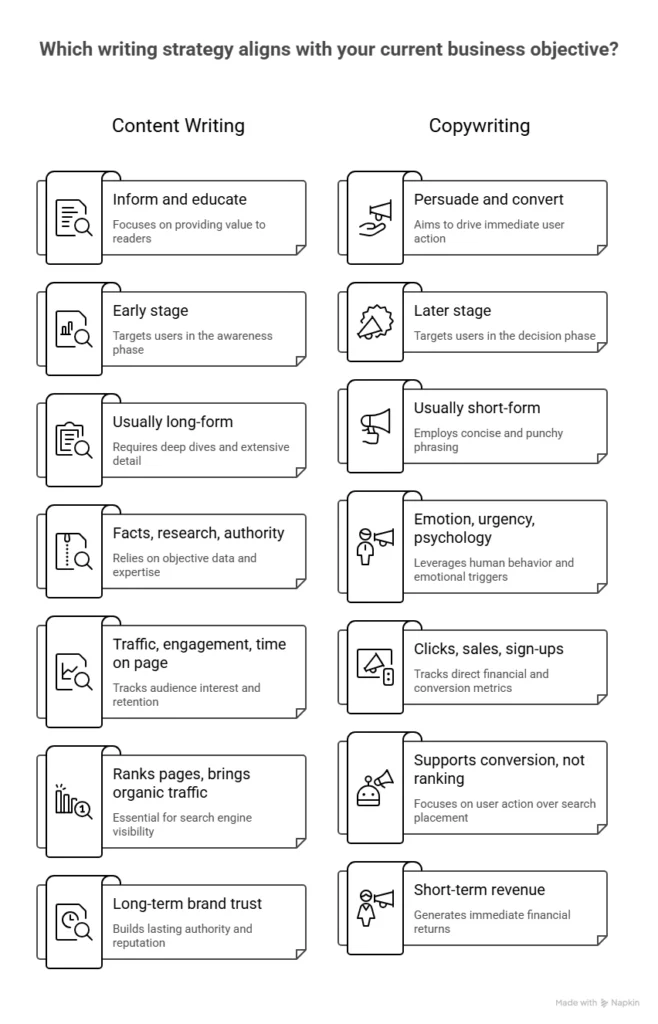
Both skills matter. Content writing brings people to you. Copywriting turns those people into customers. Now let’s look at each one closely.
What Is Content Writing?
Content writing creates material that teaches, informs, or entertains your audience. It doesn’t push a sale. It builds trust so that, when the reader is ready to buy, they already trust your brand.
Think of a content writer as a teacher. Their job is to answer questions, explain ideas, and give value — no strings attached.
What a Content Writer Needs to Know
- Research deeply. Readers can tell when a writer doesn’t understand the topic.
- Write for SEO. Content writers plan keywords, structure, and headings so search engines rank the page.
- Tell a story. Even factual content reads better with a narrative thread.
Common Types of Content Writing
- Blog posts and articles
- White papers and guides
- Case studies and research reports
- Newsletters and ebooks
Example: “What Is Performance Marketing?
A long-form pillar blog post that explains what performance marketing is, how it differs from brand and affiliate marketing, and which channels and KPIs matter — without asking the reader to buy anything. It ranks in search, answers real questions, and earns trust with marketers researching the topic. That’s content writing: no sales pitch, just value that keeps readers coming back and builds long-term authority.
What Is Copywriting?
Copywriting creates material built to make people act. It doesn’t just inform — it persuades. A copywriter’s only real question is: “Does this line get the reader to click, buy, or sign up?”
Think of a copywriter as a salesperson. Their job is to hook attention fast and close the deal.
What a Copywriter Needs to Know
- Understand psychology. What makes people click “Buy Now” instead of “Maybe later”?
- Apply the 3 C’s of copy — Clarity (say it simply), Conciseness (say it in fewer words), and a strong Call to Action (tell them exactly what to do next).
- Tell a story. Like content writers, copywriters use storytelling — but to sell, not just to inform.
Common Types of Copywriting
- Landing pages and ads
- Sales emails and email sequences
- Product descriptions
- Headlines and calls to action (CTAs)
Example: Maattam AI Video Creation Course Copy

A promotional poster for Maattam’s AI Video Creation course grabs attention with a bold Malayalam headline and a clear promise to learn AI video creation from home. The poster uses a simple blue-and-white design, a confused learner visual, and the “Learn AI Video Creation” message to highlight the problem and solution. With a clear “On Malayalam” message, contact details, website, and WhatsApp number, the design guides viewers toward taking the next step. The copy works because it identifies a learning need, presents the solution, and makes it easy to take action.
7 Key Differences Between Copywriting and Content Writing
Here’s a side-by-side breakdown of the two disciplines.
1. Purpose: Awareness vs. Action
Content writing builds awareness. Copywriting drives action. One informs; the other pushes.
2. Buyer journey stage: Early vs. Later
Content writing meets readers early, when they’re just exploring a problem. Copywriting meets them later, when they’re ready to decide.
3. Length: Long-form vs. Short-form
Content writing often runs long — 1,000 words or more — to cover a topic properly. Copywriting stays short and tight, because every extra word risks losing the reader’s attention.
4. Triggers: Informational authority vs. Emotional triggers
Content writing earns trust through facts and expertise. Copywriting moves people through emotion — urgency, fear of missing out, desire, relief.
5. Metrics: Engagement vs. Conversion
Content writers track page views, time on page, and shares. Copywriters track clicks, sign-ups, and sales.
6. Role in SEO: Ranking vs. Conversion support
Content writing does the heavy lifting for search rankings. Copywriting supports conversion once a visitor lands on the page — it doesn’t usually drive organic traffic on its own.
7. Business impact: Long-term vs. Short-term
Content writing builds brand equity that pays off over months and years. Copywriting drives revenue right now.
Where Each Fits in the Buyer Journey
Your customer moves through three stages before they buy. Each stage needs a different kind of writing.
Awareness (Top of Funnel)
The reader has a problem but doesn’t know the solution yet. Content writing plays the teacher here — it attracts interest with useful, free information (blog posts, guides, how-tos) and earns the reader’s attention without asking for anything back.
Consideration (Middle of Funnel)
The reader now knows their options and is comparing them. This stage blends both skills — education (content writing) mixed with proof and reassurance (copywriting), like case studies, comparison pages, and testimonials.
Decision (Bottom of Funnel)
The reader is ready to buy. Copywriting takes over as the salesperson — hooking attention with a strong headline and closing the deal with a clear, direct call to action.
Is Copywriting the Same as Content Writing? Two Industry Views
Not everyone agrees on how separate these two skills really are.
The Traditionalist View
Many marketers treat content writing and copywriting as distinct disciplines. They train differently, they’re measured by different metrics, and they solve different problems in the funnel. Under this view, mixing them up leads to weak content and weak copy.
The “They’re Interchangeable” View
Others argue the lines have blurred in the digital era. Clients often use “content writer” and “copywriter” as synonyms when they post job ads or hire freelancers. And a lot of modern writing blends both — human-first content that informs and persuades at the same time.
Both views hold some truth. The skills are different, but in practice, many writers use a bit of both.
Can One Person Be Both a Content Writer and a Copywriter?
Yes. Many freelancers do both — and storytelling is the skill that connects them. A writer who understands how to build a compelling narrative can apply it to a blog post just as well as a sales email.
That said, mastering both takes time. Most writers start strong in one lane, then stretch into the other as they grow.
Which One Does Your Business Need? (Quick Decision Guide)
- Want more traffic, better rankings, and long-term trust? Hire a content writer.
- Want more sales, sign-ups, or leads right now? Hire a copywriter.
- Want both? Look for a hybrid writer, or hire one of each and have them work together across your funnel.
.
Content writing and copywriting aren’t rivals. They’re two halves of the same funnel — one builds trust, the other builds sales. Know which one you need, and you’ll get far better results from your writing.

