Not everyone who visits your website is ready to buy. Some are just browsing. Some are comparing you with two or three other brands. Some have never even heard of your business before today. Every single one of these people is standing at a different point in their journey toward becoming your customer.
This is exactly why a marketing funnel matters.
A marketing funnel is simply a way of understanding that journey — from the moment someone first notices your brand to the moment they become a loyal, repeat customer. Instead of showing every visitor the same generic message, a funnel helps you give people what they actually need at that particular stage of their journey.
In this guide, we’ll break down what a marketing funnel is, why it’s worth your time, the stages every funnel goes through, the different types of funnels businesses use, how to build your own from scratch, and the metrics that tell you whether it’s actually working.
What Is a Marketing Funnel?
A marketing funnel is a simple model that shows how a stranger turns into a paying customer. Picture an actual funnel — wide at the top, narrow at the bottom. That shape isn’t random. It reflects reality: a lot of people discover your business, but only a fraction of them stick around long enough to buy something.
At the top, you have a large, loose crowd of people who’ve just come across your brand somehow — maybe through a Google search, an Instagram post, or a friend’s recommendation. As you move down the funnel, that crowd gets smaller, but more serious. By the time someone reaches the bottom, they’re not just curious anymore — they’re ready to act.
Businesses build marketing funnels to do five things well: attract new visitors, turn those visitors into leads, nurture those leads with the right information, convert them into paying customers, and eventually build a relationship that keeps them coming back.
Marketing Funnel Definition, In Simple Words
Think of it like dating before marriage. Nobody proposes on the first date. There’s a process — you meet, you talk, you build trust, you decide you’re compatible, and only then do you commit. A marketing funnel works the same way for businesses and customers. It’s the step-by-step path someone walks before they decide “yes, I’ll buy from this brand.”
How a Marketing Funnel Works
At each stage of the funnel, your job as a marketer changes. At the top, your only goal is to get noticed. In the middle, your goal is to build trust and answer questions. Near the bottom, your goal is to remove any last doubts and make buying effortless. Get any of these stages wrong — say, trying to sell hard to someone who just discovered you five minutes ago — and you’ll lose them. A good funnel matches the right message to the right moment.
Why Are Marketing Funnels Important?
Without a funnel, marketing turns into guesswork. You post on social media because everyone else does, you run an ad because it seemed like a good idea, but there’s no real structure connecting these efforts to actual sales. A funnel fixes that. Every blog post, every email, every ad has a clear job to do, based on exactly where your audience stands in their decision-making process.
A funnel also shows you where people are dropping off. Maybe hundreds of people visit your website every month, but almost nobody fills out your enquiry form. That’s a leak in your funnel — and once you can see it, you can fix it.
Benefits of a Marketing Funnel
- You understand your customers far better, because you’re studying their actual behavior at each stage
- Your conversion rates improve, since your messaging finally matches what people need to hear
- You attract more qualified leads instead of wasting time on people who were never going to buy
- The overall customer experience feels smoother and more natural
- Your marketing budget works harder, giving you a better return on investment
- Sales forecasting becomes easier, because you can see how many people are in each stage and estimate how many will convert
How Marketing Funnels Improve Conversions
When your content matches the stage a person is in, they feel understood rather than sold to. Someone who’s just discovered your brand doesn’t want a hard sales pitch — they want helpful information. Someone who’s already compared five competitors and is inches away from buying doesn’t need another blog post — they need a nudge, like a limited-time offer or a simple, friction-free checkout. Getting this sequencing right is what quietly increases conversions over time.
The Stages of a Marketing Funnel
Every business shapes its funnel a little differently, but most follow five broad stages.
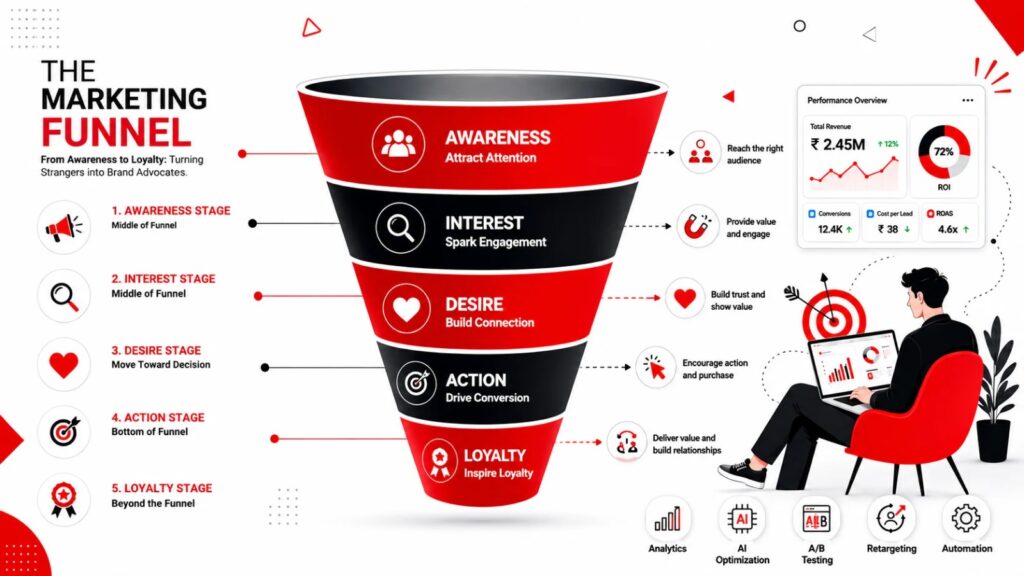
1. Awareness Stage (Top of Funnel)
This is where people discover your brand for the very first time — through a Google search, a social media post, a blog article, an online ad, or a friend’s recommendation.
Goal: Get noticed and build brand awareness.
Common tactics: SEO, blog articles, social media posts, videos, infographics, and paid advertising.
2. Interest or Consideration Stage (Middle of Funnel)
Now people know you exist, and they want to learn more. They’re comparing you against other options and trying to decide if you’re worth their time and money.
Goal: Build trust and educate.
Common tactics: Email marketing, case studies, webinars, downloadable guides, and white papers.
3. Desire Stage
At this point, people are genuinely interested in buying — from someone. They just need proof that you’re the right choice over your competitors.
Goal: Strengthen their confidence in choosing you.
Common tactics: Product demos, testimonials, customer reviews, comparison pages, and free trials.
4. Action Stage (Bottom of Funnel)
This is the moment of truth — the prospect becomes a paying customer. Anything that makes buying complicated or slow will cost you sales here, so the process needs to be as simple as possible.
Goal: Get the conversion.
Common tactics: Discount offers, limited-time promotions, a simple checkout process, sales consultations, and clear, strong calls to action.
5. Loyalty Stage
The relationship doesn’t end at checkout. In fact, keeping an existing customer happy is usually far cheaper than finding a brand-new one.
Goal: Turn one-time buyers into repeat customers and word-of-mouth advocates.
Common tactics: Loyalty programs, responsive customer support, referral programs, personalized follow-up emails, and feedback surveys.
Types of Marketing Funnels
Different businesses lean on different funnel structures depending on what they sell and who they’re selling to.
Traditional Marketing Funnel: The classic model — awareness, interest, desire, and action, in that order.
Digital Marketing Funnel: Built entirely around online channels like SEO, email marketing, content marketing, and social media.
Lead Generation Funnel: Designed purely to collect qualified leads, which are then handed off to a sales team to close.
Sales Funnel: Focused specifically on turning those qualified leads into paying customers.
Customer Loyalty Funnel: Built around keeping existing customers engaged, encouraging repeat purchases, and turning them into advocates for your brand.
B2C vs. B2B Marketing Funnels
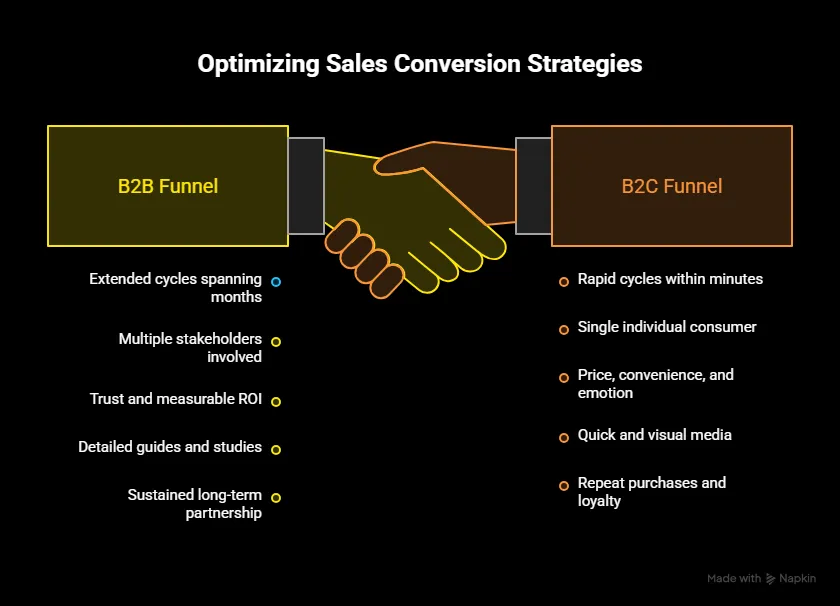
While B2B (business-to-business) and B2C (business-to-consumer) funnels share the same basic stages, the journey through them looks quite different.
B2B Marketing Funnel
B2B buying decisions usually take much longer. There are often multiple decision-makers involved — a manager, a finance team, sometimes a whole committee — and each of them wants detailed information before signing off. Trust and proof of results matter enormously here.
B2C Marketing Funnel
B2C customers, on the other hand, usually decide much faster. Price, convenience, and a smooth buying experience often matter more than long research. A B2C shopper might see an ad and buy within minutes; a B2B buyer might take weeks or months.
Key Differences Between B2B and B2C Funnels
How to Create a Marketing Funnel
Building a funnel from scratch isn’t complicated once you break it into steps.
Step 1: Identify Your Target Audience
Start by building buyer personas — profiles based on your customers’ demographics, interests, challenges, and goals. The better you understand who you’re talking to, the more precisely you can guide them through the funnel.
Step 2: Build Your Marketing Funnel Stages
Map out each stage of the customer journey and decide exactly what action you want someone to take at each point — whether that’s reading a blog post, signing up for a newsletter, or making a purchase.
Step 3: Choose Relevant Marketing Tactics
Pick the channels that genuinely support each stage. This could include SEO, email marketing, pay-per-click ads, content marketing, webinars, social media, and marketing automation tools.
Step 4: Determine Which Metrics to Track
You can’t improve what you don’t measure. Keep an eye on:
- Conversion Rate (CVR)
- Cost Per Acquisition (CPA)
- Customer Lifetime Value (CLV/LTV)
- Return on Ad Spend (ROAS)
- Time in Stage
- Net Promoter Score (NPS)
Step 5: Optimize Your Marketing Funnel
A funnel is never really “finished.” Review its performance regularly, test new ideas, improve your landing pages, refresh outdated content, and fine-tune your calls to action based on what the data tells you.
Common Marketing Funnel Mistakes to Avoid
Ignoring the top of the funnel. If you’re not investing in awareness, fewer new people ever enter your funnel in the first place — and everything downstream suffers.
Not nurturing leads. Most people aren’t ready to buy the moment they discover you. Skip the nurturing stage, and you’ll lose people who might have converted with a little more time and the right content.
Ending the funnel after conversion. A sale isn’t the finish line. Businesses that stop engaging with customers right after checkout miss out on repeat purchases and referrals — often the most cost-effective source of growth.
Failing to track performance. Without clear metrics, you’re flying blind. You won’t know which stage is leaking prospects or which tactic is actually driving results.
Modern Approaches to the Marketing Funnel
The classic funnel still holds up, but the way people move through it has changed. A few modern approaches are worth knowing about.
Customer-centric funnels focus less on rigid stages and more on real customer behavior, adjusting content and messaging based on how people actually respond, rather than forcing them down a fixed path.
Omnichannel funnels meet customers wherever they are — email, social media, search, or even in-store — creating one consistent brand experience across every touchpoint instead of treating each channel separately.
Automated funnels use tools to send the right message at the right time automatically, so no lead falls through the cracks simply because someone forgot to follow up.
None of these approaches replace the basic funnel structure — they just make it work more efficiently for how people actually shop today.
Conclusion
A marketing funnel isn’t just a diagram — it’s a practical way to understand your customers and meet them exactly where they are. Done right, it helps you attract the right audience, nurture leads with patience, convert more of them into paying customers, and build relationships that last well beyond the first sale.
Take a look at your own funnel today. Where are people dropping off? Which stage could use a little more attention? Small, regular improvements to your funnel — reviewed and refined consistently — tend to add up to real, lasting growth over time.

