Email marketing remains one of the most effective ways for businesses to connect with their audience. Despite the rise of social media and other digital channels, email continues to deliver strong engagement, build customer relationships, and drive sales. Whether you’re a small business owner, a marketer, or someone learning digital marketing, understanding how email marketing works is an essential skill.
In this guide, you’ll learn what email marketing is, its key benefits, the different types of email campaigns, how to create an effective email marketing strategy, the most important metrics to track, common challenges, and best practices to improve your results.
What Is Email Marketing?
Email marketing is a form of digital direct marketing that uses email to promote products or services, nurture leads through the sales funnel, and build long-term customer loyalty. It lets businesses deliver personalized, timely messages directly to a subscriber’s inbox without paying for ad space or competing in an auction for attention.
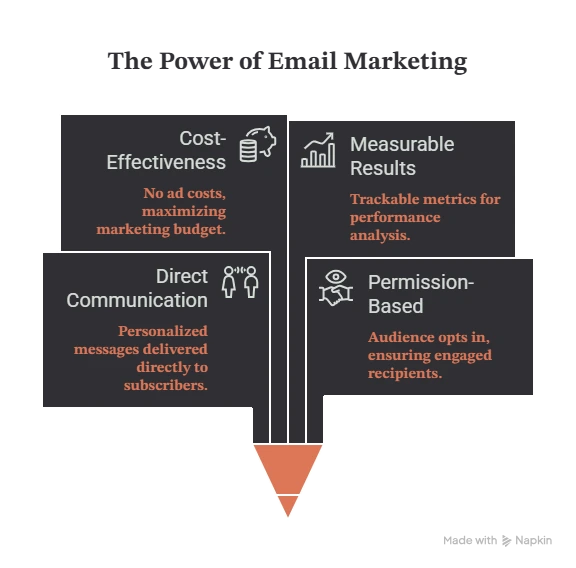
Within the broader digital marketing mix, email sits alongside channels like SEO, paid search, and social media, but it’s unique in one important way: the audience already opted in. That direct, permission-based relationship is what makes email one of the most cost-effective and measurable channels a business can own.
Why Email Marketing Matters: Key Benefits
Email earns its reputation as a marketing workhorse for a few concrete reasons.
Direct communication.
Email gives a business a direct line to a subscriber’s personal inbox a level of access that social platforms, with their algorithm-gated feeds, simply can’t match. That direct access makes it easier to build and strengthen customer relationships over time.
Cost-effective.
Compared to traditional advertising, email is inexpensive to run. There’s no media buy and no per-impression cost, and the same list infrastructure scales as a subscriber base grows, so cost per contact tends to fall over time.
High ROI.
Industry benchmarking from sources including Litmus, the DMA, and Omnisend consistently puts average email marketing ROI at ₹36–₹42 for every ₹1 spent, with retail and e-commerce brands often reaching ₹45 or more. That’s well ahead of paid search (roughly ₹2 per ₹1) and paid social (roughly ₹2.80 per ₹1).
Measurable results.
Opens, clicks, conversions, bounces, and unsubscribes are all trackable in real time, which means performance isn’t a guessing game it’s a feedback loop a marketer can act on campaign by campaign.
Automation.
Triggered sequences welcome series, cart-abandonment flows, re-engagement campaigns run in the background once they’re set up, delivering consistent, timely communication without ongoing manual effort.
Common Challenges in Email Marketing (and How to Solve Them)
Email’s upside is real, but it’s not automatic. Here’s where programs typically struggle, and how to get ahead of it.
Deliverability.
Even a well-written email is worthless if it lands in spam. Inbox providers weigh sender reputation heavily, factoring in engagement history, complaint rates, and authentication records. The fix: authenticate your sending domain (SPF, DKIM, DMARC), keep your list clean by removing hard bounces and chronic non-openers, and avoid spammy trigger words in subject lines.
Email fatigue.
Subscribers’ inboxes are crowded, and generic, high-frequency sends are the fastest way to get ignored or unsubscribed from. Segmentation and a disciplined send cadence go a long way here: fewer, more relevant emails consistently outperform more, less-targeted ones.
Operational costs.
Platform fees are only part of the cost equation; the time spent on design, copywriting, and list management adds up too. Templates, reusable content blocks, and a documented editorial calendar help control both the software spend and the labor behind it.
Types of Email Marketing Campaigns
Not every email serves the same purpose. Here are the core formats every program should understand:
- Welcome emails A new subscriber’s first message from your brand, setting expectations for what they’ll receive and how often.
- Newsletters Regular updates, insights, or curated content that keep your brand top of mind between purchases.
- Lead nurturing sequences A series of emails that guide a prospect through the funnel, building trust before asking for a sale.
- Transactional emails Purchase confirmations, shipping updates, and account notifications triggered by a specific user action.
- Re-engagement emails Targeted campaigns aimed at winning back subscribers who’ve gone quiet.
- Promotional emails Sales, discounts, and time-limited offers designed to drive immediate action.
- Abandoned cart emails Automated reminders that recover revenue from shoppers who added items but didn’t complete checkout.
Which type should you start with? Match the email to your goal, not the other way around. If you’re building an audience, prioritize welcome emails and newsletters. you’re trying to recover lost revenue, abandoned cart and re-engagement emails typically deliver the fastest payoff. If you’re driving a specific sales event, promotional emails do the job just don’t let them become the only thing you send.
Building an Email Marketing Strategy
A strong email program follows a repeatable process, not a one-off campaign.
1. Define Your Audience
Before writing a single email, build out customer personas and run basic demographic analysis. Knowing who you’re writing for shapes everything from tone to subject-line style to send frequency.
2. Establish Clear Goals
Tie every campaign to a specific outcome whether that’s driving traffic and lead generation or directly increasing sales and brand awareness. A campaign without a defined goal is hard to evaluate, let alone improve.
3. Build Your List the Right Way
Prioritize organic opt-ins and lead magnets gated guides, discount codes, free tools over any shortcut that skips genuine consent. Purchased lists in particular tend to backfire: they carry high bounce rates and low engagement, both of which damage sender reputation and deliverability.
4. Segment for Relevance
Break your list into segments based on demographics, past purchase behavior, and engagement history. Segmented campaigns consistently outperform one-size-fits-all blasts because the content is more relevant to each recipient.
5. Design, Test, and Refine
Use responsive, mobile-friendly templates, since a large share of email opens happen on phones. Then run consistent A/B tests on subject lines, send times, and content and let the data, not guesswork, guide what you send next.
Key Metrics to Track
You can’t improve what you don’t measure. These five metrics form the core of any email performance review:
| Metric | What It Tells You |
|---|---|
| Open Rate | Reflects subject line effectiveness and overall sender reputation |
| Click-Through Rate (CTR) | Measures how compelling and relevant your email content is |
| Conversion Rate | Ties email activity directly to completed goals sales, sign-ups, downloads |
| Bounce Rate | An early warning sign of list health and data quality |
| Unsubscribe Rate | Indicates how well your content and cadence match audience expectations |
A quick benchmarking note: open rates in particular vary widely by measurement method and industry commonly cited ranges run from roughly 20% to the low 40s so track your own trend over time rather than chasing a single universal number.
Conclusion
Email marketing remains one of the highest-ROI, most measurable channels available to any business, regardless of size or budget. Its strength comes from a few things working together: direct access to a subscriber’s inbox, low cost compared to traditional advertising, real-time performance data, and automation that keeps communication consistent without constant manual effort.
Getting there takes intention, though. The businesses that see the strongest results define their audience clearly, grow their list organically, segment for relevance, and continuously test and refine based on real data while tracking metrics like open rate, click-through rate, and conversion rate to keep every decision evidence-based rather than guesswork.
Get those fundamentals right, and email won’t just be another channel in your marketing mix it will consistently be one of the highest-performing ones.

