Performance marketing has transformed how businesses advertise online. Instead of paying only for exposure, businesses pay for measurable outcomes. Every campaign focuses on specific goals like clicks, leads, or sales. This approach helps marketers improve results using real-time performance data.
Unlike traditional advertising, performance marketing measures every stage of the customer journey. Businesses can track where customers come from and how they interact with campaigns. These insights help marketers improve budget allocation and campaign efficiency. As a result, businesses reduce wasted spending and maximize return on investment (ROI).
This guide explains performance marketing from the ground up. You will learn how it works, its core principles, popular channels, essential metrics, useful tools, and industry best practices.
What Is Performance Marketing?
Performance marketing is a digital marketing strategy where advertisers pay based on measurable customer actions. These actions may include clicks, leads, app installs, purchases, or other predefined conversions. Every campaign has clear objectives and measurable success indicators.
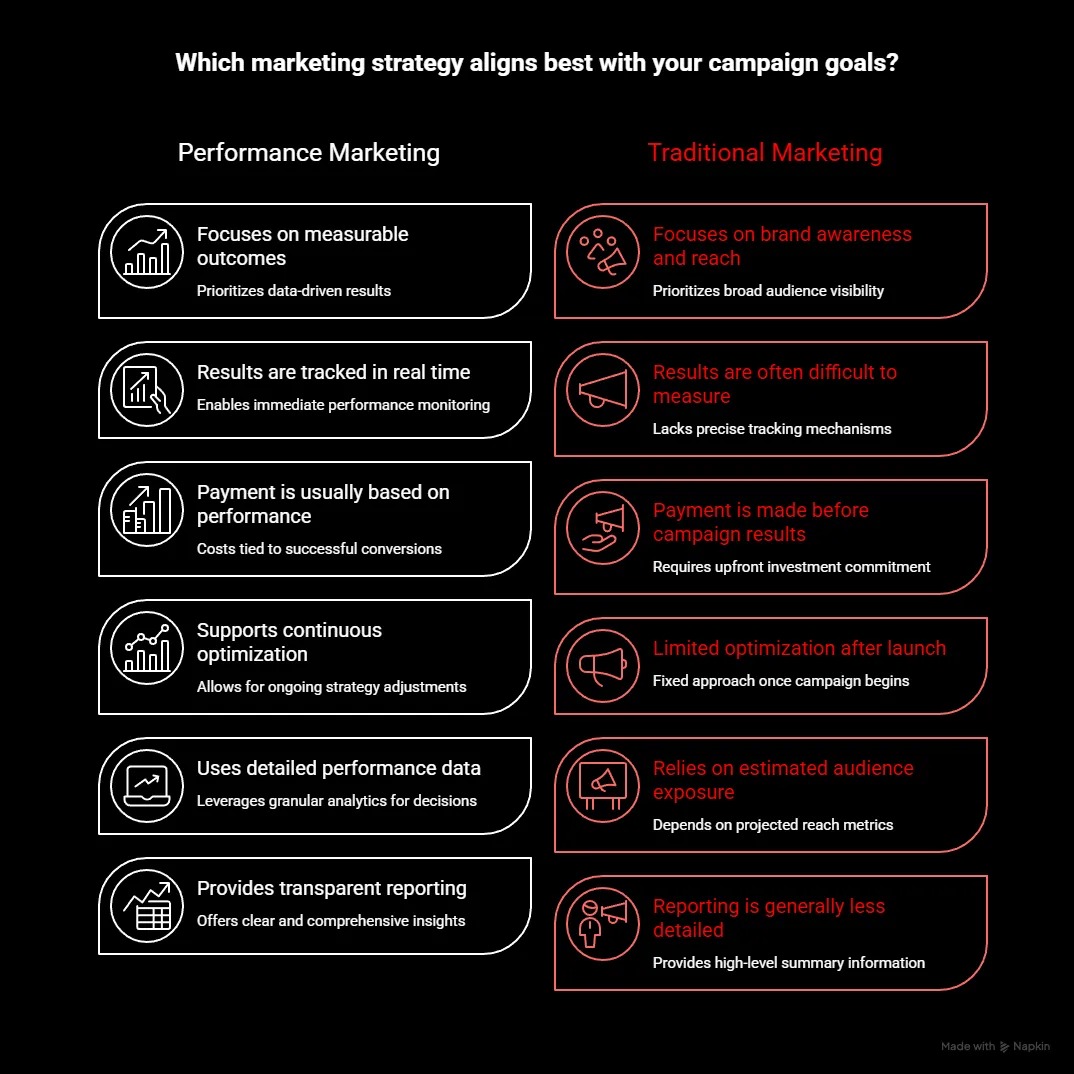
Unlike traditional advertising, performance marketing focuses on accountability. Marketers continuously monitor campaign performance and adjust strategies using real-time insights. This data-driven approach helps improve efficiency while keeping advertising costs under control.
Performance marketing is widely used across search engines, social media platforms, affiliate networks, and retail media platforms. Because every interaction is measurable, businesses can make informed decisions and improve campaign profitability over time.
Understanding the differences between these two approaches helps businesses choose the right strategy or combine both for maximum marketing effectiveness
Key Principles of Performance Marketing
Successful campaigns rely on several core principles. These principles help marketers achieve measurable business outcomes while optimizing advertising investments.
Outcome-Oriented Planning
Every campaign should begin with a clear business objective. Common goals include generating qualified leads, increasing online sales, driving website traffic, or promoting mobile app downloads. Clearly defined objectives make campaign success easier to measure.
Audience Targeting
Reaching the right audience is essential for campaign success. Advertising platforms allow businesses to target users using demographics, interests, online behavior, purchase intent, and geographic location. Better targeting improves engagement while reducing unnecessary advertising costs.
Personalization
Customers respond better to relevant marketing messages. Personalized advertisements, landing pages, and email campaigns create more meaningful customer experiences. Better relevance often leads to higher conversion rates and stronger customer relationships.
Full-Funnel Measurement
Performance marketing measures the complete customer journey. Businesses analyze customer behavior during awareness, consideration, conversion, and retention stages. Measuring every stage helps marketers identify opportunities for improvement and optimize future campaigns.
How Does Performance Marketing Work?
Performance marketing follows a structured process that helps businesses achieve measurable results.
Step 1: Define Campaign Goals
Every campaign starts with a measurable objective. Businesses may aim to generate leads, increase product sales, improve website traffic, or encourage app installations. Each goal requires clearly defined key performance indicators (KPIs).
Step 2: Select the Right Marketing Channels
Different marketing channels serve different business objectives.
For example:
- Search advertising captures high-intent customers.
- Social media advertising builds awareness and engagement.
- Affiliate marketing expands market reach.
- Native advertising promotes educational content.
Many businesses combine multiple channels to improve overall campaign performance.
Step 3: Launch Campaigns
After selecting channels, marketers create advertisements, landing page, audience segments, budgets, and bidding strategies. Tracking technologies should be configured before launch to ensure accurate performance reporting.
Step 4: Track Customer Actions
Tracking tools monitor how users interact with advertisements and websites. Businesses measure impressions, clicks, form submissions, purchases, and other conversions. This information helps marketers understand customer behavior throughout the buying journey.
Step 5: Measure Campaign Performance
Campaign data is evaluated using performance metrics such as click-through rate, conversion rate, cost per acquisition, and return on ad spend. These metrics reveal which campaigns produce profitable results and which require improvements.
Step 6: Optimize and Scale
Optimization begins after sufficient performance data becomes available. Marketers improve creatives, bidding strategies, landing pages, and audience targeting through continuous testing. Once campaigns consistently deliver profitable results, businesses can gradually increase budgets and expand into additional channels.
Performance Marketing Channels
Businesses rarely rely on a single advertising platform. Using multiple channels helps reach customers throughout the buying journey. Each channel supports different marketing objectives and audience segments.
Search Engine Marketing (SEM)
Search engine marketing displays ads when users search for relevant keywords. These users usually have high purchase intent, making SEM one of the most effective performances marketing channels. Advertisers can control keywords, budgets, bidding strategies, and audience targeting.
Social Media Advertising
Social media advertising helps businesses reach targeted audiences through visual and interactive content. Platforms use customer demographics, interests, and behaviors to deliver personalized advertisements.
Popular platforms include
- X
These platforms support brand awareness, lead generation, website traffic, and online sales.
Performance Marketing Tools
Performance marketing depends on tools that help businesses manage campaigns, track customer behavior, and optimize advertising performance. Choosing the right tools improves decision-making and increases campaign efficiency.
Google Ads
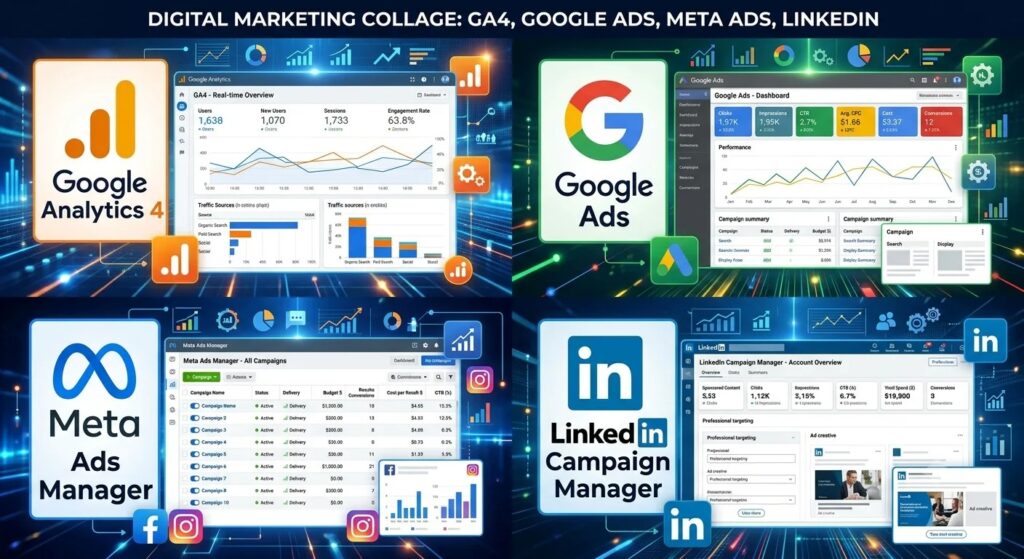
Google Ads enables businesses to create search, display, shopping, video, and Performance Max campaigns. It provides advanced bidding strategies, audience targeting, and conversion tracking for measurable results.
Google Analytics 4 (GA4)
Google Analytics 4 tracks website and app user behavior across multiple devices. It measures traffic sources, user engagement, conversions, and customer journeys to support data-driven decisions.
Google Tag Manager (GTM)
Google Tag Manager simplifies the deployment of tracking codes without modifying website code. Businesses can manage analytics, advertising pixels, and event tracking from a single interface.
Meta Ads Manager
Meta Ads Manager helps businesses create and manage advertising campaigns across Facebook and Instagram. It offers advanced audience targeting, A/B testing, budget management, and performance reporting.
LinkedIn Campaign Manager
LinkedIn Campaign Manager is designed for B2B advertising. Businesses can target professionals using job titles, industries, company size, and seniority levels to generate high-quality leads.
Benefits of Performance Marketing
Performance marketing offers measurable advantages for businesses of all sizes. It helps organizations improve campaign efficiency, optimize advertising budgets, and achieve sustainable growth. Since every campaign is tracked, businesses can make informed decisions based on real performance data.
Measurable Results
Every campaign is evaluated using predefined key performance indicators (KPIs). Businesses can track clicks, leads, conversions, and revenue in real time. Clear performance data makes it easier to measure marketing success and identify improvement opportunities.
Better Return on Investment (ROI)
Performance marketing focuses on campaigns that generate measurable outcomes. Businesses invest more in high-performing campaigns while reducing spending on underperforming ones. This approach improves overall return on investmentand marketing efficiency.
Audience Targeting
Modern advertising platforms allow businesses to reach specific customer segments using demographics, interests, behaviors, and purchase intent. Better targeting improves engagement while reducing unnecessary advertising costs.
Budget Optimization
Performance data helps marketers allocate budgets more effectively. Businesses can quickly identify profitable channels and adjust spending based on campaign performance. This flexibility improves cost efficiency and reduces wasted advertising investment.
Improved Decision-Making
Performance reports provide valuable insights into customer behavior and campaign performance. Businesses can identify successful strategies, refine future campaigns, and respond quickly to market changes.
Scalable Growth
Successful campaigns can be expanded gradually without sacrificing profitability. Businesses increase budgets after validating campaign performance and can extend winning strategies across new markets, products, or audience segments.
Best Practices for Performance Marketing
Following proven best practices helps businesses improve campaign performance and achieve consistent results. Small improvements across multiple areas often lead to significant long-term gains.
Set Clear Campaign Objectives
Define measurable goals before launching any campaign. Objectives should align with business priorities and include specific success metrics. Clear goals simplify performance measurement and campaign optimization.
Know Your Target Audience
Understand customer needs, interests, and online behavior before creating advertisements. Segmenting audiences allows businesses to deliver more relevant messages and improve conversion rates.
Optimize Landing Pages
Landing pages should match the advertisement’s message and guide visitors toward one clear action. Fast loading speeds, mobile-friendly design, and simple forms improve user experience and increase conversions.
Landing Page Checklist
- Write a clear value proposition.
- Use one primary call to action.
- Minimize form fields.
- Improve page loading speed.
- Add customer testimonials.
- Display security or trust badges.
- Test different page layouts.
Conduct A/B Testing
A/B testing compares different versions of advertisements, headlines, landing pages, or call-to-action buttons. Testing one variable at a time helps marketers identify which version delivers better performance.
Common elements to test include:
- Headlines
- Images
- Ad copy
- CTA buttons
- Landing pages
- Audience segments
- Bidding strategies
Evaluate Traffic Quality
High traffic does not always produce better results. Businesses should analyze the quality of visitors using metrics such as:
- Conversion rate
- Bounce rate
- Average engagement time
- Revenue generated
- Customer acquisition cost
- Return on ad spend
Focusing on high-quality traffic improves long-term campaign profitability.
Deliver a Mobile-First Experience
Most customers browse and shop using mobile devices. Responsive websites, faster page speeds, and simplified navigation improve user experience and support higher conversion rates.
Future Trends in Performance Marketing
Performance marketing continues to evolve as technology and consumer behavior change. Businesses that adopt emerging trends can improve campaign efficiency and maintain a competitive advantage.
Artificial Intelligence (AI)
AI helps marketers automate repetitive tasks, analyze large datasets, and optimize advertising campaigns. Businesses use AI to generate ad copy, personalize customer experiences, predict campaign performance, and improve bidding strategies.
First-Party Data
As privacy regulations evolve, businesses increasingly rely on first-party data collected through websites, email subscriptions, customer accounts, and purchase history. This data improves audience targeting while supporting privacy-focused marketing strategies.
Social Commerce
Social media platforms now allow customers to discover and purchase products without leaving the platform. This shorter buying journey improves convenience and helps businesses increase conversions through engaging content and product recommendations.
Predictive Analytics
Predictive analytics uses historical data and machine learning to forecast future customer behavior. Businesses can estimate demand, identify valuable audiences, and optimize advertising budgets before launching campaigns.
Omnichannel Marketing
Customers interact with businesses across multiple digital touchpoints before making a purchase. Maintaining consistent messaging across search engines, social media, email, and websites creates a seamless customer experience and improves overall campaign performance
Conclusion
Performance marketing enables businesses to achieve measurable marketing results through data-driven strategies. By focusing on specific objectives, tracking meaningful KPIs, and optimizing campaigns continuously, organizations can improve efficiency and maximize return on investment.
Success depends on selecting the right marketing channels, using reliable tracking tools, and analyzing performance metrics regularly. Technologies such as AI, first-party data, predictive analytics, and marketing automation continue to shape the future of performance marketing.
Whether you are a business owner, marketer, or student, understanding performance marketing provides a strong foundation for creating effective digital campaigns. Start with clear goals, measure meaningful results, and refine your strategy continuously to achieve sustainable business growth.

