Professional photography is a business asset and not only about taking attractive pictures. It helps businesses present their products, services, people, and brand in a clear and consistent way. Strengthening brand identity, building customer confidence, supporting sales, and providing valuable content for various marketing channels. It can also help businesses present themselves differently from competitors using generic or inconsistent visuals.
But the value depends on how photography connects with business goals. A planned photoshoot can create visual assets for a website, social media, advertising, e-commerce pages, brochures, and other marketing materials.
Here are the main ways professional photography can help your business grow.
Strengthens Brand Identity and Recognition
A strong brand needs more than a logo and color palette. Customers also recognize businesses through their visual style.
Professional photography can help create that visual identity. The choice of lighting, composition, colors, backgrounds, styling, and subject presentation can make a brand look distinctive.
Creates a Unique Visual Identity
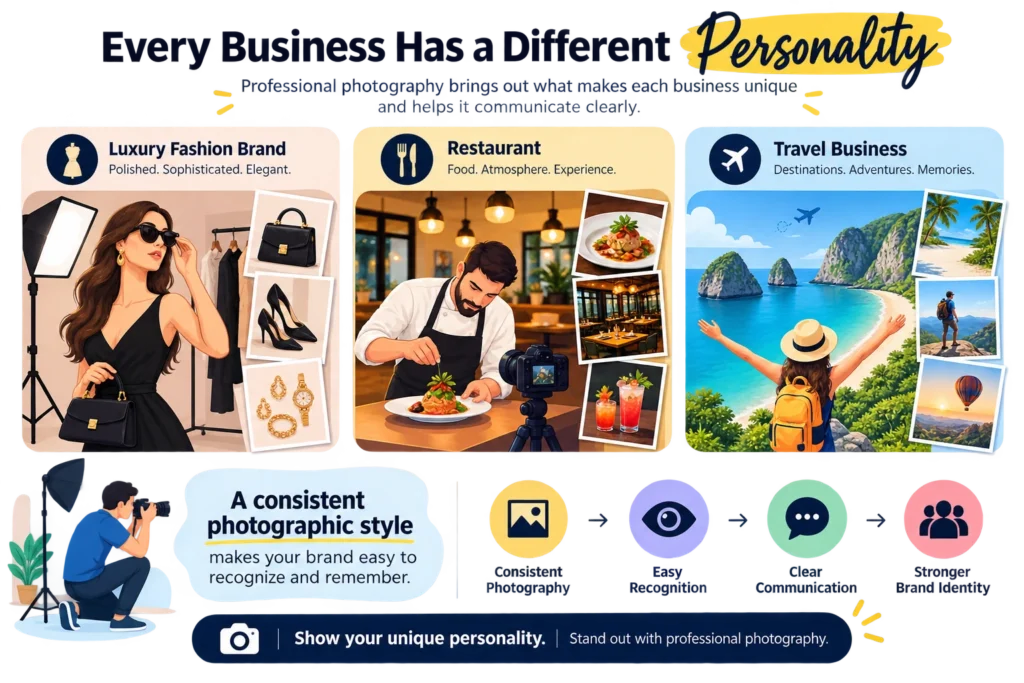
Every business has a different personality. A luxury fashion brand may need polished and sophisticated images. A restaurant may focus on food, atmosphere, and customer experience. A travel business may highlight destinations and experiences.
Professional photography allows these differences to appear visually. Instead of using random images from different sources, a business can develop a consistent photographic style. This makes its visual communication easier to recognize.
Builds a Consistent Brand Persona
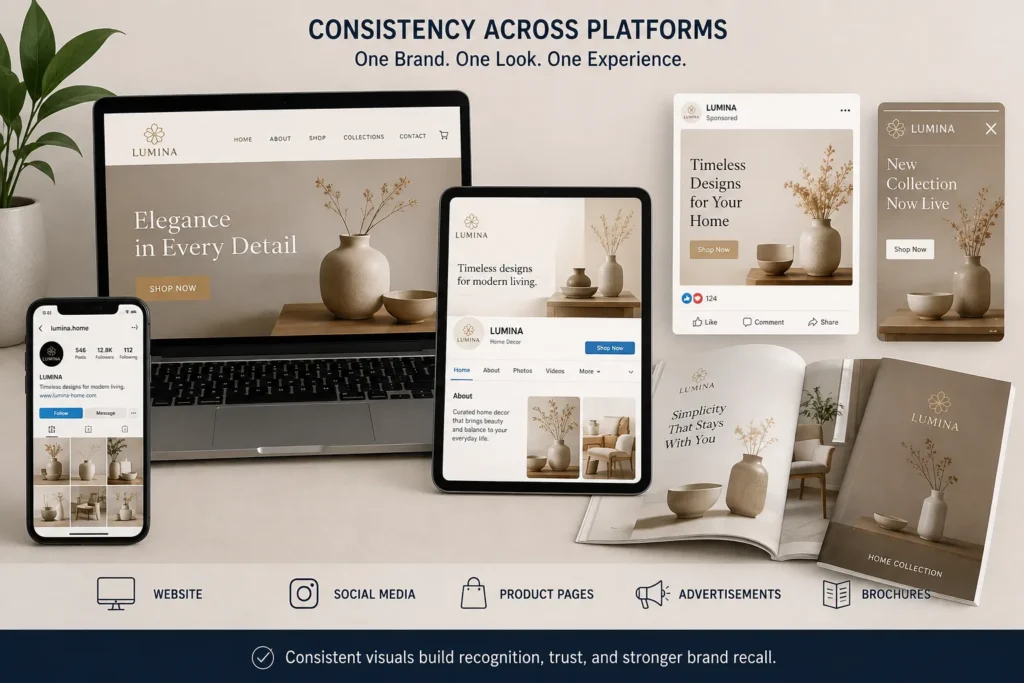
Consistency matters when customers encounter a business across different platforms. Your website, social media profiles, product pages, advertisements, and brochures should feel connected. Professional photographs can give these channels a common visual direction.
For example, a brand may consistently use similar lighting, composition, colors, and styling. Customers can then associate those visual elements with the business.
Increases Brand Memorability
Customers see thousands of images every day. A consistent visual style can help a business stand out in that crowded environment. When similar visual elements appear repeatedly across different touchpoints, customers have more opportunities to recognize the brand. Professional photography therefore supports recognition beyond a single campaign or advertisement.
Communicates Brand Personality
Photography can also communicate what a business represents.
Images can show:
- Brand personality
- Lifestyle
- Values
- Product positioning
- Customer experience
- Brand story
This gives customers more context than a basic product or service description.
How to Build Trust and Credibility
Customers want to know whether a business is reliable before spending money.
This becomes especially important online. Customers cannot always touch a product, visit a store, or speak directly with a business before making a decision.
Professional photography can provide visual evidence that helps reduce this uncertainty.
Creates a Professional First Impression
The quality of your business images can influence how customers perceive your company.
Clear, well-composed photographs can make a business appear organized and professional. This matters across websites, product pages, advertisements, and social media.
A strong first impression does not guarantee a sale. However, poor visuals can create unnecessary doubts about the business.
Shows Authenticity
Generic stock photos may be useful in some situations. However, they do not always represent the real business.
Original photography shows actual products, locations, people, facilities, and experiences.
For example, a hotel can show its actual rooms. A restaurant can show its real dishes and dining environment. An e-commerce brand can display its own products from different angles.
These visuals make the business easier for customers to understand.
Provides Visual Proof of Quality
Photography can reveal details that written descriptions cannot fully communicate.
Product images can show:
- Materials
- Texture
- Shape
- Color
- Design
- Finishing
- Product details
For service businesses, photographs can show the environment, process, team, or final results.
This gives potential customers more information before they make contact or purchase.
Builds Consumer Confidence
The more clearly customers understand what they are buying, the less uncertainty they may experience.
This is particularly valuable for online businesses. Professional images help customers form a clearer expectation of a product or service before making a decision.
Some Key Supports for Sales and Conversion Growth
Professional photography can influence the way customers evaluate products and services. The goal is not simply to make an image attractive. The image should help customers understand the value of what the business offers.
Highlights Important Product Features
A professional product photograph can present important features clearly.
Depending on the product, customers may need to see its:
- Shape
- Size
- Texture
- Color
- Design
- Materials
- Functionality
Good photography gives these details visual priority.
This is particularly important for e-commerce businesses where customers cannot physically examine products.
Creates an Emotional Connection
People do not always buy products based only on technical specifications. Lifestyle photography can place products in realistic situations. It can help customers imagine how the product fits into their own lives.
For example, clothing photography can show how an outfit looks when worn. Hospitality photography can show the experience of staying at a property.
The photograph becomes more than a product display. It communicates an experience.
Uses Visual Storytelling
A single image can communicate one idea. A planned collection of images can communicate a complete experience.
A business can structure its visual content around:
Product → Context → Lifestyle → Experience …
This approach is useful for brands that want to show how their products or services fit into real situations.
Reduces Purchase Uncertainty
Customers often have questions before buying.
They may wonder:
- What does the product actually look like?
- How large is it?
- What is the finish like?
- How does it look in use?
- What experience can I expect?
Professional photography cannot answer every question. However, it can provide useful visual information that supports the buying decision.
Strengthens Marketing and SEO
Professional photographs can become valuable marketing assets when they are planned for different channels.
However, simply uploading high-quality images does not automatically improve Google rankings. The value comes from using and optimizing those images as part of a broader digital marketing strategy.
Supports Better Search Visibility
Businesses can improve the usability and discoverability of images through proper optimization.
Important practices include:
- Descriptive image filenames
- Relevant alt text
- Image compression
- Appropriate image formats
- Fast-loading images
These practices help create a better experience for users and search engines.
Image optimization should therefore be treated as part of overall website optimization rather than a standalone ranking shortcut.
Makes Social Media Content Stronger
Social platforms depend heavily on visual communication.
Professional photographs give social media teams a reliable collection of branded content. Instead of repeatedly using low-quality or unrelated images, businesses can publish visuals that reflect their identity.
This can support:
- Product posts
- Promotional campaigns
- Behind-the-scenes content
- Educational posts
- Brand announcements
- Customer-focused campaigns
Enables Multi-Platform Asset Reuse
One well-planned photoshoot can create assets for several marketing channels.
The same photography project may produce images for:
- Website pages
- Digital advertisements
- Email campaigns
- Brochures
- Product pages
- Catalogues
This makes professional photography more useful than treating each image as a one-time piece of content.
Builds a Visual Content Library
A planned photoshoot can create a collection of images that remains useful for future campaigns.
Instead of searching for new visuals every time a campaign begins, marketing teams can work from an organized library of branded photographs.
This supports a simple principle:
One professional shoot can support multiple marketing campaigns.
Gives Businesses Access to Professional Expertise
Businesses can take photographs using smartphones and basic cameras. That can work well for everyday content.
Professional photography becomes more valuable when the images need strategic planning, consistent quality, and a specific business purpose.
Provides Better Technical Quality
Professional photographers understand how to control factors that affect the final image.
These include:
- Lighting
- Composition
- Camera settings
- Color management
- Editing
- Image consistency
The result is not simply a sharper photograph. It is an image created with a specific purpose in mind.
Brings Industry Knowledge
Different industries require different visual approaches.
Product photography needs to show products clearly. Food photography needs to make dishes look appealing. Hospitality photography needs to communicate space and experience.
A professional can adapt the photographic approach to the business and its audience.
Simplifies Production Planning
A successful photoshoot involves more than operating a camera.
Depending on the project, planning may include:
- Creative direction
- Locations
- Styling
- Props
- Models
- Shot lists
- Production schedules
Planning these elements before the shoot can prevent missing important visual assets.
Adds a Creative Perspective
Business owners know their products and services well. A professional photographer brings another perspective.
They can identify different angles, compositions, settings, and visual concepts that the business may not have considered.
This can help a brand present familiar products in a more engaging way.
How Professional Photography Works Across Different Industries
The value of professional photography changes according to the business model.
A product company may focus on conversion. A hotel may focus on attracting visitors. A restaurant may need strong food and atmosphere photography.
E-commerce and Retail
Online shoppers cannot physically examine products before purchasing.
Professional product photography can therefore help customers understand what they are considering.
Clear product images can show different angles, details, textures, colors, and usage contexts.
For retailers and e-commerce brands, this can support product trust and conversion-focused presentation.
Tourism and Hospitality
Tourism businesses sell destinations and experiences.
Hotels, resorts, travel companies, and tourism brands can use photography to show:
- Destinations
- Rooms
- Facilities
- Local culture
- Landscapes
- Activities
- Guest experiences
These visuals help potential visitors understand what they may experience before making travel decisions.
Restaurants and Cafés
Food businesses depend heavily on visual appeal.
Professional food photography can showcase dishes while interior photography can communicate atmosphere.
Useful photography may include:
- Food images
- Menu photographs
- Interior images
- Ambience
- Staff
- Customer experience
Together, these visuals can give customers a better understanding of the restaurant.
Events and Sports
Events create moments that cannot be recreated after they happen.
Professional event photography can document:
- Conferences
- Brand activations
- Sports competitions
- Corporate events
- Live experiences
- Important moments
These photographs can later support social media, public relations, marketing campaigns, event promotions, and company communications.
Professional Photography as a Long-Term Business Asset
A professional photoshoot should not always be viewed as a one-day expense.
When planned around business objectives, it can create a collection of assets with multiple uses.
Those assets can support:
Branding + Website + Social Media + E-commerce + Advertising + Marketing Materials
For example, a business launching a new product could plan one photoshoot around product details, lifestyle scenes, promotional images, website banners, and social media content.
The result is a stronger visual library rather than a few isolated photographs. Marketing teams can work from the same photography style across campaigns and platforms. The long-term value comes from how effectively the business uses the assets after the photoshoot.
Professional Photography vs DIY Photography
DIY photography has a place in modern business marketing.
Smartphones can be useful for quick updates, behind-the-scenes content, and everyday social media posts. The decision changes when photography directly affects brand perception or product presentation.
| Professional Photography | DIY Photography |
| Strategic planning | Often spontaneous |
| Consistent visual quality | Variable quality |
| Brand-focused approach | Usually content-focused |
| Professional lighting | Limited lighting control |
| Creative direction | Limited creative planning |
| Multiple planned assets | Often individual images |
The key difference is not that DIY photography is always bad.
It is that professional photography is designed around a specific business objective.
When Should a Business Invest in Professional Photography?
Professional photography can be particularly useful when a business reaches an important visual milestone.
Consider investing when you are:
- Launching a new brand
- Introducing a new product
- Rebranding the business
- Building an e-commerce store
- Updating your website
- Running an advertising campaign
- Improving your social media presence
- Entering a premium market
- Creating a product catalogue
- Preparing for a major event
The right time depends on the business goal.
If your current images no longer represent the quality of your products or services, a professional photography project may be worth considering.
How to Plan a Professional Business Photoshoot
A successful photoshoot begins before the camera comes out.
Define the Business Goal
First, identify what the photography needs to achieve.
Are you launching a product? Updating your website? Building a brand library? Creating advertising assets?
The answer will influence every later decision.
Identify the Target Audience
Think about who will see the photographs.
A visual approach for young fashion shoppers may differ from one designed for corporate decision-makers.
Understanding the audience helps determine the style, setting, and message.
Decide Where the Images Will Be Used
List every intended channel before the shoot.
These may include:
- Website
- Social media
- E-commerce
- Advertising
- Print materials
Knowing the channels helps the photographer plan appropriate compositions and image variations.
Create a Shot List
A shot list prevents important images from being forgotten.
List the products, people, locations, angles, scenes, and formats needed for the project.
This also makes the shoot easier to manage.
Maintain Brand Consistency
Finally, ensure the visual direction matches the existing brand.
Consider your brand colors, personality, audience, product positioning, and overall visual identity.
The goal is to create photographs that look like they belong to the same business.
Conclusion
Professional photography can do much more than make a business look attractive.
It can help a brand establish a recognizable visual identity, create stronger first impressions, communicate product quality, and give customers more confidence.
It can also support sales presentation and provide a reusable collection of visual assets for marketing.
The biggest value comes from treating photography as part of the business strategy.
Instead of asking, “How can we get better pictures?”, businesses should ask, “What do we need these images to achieve?”
That shift changes photography from a simple creative expense into a useful business asset.
If your business needs stronger visuals for branding, products, marketing, or customer communication, a professionally planned photography project can give you the assets needed to build a more consistent and credible visual presence.
