Search is no longer just about finding web pages—it’s about getting answers.
For decades, traditional search engines helped users discover information by ranking web pages. Today, AI-powered platforms like ChatGPT Search, Google AI Overviews, Perplexity, Gemini, and Microsoft Copilot are changing that experience. Instead of displaying a list of links, they understand user intent, retrieve relevant information, and generate direct, conversational answers often with citations.
Behind these AI-generated responses is a powerful ecosystem of technologies, including Large Language Models (LLMs), Retrieval-Augmented Generation (RAG), AI crawlers, semantic search, vector embeddings, and ranking systems. Together, they enable AI to understand questions, retrieve reliable information, and produce accurate responses.
Understanding how AI search works is now essential for business owners, marketers, SEO professionals, and content creators. As search shifts from ranking web pages to generating answers, organizations that create trustworthy, machine-readable, and authoritative content will be better positioned to increase their visibility in AI-powered search results.
What Is AI Search?
AI search is a search experience that uses artificial intelligence to understand user intent, retrieve relevant information, and generate direct, conversational answers instead of simply listing web pages.
Unlike traditional search, which relies on keyword matching, AI search combines technologies such as Natural Language Processing (NLP), Large Language Models (LLMs), semantic search, and Retrieval-Augmented Generation (RAG) to understand questions and deliver context-aware responses.
For example, instead of showing multiple links for the query “What’s the best CRM for a small marketing agency?”, an AI search engine analyzes the question, compares relevant information, and provides a summarized answer with supporting sources when available.
AI Search vs Traditional Search
While both help users find information, they deliver results differently. Traditional search ranks web pages, whereas AI search understands user intent and generates direct, conversational answers.
| Feature | Traditional Search | AI Search |
| Output | Ranked web pages | Direct answers |
| Search Method | Keyword matching | Intent & semantic understanding |
| Information Source | Indexed web pages | Retrieved content + LLM |
| Citations | User opens links | AI may cite sources |
| Experience | Multiple clicks | Conversational |
Complete AI Search Workflow
Although AI-generated answers may seem instantaneous, they result from multiple systems working together behind the scenes.
A simplified AI search workflow looks like this:
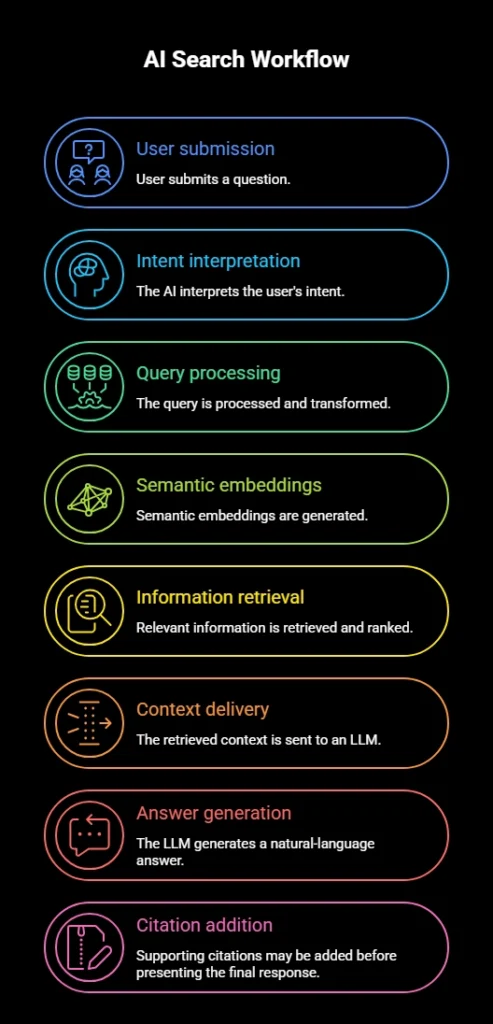
Unlike traditional search, where ranking is the final step, AI search continues beyond retrieval by synthesizing information into a coherent answer. This connected workflow is what differentiates modern answer engines from conventional search engines.
How AI Search Works
Unlike traditional search engines that return a list of web pages, AI search understands a user’s question, retrieves relevant information, and generates a direct, conversational answer. This process involves several intelligent steps.
1. User Query
Every AI search starts with a natural-language question, such as “How does AI search work?” or “Which CRM is best for startups?” These detailed queries help AI understand the user’s needs.
2. Intent Detection
The AI identifies the purpose behind the query, such as:
- Informational – Learn something
- Commercial – Compare products or services
- Transactional – Complete an action
Understanding search intent helps deliver more relevant answers.
3. Query Processing
The system refines the query by correcting spelling, identifying entities (brands, products, or locations), and rewriting ambiguous questions to improve search accuracy.
4. Semantic Search
The processed query is converted into vector embeddings, allowing AI to search based on meaning rather than exact keywords. This helps retrieve relevant content even when different words are used.
5. Retrieval & Ranking
Finally, the AI retrieves and ranks the most relevant content based on factors like relevance, authority, freshness, content quality, and E-E-A-T. The selected information is then passed to a Large Language Model (LLM), which generates a clear, conversational response—often with citations.
What Are Large Language Models (LLMs)?
A Large Language Model (LLM) is an artificial intelligence model trained on massive collections of text to understand, predict, and generate human language.
Rather than storing predefined answers, an LLM learns statistical patterns, relationships between words, grammar, facts, and reasoning techniques. When you ask a question, it predicts the most appropriate sequence of words based on what it has learned and the context provided.
Popular LLMs include:
- GPT (OpenAI)
- Gemini (Google)
- Claude (Anthropic)
- Llama (Meta)
An LLM serves as the reasoning engine in AI search. However, by itself, it has limitations. Its knowledge reflects its training data and may not include recent events or newly published content. This is why modern AI search combines LLMs with retrieval systems instead of relying solely on the model’s internal knowledge.
How RAG Powers AI Search
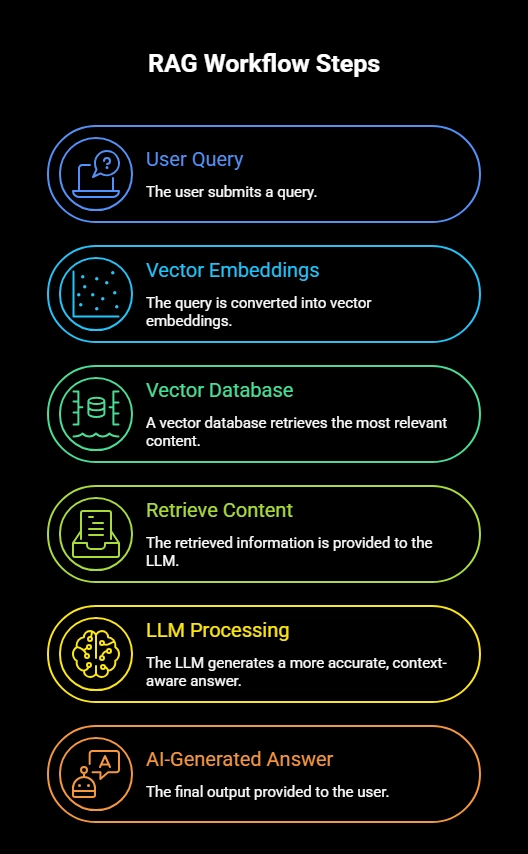
Large Language Models (LLMs) are trained on existing data and may not know about recent events or newly published content. Retrieval-Augmented Generation (RAG) improves AI search by retrieving relevant information from external sources before the LLM generates a response.
How RAG Works
RAG follows a simple process:
- The user submits a query.
- The query is converted into vector embeddings.
- A vector database retrieves the most relevant content.
- The retrieved information is provided to the LLM.
- The LLM generates a more accurate, context-aware answer.
Vector Databases
A vector database stores content as embeddings, allowing AI to search by meaning rather than exact keywords. This helps retrieve relevant information even when different words express the same intent.
Why RAG Matters
RAG enhances AI search by:
- Providing up-to-date information.
- Improving answer accuracy.
- Reducing AI hallucinations.
- Retrieving information based on semantic meaning.
RAG Workflow
AI Crawlers
Before AI systems can retrieve information, they must first discover it.
This is the role of AI crawlers.
AI crawlers automatically visit websites, access publicly available content, and help make that information available for indexing, retrieval, or other AI-powered search processes.
AI crawlers generally evaluate:
- Page accessibility
- Content quality
- Structured information
- Entity relationships
- Machine-readable formatting
- Freshness of content
If valuable content cannot be discovered or interpreted, it is much less likely to appear in AI-generated answers.
Search Crawlers vs AI Crawlers
Although both discover web content, their objectives differ.Traditional crawlers prepare pages for ranking, while AI crawlers contribute to systems that help LLMs retrieve relevant information for answer generation.
| Feature | Traditional Search Crawlers | AI Crawlers |
| Primary Goal | Index web pages | Support AI retrieval and answer generation |
| Output | Search index | Retrieval-ready content and context |
| Focus | Pages and links | Meaning, entities, and semantic relationships |
| Optimization | SEO | SEO + GEO + structured content |
| End Result | Ranked search results | AI-generated answers with supporting sources |
What Are Answer Engines?
An answer engine is an AI-powered system designed to generate complete answers rather than simply returning a list of links.
Instead of asking:
Which pages might help?
Answer engines ask:
What is the best answer I can generate using trustworthy information?
Modern answer engines combine:
- LLM reasoning
- Semantic retrieval
- RAG
- Source evaluation
- Natural language generation
The result is a conversational response that often includes citations and follow-up context.
Search Engines vs Answer Engines
Search engines help users find information.
Answer engines help users understand information.
This shift explains why content optimized only for rankings may not automatically earn visibility in AI-generated answers.
Original Framework: The AWARE AI Search Framework
Use this framework to understand the complete technology stack behind AI search.
| Stage | Purpose |
| A – Ask | User submits a natural-language question. |
| W – Understand | AI detects intent, entities, and context. |
| A – Access | Retrieval systems locate semantically relevant information. |
| R – Reason | The LLM combines retrieved context with learned knowledge to generate an answer. |
| E – Explain | The AI delivers a conversational response and, when appropriate, cites authoritative sources. |
The AWARE Framework emphasizes that AI search is not a single technology but a coordinated process involving language understanding, retrieval, reasoning, and explanation.
How AI Chooses and Cites Sources
AI search platforms don’t just rank web pages—they evaluate multiple sources to generate accurate, trustworthy answers. Many platforms also include citations so users can verify the information.
How AI Chooses Sources
AI typically selects content based on:
- Relevance to the query
- Authority of the website
- Semantic relevance (matches user intent)
- Freshness of information
- E-E-A-T signals
Well-structured, high-quality content is more likely to be selected.
How AI Cites Sources
AI platforms are more likely to cite content that:
- Comes from trusted websites
- Is accurate and comprehensive
- Uses clear headings and structure
- Includes credible references or original insights
ChatGPT vs Gemini vs Perplexity vs Google AI Overviews
| Platform | Primary Strength | Live Information | Citations | Best Use Case |
| ChatGPT Search | Conversational answers | Yes | Yes | Research, learning, productivity |
| Google AI Overviews | Integrated search summaries | Yes | Yes | General web search |
| Perplexity | Research-focused responses | Yes | Strong emphasis | Academic and fact-based research |
| Gemini | Google ecosystem integration | Yes | Yes | Multimodal search and productivity |
AI Search vs SEO vs AEO vs GEO
Understanding these four concepts is essential for future-proofing your digital strategy.
| Strategy | Primary Goal | Optimization Target |
| SEO | Improve rankings in traditional search results | Search engines |
| AEO | Provide concise, answer-ready content | Answer engines |
| GEO | Increase visibility in AI-generated responses | Generative AI platforms |
| AI Search Optimization | Improve discoverability across all AI search systems | AI search ecosystem |
Think of them as complementary rather than competing strategies.
- SEO helps users find your website.
- AEO helps AI extract your answers.
- GEO helps AI recommend and cite your brand.
- Businesses that integrate all three approaches will be better positioned as search continues to evolve.
AI Search Optimization Framework
The SEARCH Framework
Use this six-step framework to improve AI visibility.
| Step | Action |
| S – Structure | Organize content using logical headings, tables, and FAQs. |
| E – Establish Authority | Demonstrate expertise with author bios, evidence, and original insights. |
| A – Answer First | Provide concise answers before expanding with detail. |
| R – Reinforce Entities | Connect related concepts using semantic content and internal links. |
| C – Cite Reliable Sources | Support claims with authoritative references and current data. |
| H – Keep Content Healthy | Refresh content regularly and maintain technical SEO best practices. |
This framework aligns with how modern AI systems retrieve, understand, and prioritize information.
AI Search Checklist
Before publishing your content, ask:
- Does the page answer the user’s question clearly and directly?
- Is the content well-structured with descriptive headings?
- Does it demonstrate E-E-A-T (Experience, Expertise, Authoritativeness, and Trustworthiness)?
- Is the information accurate, up-to-date, and supported by credible sources?
- Is the content easy for both users and AI systems to understand?
- Have you implemented structured data where appropriate?
Common Mistakes
Many businesses unknowingly reduce their AI search visibility by making these mistakes:
- Publishing thin, keyword-stuffed articles.
- Ignoring search intent.
- Failing to define technical concepts.
- Creating poor heading structures.
- Using outdated information.
- Omitting schema markup.
- Neglecting internal linking.
- Publishing content without demonstrating expertise.
Optimizing for AI search is about improving content quality—not manipulating algorithms.
Future of AI Search
AI search is evolving rapidly. Over the next few years, several trends are likely to shape how users discover information:
- Agentic AI capable of completing multi-step tasks.
- Multimodal search that understands text, images, audio, and video together.
- Voice-first search through conversational assistants.
- Personalized AI experiences tailored to user preferences and context.
- Smarter retrieval systems that deliver increasingly accurate, evidence-backed answers.
As these capabilities mature, businesses that invest in structured, authoritative, and entity-rich content will have a stronger foundation for long-term visibility.
Conclusion
Search is undergoing its biggest transformation since the rise of Google.
Instead of directing users to lists of links, AI-powered search engines are becoming intelligent answer engines capable of understanding intent, retrieving relevant information, reasoning across multiple sources, and delivering clear, conversational responses.
Behind every AI-generated answer is a sophisticated ecosystem of LLMs, vector embeddings, Retrieval-Augmented Generation (RAG), AI crawlers, semantic retrieval, ranking systems, and citation mechanisms working together. Understanding this ecosystem is no longer optional for marketers, business owners, and SEO professionals—it is essential for maintaining visibility in the next generation of search.
Organizations that focus on expertise, content quality, semantic relevance, and machine-readable structure will be best positioned to earn trust, citations, and long-term AI search visibility.

