Have you ever visited a website, looked around, and then left without buying anything? Then, a few hours later, you saw an ad for that same product on Instagram or Facebook?
That’s retargeting.
Most people who visit your website don’t buy on the first visit. They get busy, they compare prices, they forget. Retargeting is how you remind them and bring them back. In this guide, we’ll explain what retargeting is, the different types, when to use it, and how to run your own campaign – including a real example from one of our own campaigns.
What is retargeting and why is it important?
Retargeting means showing ads to people who have already visited your website or interacted with your brand. It’s not for strangers who’ve never heard of you – it’s for people who already showed interest.
Here’s how it works in simple terms: a small piece of code (called a pixel) sits on your website. When someone visits your site, this pixel places a small file called a cookie in their browser. Later, when that person visits other websites or apps, the cookie tells advertising platforms to show them your ad again.
Why does this matter? Because most website visitors don’t buy the first time. If you don’t use retargeting, you lose them — you paid to bring them to your site once, and you may never see them again. With retargeting, you get another chance to turn that interest into a sale, and it usually costs a lot less than trying to reach a brand-new customer.
What is an example of retargeting?
Here’s a real one. We ran a 30-day ad campaign on Meta (Facebook and Instagram) for the Maattam AI Video Creation Course. The goal was simple: get people interested in the course to sign up as leads.
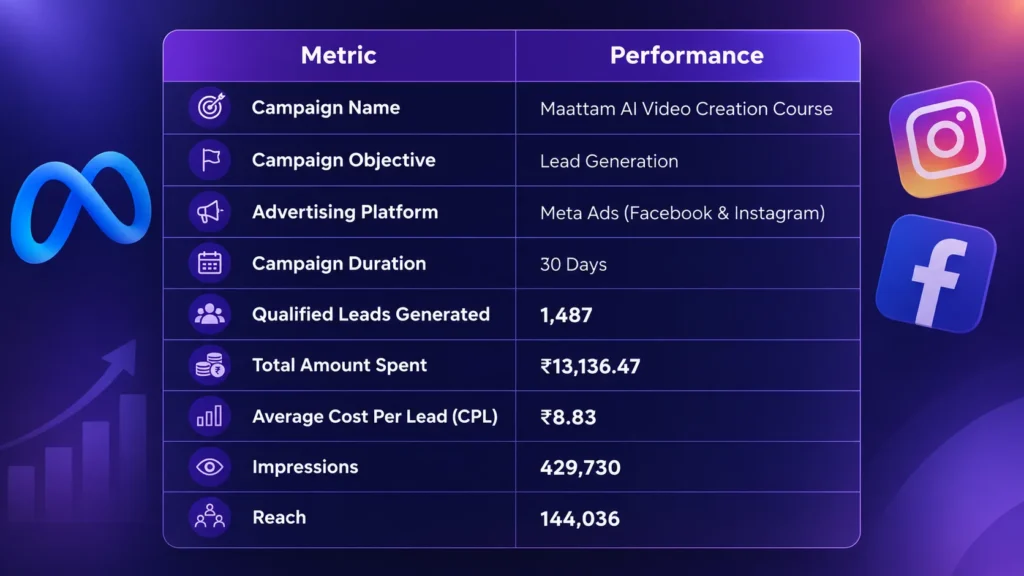
That’s a great result. But not everyone who showed interest joined the course right away. That’s normal – people often need a little more time or a little more information before they commit. That gap between “interested” and “enrolled” is exactly where retargeting comes in. We’ll explain what we did about it later in this guide.
Make retargeting work for your brand
A few simple habits make retargeting work better:
- Write clear, honest copy – remind people why they were interested in the first place.
- Use a clear call-to-action – tell people exactly what to do next.
- Use good, real-life images – especially for products or courses where people want to picture the result.
- Be transparent – vague, overly “salesy” ads lose trust. Clear, honest messaging builds it.
- Optimize for mobile – most people will see your retargeting ads on their phone.
Here’s how this played out in our own campaign. After the 30-day Meta Ads campaign for the Maattam AI Video Creation Course, we didn’t just show the same ad again to the 1,487 leads who hadn’t joined yet. Instead, we built a separate retargeting campaign with a different message.

Instead of repeating the same offer, the retargeting ads focused on two things: who is actually teaching the course – the tutor’s background and experience – and what exactly the course includes – the topics, format, and what students can expect to learn. In short, the goal wasn’t to push harder. It was to answer the questions that were still holding people back.
That’s the real lesson here: once someone has already shown interest, showing them the same ad again rarely works. What works is retargeting that builds trust – showing the people and the substance behind your offer, not just repeating it.
It’s also worth keeping an eye on where retargeting is heading. As third-party cookies get phased out, cookieless retargeting, privacy-friendly methods, and AI-based audience targeting are becoming more important.
How many types of retargeting ads are there?
Retargeting isn’t just one thing – there are different ways to do it, depending on who you’re targeting and where.
First, there are two main methods:
- Pixel-based retargeting – reaches people using the tracking pixel and cookies mentioned above. It works automatically, even if you don’t know the person’s name or email.
- List-based retargeting – uses a list of contacts you already have, like an email list, to show them ads on other platforms. It’s more precise, but you need a big enough list, and not everyone on your list will be matched.
There are also different types of retargeting campaigns based on where the ads appear:
- Display ads – image or banner ads shown on other websites.
- Email retargeting – emails sent based on specific actions, like an abandoned cart.
- Search retargeting (RLSA) – showing ads to past visitors when they search on Google again.
- Social media retargeting – ads shown on Facebook, Instagram, and LinkedIn.
- Mobile retargeting – used to bring people back to your app.
- CTV and OTT retargeting – ads shown to past visitors on streaming TV platforms like YouTube TV or connected devices.
Segmented users in sales funnels
Not everyone should see the same ad. Someone who only read one blog post is very different from someone who put an item in their cart and left. Grouping people by where they are in the buying process – just browsing, comparing, or almost ready to buy — helps you show each person the right message at the right time.
Buyer persona
It also helps to think about who your customer actually is. Their interests, age, location, and past behavior all matter. A bride shopping for a wedding outfit and someone buying a gift are looking for very different things, even if they visited the same page.
Social media custom audiences
One of the easiest ways to start retargeting is through custom audiences on Facebook and Instagram. You can build an audience from people who visited your website, or from a list of contacts you already have. You can also create “lookalike” audiences – new people who are similar to your best customers.
Cross-channel marketing
The best retargeting doesn’t stick to just one platform. It follows the same person across display ads, social media, and even streaming TV, so your brand stays visible wherever they go online – not just in one place.
When should you use retargeting campaigns?
Retargeting can support many different goals – building brand awareness, driving more sales, recovering abandoned carts, keeping existing customers coming back, launching new products, or simply helping people move closer to buying. Here are some common situations where it works well.
Promoting bestsellers
If a product already sells well, retargeting helps put it back in front of people who showed interest but didn’t buy – using demand you already know is there.
Introducing new collections
When you launch something new, the people most likely to care are the ones who already know your brand. Retargeting lets you show your new collection or new course to past visitors and customers first.
Moving inventory
Need to clear out old stock? Show the exact items people already looked at, with a little urgency added – this often works better than a generic discount ad shown to strangers.
Building brand awareness
Not every ad needs to push for a sale right away. Sometimes retargeting simply keeps your brand visible, so when someone is finally ready to buy, they think of you first.
Recovering abandoned carts
This is one of the most useful and effective ways to use retargeting. Someone who added something to their cart already made most of the decision – a simple reminder ad or email is often all it takes to bring them back to finish buying.
Retargeting vs remarketing campaigns
These two words are often used to mean the same thing, but they’re a little different.
Remarketing usually means sending emails to people you already know – past customers, existing leads, or people on your subscriber list. It happens through a channel you own, like email.
Retargeting usually means showing paid ads to people based on what they did – like visiting your website or leaving items in a cart — even if you don’t know their name yet. It happens through ad platforms, based on behavior.
In practice, the two work well together. Remarketing nurtures people you already know. Retargeting brings back the much bigger group of visitors who left without giving you their contact details.
How retargeting works
At its core, every retargeting campaign works the same way: a small piece of code on your website drops a cookie in a visitor’s browser. Later, when that person is browsing elsewhere, ad platforms recognize the cookie and show them your ad.
Turning this into a real campaign usually follows eight simple steps:
- Identify your goals and metrics – decide what success looks like: awareness, leads, or sales.
- Segment your audience – group people by behavior and interests instead of treating everyone the same.
- Choose your channels – display, email, search, social, mobile, or streaming TV, wherever your audience spends time.
- Plan your message sequence – decide what someone sees first, second, and third, instead of showing the same ad over and over.
- Set timing and frequency limits – showing an ad too often can annoy people instead of persuading them.
- Design your ad creative – make sure it fits each channel and each audience.
- Launch the campaign – with tracking set up from day one.
- Monitor and improve – test different versions and keep improving instead of leaving it on autopilot.
A few tools make this easier: Google Ads for search retargeting, Facebook Ads Manager for social audiences, AdRoll for retargeting across multiple channels, Criteo for personalized ads, Outbrain for native ads, Mailchimp for email retargeting, and platforms like Vibe.co for streaming TV ads.
Benefits of retargeting
Improved conversion rates
Because you’re reaching people who already showed interest, retargeting ads usually convert better than ads shown to strangers. You’re reminding someone, not introducing yourself for the first time.
Reinforcing brand recall
Seeing your brand again and again – even without clicking – builds familiarity. That familiarity is often what makes someone choose you later, when they’re finally ready to buy.
Better ROI compared to cold outreach
Because you’re targeting a smaller, warmer group of people, retargeting usually costs less per result than reaching a brand-new audience. Our Maattam AI Video Creation Course campaign is a good example – 1,487 qualified leads at just ₹8.83 each. That kind of efficiency is exactly why it made sense to follow up with retargeting instead of spending the whole budget chasing new visitors.
Personalized customer journeys
Because retargeting is based on what someone actually did – the page they viewed, the item they left in their cart – the ad they see can match their exact interest, instead of showing everyone the same generic message.
Where retargeting fits into your marketing strategy
Retargeting isn’t meant to replace the rest of your marketing – it fills the gap in the middle. Ads and SEO bring new visitors to your site. Retargeting keeps them engaged after that first visit. And offers, emails, or a sales follow-up help close the deal. Think of it as the piece that keeps people moving forward instead of losing interest after visit one.
Key Takeaways
- Retargeting shows ads to people who already visited your website or interacted with your brand, using a pixel and cookie, or a contact list.
- There are two main methods — pixel-based and list-based — and several types of campaigns, including display, email, search, social, mobile, and streaming TV.
- Retargeting and remarketing aren’t the same thing: remarketing usually means emailing people you already know, while retargeting means showing ads based on behavior, even to people you don’t know yet.
- Following a clear process — from setting goals to testing and improving — makes retargeting far more effective than running it randomly.
- The best retargeting builds trust instead of just repeating the same ad. In our Maattam AI Video Creation Course campaign, that meant highlighting the tutor and the course details after an initial campaign that brought in 1,487 leads at ₹8.83 each.
- Retargeting works best as part of your full marketing strategy, not as a standalone trick.

