Most advertising campaigns fail not from weak creative or budget, but because they were never truly planned — just assembled. A goal gets typed into a brief, an audience gets guessed at, budget gets split evenly “to be safe,” and weeks later everyone is staring at a dashboard wondering why CPA is climbing.
Campaign management doesn’t have to be improvisational. There’s a clear, repeatable sequence that takes a campaign from vague idea to measured result. Here’s the framework, in seven stages.
1. Start With Evaluation and Goal Setting
Before any ad is designed, answer two questions honestly: what business problem are we solving, and what would make this a win?
“We need more sales” is a symptom, not a problem. The real issue might be a competitor dominating a category, a new product needing awareness, or lapsed repeat customers. Naming the specific problem shapes the audience, channels, and creative that follow. Pin down your competitive differentiation too — why someone should choose you over the alternatives in the same feed.
Goals must be SMART: Specific, Measurable, Achievable, Relevant, Time-bound. “Increase brand awareness” isn’t actionable; “Reach 500,000 unique users in our target region within 60 days” is.
Decide upfront how success will be judged, across two buckets: campaign outcomes (leads, sales, sign-ups) and behavioral changes (shifts in engagement, retention, or brand lift).
Skipping this stage is the top reason campaigns end in debate about whether they “worked” — undefined success gets defined retroactively, rarely in the campaign’s favor.
2. Define the Target Audience With Precision
A campaign aimed at “everyone” reaches no one. Audience definition has two layers: who they are, and where they are in the journey.
Profiling should cover four dimensions: demographic (age, income, life stage), geographic (region, urban/rural, local factors), psychographic (values, interests, attitudes), and behavioral (purchase history, brand interactions).
The second layer is funnel segmentation: awareness (cold — don’t know you yet), consideration (warm — know you, haven’t decided), and conversion (ready — close to purchasing).
Each stage needs different messaging and CTAs — map creative to funnel stage, and spend starts working with the buyer’s mindset instead of against it.
3. Get Budget and Allocation Right
Budgeting is an ongoing discipline, not a one-time decision. Audit at least 90 days of spend data, and don’t rely solely on each platform’s self-reported numbers, since platforms tend to over-credit themselves. An independent attribution view, even a shared tracking sheet, gives a more honest picture.
Build an allocation strategy: bucket budget by funnel stage rather than just channel, keep a 10–15% reserve to double down on winners or react to shifts, and run bi-weekly checkpoints instead of monthly reviews — a two-week lag can burn budget fast.
Three classic methods still apply: percentage-of-sales (budget scales with a fixed % of revenue — best for stable businesses), objective-and-task (budget built from the cost of tasks needed to hit goals — best for goal-driven campaigns), and competitive parity (budget benchmarks competitor spend — best for share-of-voice categories). None is universally correct — it depends on whether you’re optimizing for efficiency, growth, or market position.
4. Build the Media Strategy
With audience and budget defined, decide where the campaign lives.
Channels span three buckets: digital (search, social, display — tightest targeting), ATL (TV, print, radio — broad reach and credibility), and outdoor (hoardings/signage — local presence and repetition).
Channel mix should follow objectives: maximizing reach, optimizing frequency, or managing pacing so spend doesn’t cluster.
Underneath sits account architecture — thematic ad groups with consistent naming. It sounds like housekeeping, but messy structure makes it nearly impossible to later tell which creative, audience, or channel drove results.
5. Get the Creative and Copy Strategy Right
This is where strategy becomes visible.
Effective copy leans on psychology: loss aversion (avoiding loss motivates more than an equivalent gain), social proof (showing others have already trusted the product), authority bias (expert or credible validation), and urgency/scarcity (pushing a decision instead of letting it drift).
Layered on top: clarity over cleverness (confusion costs the click), contrast (showing the gap between problem and improved state), and benefits over features (people buy what a feature does for them).
Format matters too: dynamic ad rotation lets variants compete so the winner surfaces; video view optimization pays for real attention, not a half-second scroll-past.
6. Monitor and Optimize Continuously
A campaign left untouched after launch will decay. Audiences fatigue, search terms drift, costs creep up.
Prevent fatigue by watching CTR/CPC trends, refreshing creative before performance drops, and widening audiences when a segment saturates. For search, audits should include negative keyword filtering and refining terms based on the actual queries triggering ads.
None of this works without good dashboards — a unified tracking layer with real-time KPIs turns optimization into a daily five-minute check instead of a monthly scramble.
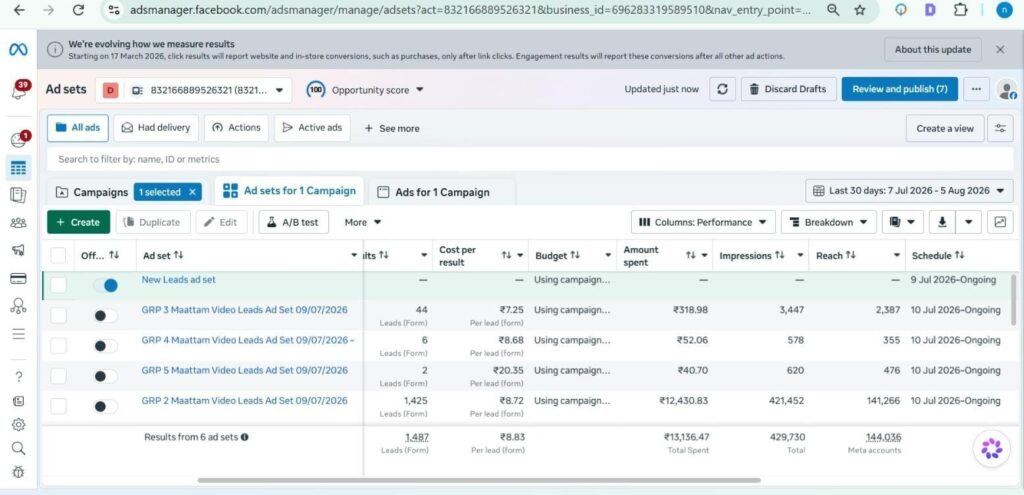
To demonstrate how the seven-stage advertising campaign framework works in practice, I managed a Meta Ads Lead Generation campaign for Maattam’s AI Video Creation Course. The campaign was designed to attract potential learners interested in AI-powered video creation by targeting students, educators, content creators, freelancers, entrepreneurs, and digital marketers. Using audience segmentation, compelling ad creatives, optimized lead forms, and continuous performance monitoring, the campaign successfully generated high-quality leads while maintaining an efficient advertising budget. The results below highlight the campaign’s overall performance and demonstrate how a structured advertising strategy can deliver measurable business outcomes.
Campaign Performance Metrics
| Metric | Performance |
| Campaign Name | Maattam AI Video Creation Course |
| Campaign Objective | Lead Generation |
| Advertising Platform | Meta Ads (Facebook & Instagram) |
| Campaign Duration | 30 Days |
| Qualified Leads Generated | 1,487 |
| Total Amount Spent | ₹13,136.47 |
| Average Cost Per Lead (CPL) | ₹8.83 |
| Impressions | 429,730 |
| Reach | 144,036 |
7. Measure, Evaluate, and Feed It Back
The final stage closes the loop — and is most likely to get skipped once a campaign “ends.”
The PRACE framework (Plan, Reach, Act, Convert, Engage) maps neatly back onto the funnel stages defined earlier.
Three KPIs matter most: ROAS (revenue per dollar spent), CPA (cost per conversion), and fully loaded Customer Acquisition Cost. But numbers don’t explain why something worked — feedback loops fill that gap: recall studies, social listening, and quarterly deep-dives that step back from daily dashboards.
CONCLUSION
Advertising campaigns deliver the best results when they are executed as a structured process rather than a series of independent tasks. Every stage—from setting SMART goals and identifying the right audience to allocating budgets, selecting appropriate media channels, creating compelling ad creatives, optimizing performance marketing, and measuring results—builds on the one before it. Before launching or reviewing a campaign, marketers should evaluate whether the objectives were achieved, whether the audience targeting attracted the right customers, whether the budget was invested effectively, and which media channels and creative strategies generated the strongest performance. It is equally important to compare key performance indicators such as reach, impressions, conversions, CPA, and ROAS with qualitative feedback to understand not only what worked but also why it worked. Following the campaign management process in the right order ensures that every decision is supported by data, reduces wasted advertising spend, and creates a strong foundation for continuous improvement. Whether managing campaigns for a small business or a large brand, marketers who consistently plan, execute, analyze, and optimize their campaigns are more likely to achieve sustainable growth and long-term advertising success.

