A/B testing lets you compare two versions of a landing page. It shows you which one performs better. Instead of guessing which headline, image, layout, or call-to-action (CTA) works best, you test the change with real visitors.
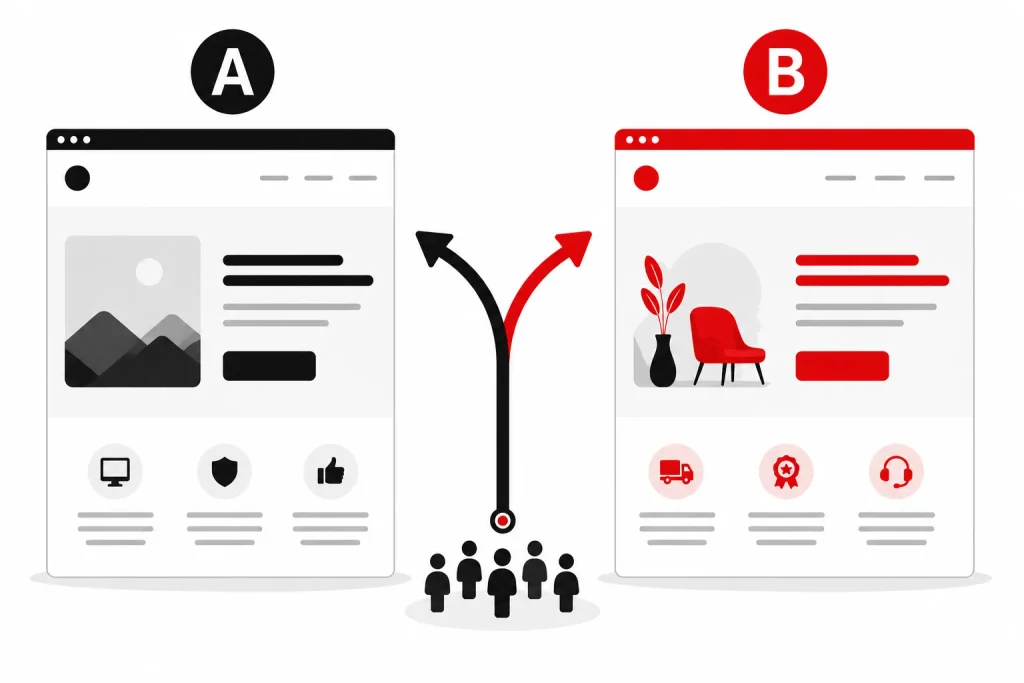
Marketers also call A/B testing split testing.
The process is simple. First, you create two versions of a page. Then you show them to different groups of visitors. Finally, you measure which version performs better against a specific goal.
So, A/B testing turns landing page optimization into a data-driven process.
What Is A/B Testing?
A/B testing is a method of comparing two versions of a landing page. It shows you which one gets better results.
The original page becomes the Control (A). The new version becomes the Variation (B).
You then divide your traffic between both versions. After that, you measure the same conversion goal.
That goal could be:
- CTA clicks
- Form submissions
- Sign-ups
- Purchases
- Downloads
- Lead generation
The basic process is:
Change one element → Split the traffic → Measure the result → Learn from the result
For example, imagine a boutique that sells handcrafted jewelry.
The current landing page uses:
“Timeless Pieces for Every Occasion.”
The team creates another version:
“Handcrafted Jewelry, Delivered in 3 Days.”
Some visitors see Version A. Others see Version B. The team then compares their clicks and conversions.
This gives the team evidence, instead of relying only on opinions.
However, A/B testing does not replace creativity. You still need good ideas and a clear test hypothesis. But real visitor behavior helps you decide which version performs better.
“Either take action, or make it easy to step back.” — Neeraj R. Chandran
This idea fits landing page optimization well.
A landing page should make the next step clear. It should encourage visitors to take the desired action, without creating unnecessary confusion.
So, A/B testing helps you discover which headlines, CTAs, images, forms, and layouts make that action easier.
Why Is A/B Testing Important?
A/B testing helps you replace guesswork with evidence.
Instead of asking, “Which version looks better?”, you can ask, “Which version helps more visitors take action?”
Improve Your Conversion Rate
One major goal of A/B testing is to improve your conversion rate.
You can test:
- Headlines
- Subheadlines
- CTA buttons
- Forms
- Images
- Page layouts
- Trust signals
- Offers
For example, you can test “Submit” against “Get My Free Quote.”
The second CTA explains the next step more clearly. So, instead of assuming it will perform better, you can test both versions.
This makes A/B testing an important part of conversion rate optimization (CRO).
Reduce the Risk of Major Changes
A complete landing page redesign can take time and resources.
A/B testing lets you test a new idea before making a major change.
For example, if you want to change your page layout, you can first test the new layout against the existing one.
If it performs poorly, you have evidence before making the change across the website.
Get More Value From Existing Traffic
More traffic does not always solve a conversion problem.
Sometimes, you can get better results from the visitors you already have.
For example, if 10,000 visitors reach your landing page and your conversion rate is 2%, you get 200 conversions.
If you increase the conversion rate to 3%, the same traffic can produce 300 conversions.
So, A/B testing can help you find changes that improve how your existing traffic converts.
Understand User Behavior
Your assumptions may not always match visitor behavior.
A design that looks good to your team may not perform well with your audience.
Testing can show whether visitors respond better to:
- Clearer headlines
- Stronger benefits
- Shorter forms
- Specific CTA copy
- Better images
- Trust signals
- Different page layouts
Each test gives you another insight about your audience.
Make Data-Driven Marketing Decisions
Marketing teams often have different opinions.
One person may prefer one headline. Another may prefer a different version.
A/B testing lets you compare those versions using actual performance data.
You can measure:
- Conversion rate
- Click-through rate
- Form submissions
- Sign-ups
- Purchases
- CTA clicks
So, this helps you make decisions based on evidence, rather than personal preference.
A/B Testing Is a Step-by-Step Learning Process
A/B testing is not about finding the perfect landing page in one experiment.
You cannot learn everything from one test.
Think of A/B testing as a continuous learning cycle:
Test → Learn → Improve → Test Again → Learn Again
You may start by testing your headline.
The result may show that visitors respond better to a clear benefit. Then, you can use that learning to test your CTA.
After that, you may test your form or page layout.
Each experiment gives you another piece of information.
So, you do not need to gain everything at one time.
A/B testing is a step-by-step process of learning what works for your audience.
The goal is not to find a perfect page in one test. Instead, the goal is to keep learning and improving.
How Does A/B Testing Work?
A/B testing follows a simple process.
Split Your Traffic
Start with your original landing page as the Control (A).
Create a second version with one meaningful change. This becomes the Variation (B).
Then, randomly divide visitors between both versions.
Run Both Versions at the Same Time
Run the Control and Variation at the same time.
Outside factors, such as promotions, seasonality, traffic spikes, and advertising changes, can affect visitor behavior.
So, running both versions together creates a fairer comparison.
Measure One Clear Goal
Choose your primary goal before starting the test.
Your goal could be:
- A click
- A sign-up
- A purchase
- A form submission
- A lead
A clear goal makes the experiment easier to evaluate.
Collect Enough Data
Do not stop a test simply because one version looks better after a few days.
Early results can change.
So, collect enough data before making a decision. You should also consider statistical significance when you analyze the result.
Key A/B Testing Terms to Know
Control
Control is the original version of your landing page.
Variant or Variation
Variation is the new version that you test against the Control.
Champion
Champion is the version currently performing best. It’s usually the version live on your website.
Challenger
Challenger is the new version trying to outperform the Champion.
Conversion Rate
Conversion rate is the percentage of visitors who complete your desired action.
For example, if 100 visitors reach your page and 10 submit a form, your conversion rate is 10%.
Statistical Significance
Statistical significance helps you judge one thing. It shows whether the difference between two versions is a real performance difference, or just random variation.
Hypothesis
Hypothesis is your testable prediction.
For example:
“A clearer CTA will increase clicks because visitors will understand the next step more easily.”
Sample Size
Sample size means the number of visitors or conversions included in your test.
A very small sample may not provide enough evidence for a reliable decision.
A/B Testing vs. Multivariate vs. Split URL Testing
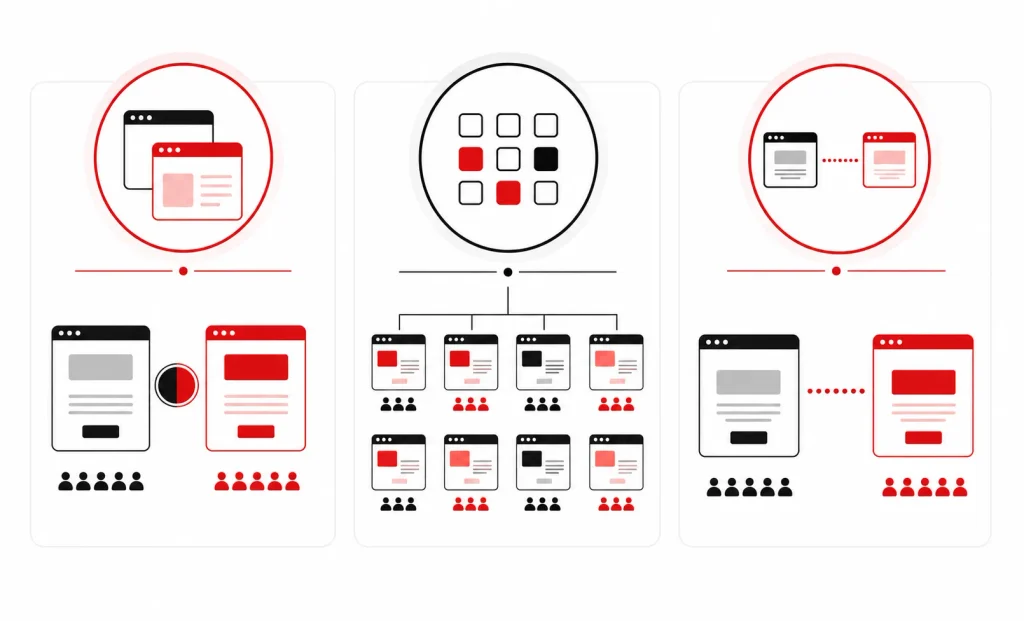
A/B Testing
A/B testing compares two versions of a page.
It works well for testing one clear change, such as a headline, CTA, image, or form.
Multivariate Testing
Multivariate testing (MVT) tests several elements and their combinations.
For example, you could test two headlines, two CTAs, and two images.
So, this approach requires enough traffic to evaluate the different combinations.
Split URL Testing
Split URL testing compares substantially different page designs using separate URLs.
It works well for major redesigns.
A/B/n Testing
A/B/n testing compares more than two versions at the same time. For example, Version A, Version B, and Version C.
Multi-Armed Bandit Testing
Multi-Armed Bandit testing shifts more traffic toward better-performing versions while the test continues.
So, it can suit time-sensitive campaigns where you want to reduce traffic sent to weaker versions.
What Can You A/B Test on a Landing Page?
Headlines and Subheadlines
Test different benefits, value propositions, messages, and levels of specificity.
Call-to-Action Buttons
Test:
- CTA text
- Button placement
- Button size
- Supporting copy
- CTA design
Make the next action clear.
Forms
Test:
- Number of fields
- Field order
- Form placement
- Field labels
- Supporting text
Hero Images
Test product photos, lifestyle images, illustrations, or different visual styles.
Keep the offer consistent, so you can understand the effect of the image.
Page Layout
Test content order, section placement, spacing, navigation, information hierarchy, and CTA placement.
Trust Signals
Test reviews, testimonials, ratings, guarantees, security badges, certifications, and client logos to strengthen trust signals on your page.
Common A/B Testing Mistakes
Stopping a Test Too Early
Do not declare a winner simply because one version performs better for a few days.
Early results can change as you collect more data.
Testing Too Many Elements at Once
If you change the headline, CTA, image, and layout together, you may not know which change caused the result.
So, keep your test focused.
Ignoring Sample Size
A small sample may not provide enough evidence.
Give low-traffic pages enough time to collect useful data.
Not Defining the Goal Before the Test
Choose your primary conversion goal before launching the experiment.
Ignoring External Factors
Consider seasonality, promotions, advertising changes, traffic sources, device mix, and other factors that may influence results.
How to Start Your First A/B Test
Identify the Problem
Use your analytics data to find where visitors struggle or leave.
Choose One Element
Choose one element that could affect the problem.
Create a Test Hypothesis
Explain what you want to change, what you expect to happen, and why.
Build the Variation
Create Version B, while keeping the other important elements consistent.
Define Your Primary Metric
Choose one main goal, such as CTA clicks, form submissions, or purchases.
Split Your Traffic
Send visitors randomly to the Control and Variation.
Run the Test
Run both versions at the same time and collect enough data.
Analyze the Results
Compare conversion rates and other relevant metrics.
Apply the Learning
If the Variation performs better with reliable evidence, use the learning.
If it does not win, you still learned something.
So, use that learning to create your next hypothesis.
A/B Testing and Conversion Rate Optimization
A/B testing supports conversion rate optimization (CRO). It gives you a structured way to test improvements.
The process looks like this:
Identify → Hypothesize → Test → Measure → Learn → Improve → Test Again
This cycle shows why one experiment cannot answer every question.
One test gives you one learning. The next test builds on that learning.
Over time, this step-by-step process helps you understand your audience and improve your landing page.
Final Takeaway
A/B testing helps you make better landing page decisions, using real visitor behavior.
You can test headlines, CTAs, forms, images, layouts, and trust signals.
But remember:
You cannot learn everything from one test.
A/B testing is a step-by-step learning process.
Test → Learn → Improve → Test Again.
Your landing page should make the next step clear.
So, A/B testing helps you discover how to make that step easier.
Start with one problem. Create one clear hypothesis. Test one meaningful change. Measure the result. Learn from it.
