Introduction
Creating content that ranks requires more than choosing a keyword and starting to write. A successful SEO article needs a clear purpose, the right search intent, relevant topic coverage, and a structure that helps both readers and search engines understand the content.
This is where an SEO content brief becomes important.
An SEO content brief acts as a blueprint for content creation. It brings together keyword targeting, search intent, audience needs, content goals, topic structure, internal linking, and editorial direction before writing begins.
A well-prepared brief also keeps the writer focused. It prevents unnecessary sections, reduces revisions, and helps ensure that the final article addresses the topic comprehensively without drifting into unrelated subjects.
In this guide, you’ll learn what an SEO content brief is, why it matters, what it should contain, and how to create one that supports SEO-driven content creation.
What Is an SEO Content Brief?
An SEO content brief is a strategic document that guides the creation of search-focused content.
It tells writers and content teams what the content should cover, who it should target, what search intent it should satisfy, and how the finished page should support broader SEO goals.
Unlike a simple writing outline, an SEO content brief connects keyword research, search intent, audience needs, content structure, entities, internal linking, and conversion goals.
Think of it as the blueprint for an SEO article.
Before writing begins, the brief answers questions such as:
- What is the primary topic?
- Which keyword should the page target?
- What does the searcher want?
- Who is the content for?
- What questions should it answer?
- Which subtopics should it cover?
- Which entities are relevant?
- Which pages should it link to?
- What action should the reader take?
This makes the brief a bridge between SEO strategy and content execution.
For example, a basic instruction might say:
Write an article about SEO content briefs.
An SEO content brief would provide much more context:
Target the keyword “SEO Content Brief,” satisfy informational intent, explain the essential components, provide a creation process, identify common mistakes, and connect the topic with relevant Content SEO resources.
This difference makes content planning more strategic.
Why Is an SEO Content Brief Important?
An SEO content brief connects SEO strategy with content execution.
Without a clear brief, writers may interpret the same topic differently. One article may focus heavily on keywords, while another may focus on writing style and completely miss search intent.
A brief creates a shared direction.
1. Aligns Content With Search Intent
The brief identifies what users expect when they search for the topic.
This helps the writer create content that answers the right questions in the right format.
2. Improves Topic Coverage
A brief identifies the important concepts that should be addressed.
This helps prevent incomplete content without forcing unrelated information into the article.
3. Reduces Content Revisions
When SEO requirements and editorial expectations are defined before writing, writers have clearer instructions from the beginning.
4. Improves Team Collaboration
SEO specialists, writers, editors, designers, and developers can work toward the same objectives.
5. Supports Topical Authority
The brief can identify relevant internal links and relationships with other pages.
For example, an SEO Content Brief article can connect naturally with Keyword Research, Search Intent, Topical Clusters, Semantic SEO, E-E-A-T, and Website Architecture without explaining those subjects in depth.
6. Makes Content Production Scalable
A standardized briefing process allows teams and agencies to create content more consistently.
What Should an SEO Content Brief Include?
A useful brief should contain enough information to guide the content without unnecessarily scripting the writer.
1. Primary Keyword
The primary keyword represents the main search topic.
For this article:
Primary keyword: SEO Content Brief
The keyword should appear naturally in important areas such as:
- SEO title
- H1
- Introduction
- Relevant headings
- Body content
- URL
The goal is not to repeat the keyword excessively.
The goal is to clearly establish the page’s topic.
2. Secondary Keywords
Secondary keywords support the primary topic.
Examples include:
- Content Brief
- SEO Brief
- SEO Writing Brief
- Blog Content Brief
- Content Planning
- SEO Content Strategy
- Content Optimization
These variations help the writer understand the broader language users may use around the topic.
3. Long-Tail Keywords
Long-tail keywords represent more specific searches.
Examples include:
- How to create an SEO content brief
- SEO content brief template
- What should an SEO content brief include?
- SEO content brief for blog writing
- Content brief example
These can also help identify questions and subtopics worth addressing.
Search Intent: The Starting Point of the Brief
Search intent describes the reason behind a user’s search.
For an SEO content brief, understanding search intent is essential because the content must solve the user’s actual problem.
For this topic, the primary intent is:
1. Informational Intent
The user wants to learn or find information about a topic. They are usually looking for an explanation, answer, guide, or solution rather than making an immediate purchase.
Examples:
- What is SEO?
- How does keyword research work?
- How to create an SEO content brief?
Best content formats: Guides, tutorials, blogs, FAQs, and educational articles.
2. Transactional Intent
The user is ready to take an action, often involving a purchase, sign-up, download, booking, or subscription.
Examples:
- Buy running shoes online
- Download an SEO template
- Book a digital marketing course
Best content formats: Product pages, service pages, landing pages, and signup pages.
3. Commercial Intent
The user is researching options before making a purchase decision. They may be comparing products, services, brands, or solutions.
Examples:
- Best SEO tools
- Ahrefs vs Semrush
- Best digital marketing course in Kerala
Best content formats: Comparisons, reviews, buying guides, and product/service roundups.
4. Navigational Intent
The user wants to find a specific website, page, brand, or resource. They usually already know where they want to go.
Examples:
- Google Search Console
- Semrush login
- ICT Academy website
Best content formats: Usually the relevant official website or specific destination page.
5. Local Intent
The user wants information about a business, service, product, or place within a specific geographic area.
Examples:
- SEO agency in Trivandrum
- Bridal jewelry rental in Kerala
- Digital marketing course near me
Best content formats: Local landing pages, Google Business Profile listings, location pages, and locally relevant service content.
Target Audience
An SEO content brief should clearly define who the content is written for.
Potential audiences for this topic include:
Beginners
They need simple explanations of SEO content planning.
Students
They may want to understand professional content workflows.
Bloggers
They may want to create more search-focused blog content.
Business Owners
They may want content that supports organic visibility and lead generation.
SEO Professionals
They may need standardized briefing processes.
Agencies
They may need a repeatable system for managing large content operations.
Defining the audience helps determine the level of explanation and examples required.
Content Goal
Every brief should establish what the content is supposed to achieve.
For an SEO content brief article, goals may include:
- Educating readers about SEO content briefs.
- Explaining how to create them.
- Improving content planning.
- Reducing unnecessary revisions.
- Supporting a broader Content SEO strategy.
- Connecting readers with related SEO resources.
The content goal keeps the article focused.
Content Outline
The outline provides the structure writers will follow.
A strong SEO content outline should follow the reader’s learning journey.
For this topic, the natural flow is:
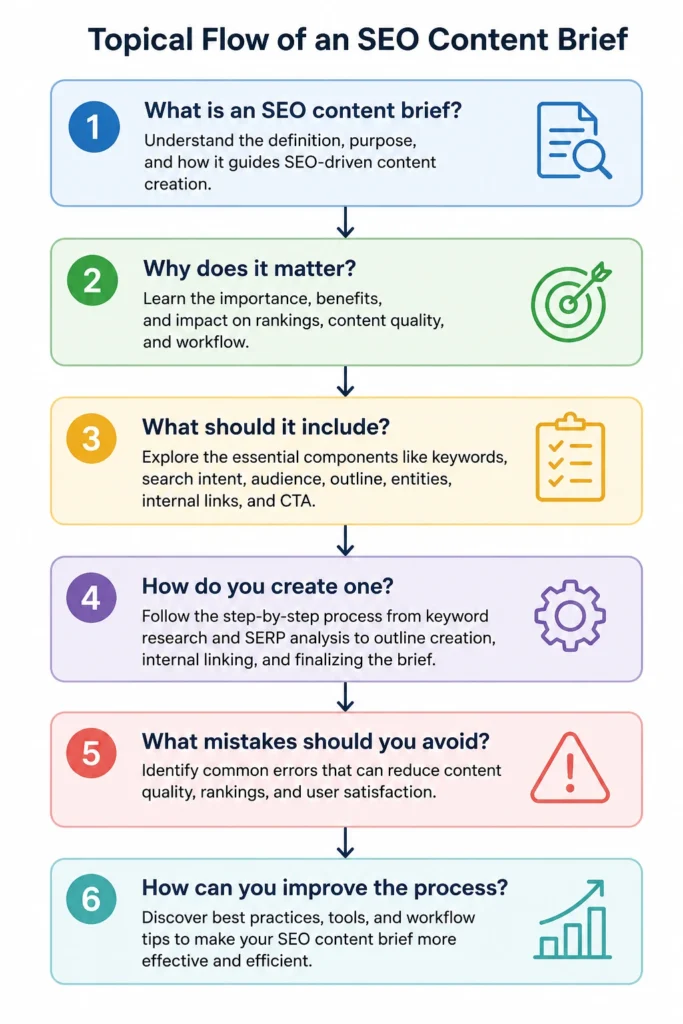
This structure keeps each section connected to the main topic.
How to Create an SEO Content Brief
Creating an SEO content brief can be broken into a clear process.
Step 1: Perform Keyword Research
Start by identifying the main keyword and related search terms.
Look at:
- Keyword relevance
- Search demand
- Long-tail variations
- Related queries
- Competition
- Search intent
The purpose is not to collect hundreds of keywords.
Instead, identify the terms that genuinely support the main topic.
For a deeper explanation of this process, the dedicated [Keyword Research Guide] can cover keyword discovery, evaluation, and mapping.
Step 2: Analyze the SERP
Review the search results for the primary keyword.
Look at:
- Top-ranking pages
- AI overview (Featured snippet)
- People Also Ask
- Related searches
- Competitor headings
- Content formats
- Tables
- Images
- Templates
- Checklists
This helps you understand what users currently expect from the topic.
SERP analysis should inform your brief rather than encourage you to copy competing pages.
Step 3: Analyze Competitors
Study relevant competing pages to understand:
- Topics they cover
- Questions they answer
- Content structure
- Depth
- Internal linking
- Media usage
- Missing information
The goal is to identify opportunities to create more useful and focused content.
Competitor analysis should not become a reason to add every topic competitors mention.
Only include information that supports your primary topic.
Step 4: Identify Content Gaps
A content gap is an important area that existing content does not address adequately.
For an SEO content brief, useful gaps may include:
- Practical workflow
- Entity mapping
- Internal linking strategy
- Team collaboration
- Brief templates
- Checklists
- Common mistakes
Content gaps should improve the article’s usefulness.
They should not become excuses for adding unrelated SEO topics.
Step 5: Map Relevant Concepts
Map the concepts directly connected to the primary topic.
For SEO content briefs:
Keyword Research : helps identify
Target Keywords: which support
Search Intent : which influences
Content Structure : which determines
Topic and Entity Coverage : which connects through
Internal Linking : This creates a logical relationship between SEO planning elements.
Step 6: Build the Final Outline
Once research is complete, organize the information into H2 and H3 sections.
Every section should answer a relevant question or support the main objective.
Before adding a section, ask:
Does this directly help the reader understand or create an SEO content brief?
If the answer is no, it probably belongs in another article.
This simple test helps prevent topical dilution.
Step 7: Plan Internal Links
Internal links should be planned before publication.
For this article, relevant links may include:
- Content SEO
- Keyword Research
- Search Intent
- Topical Clusters
- Semantic SEO
- Helpful Content
- E-E-A-T
- Website Architecture
The links should appear naturally within relevant sections.
Avoid adding links simply to increase the number of internal links.
Each link should provide additional value to the reader.
Step 8: Define the CTA
The brief should specify the action you want the reader to take after consuming the content.
Possible CTAs include:
- Download an SEO content brief template.
- Read the Keyword Research Guide.
- Explore related Content SEO resources.
- Contact an SEO professional.
- Book an SEO consultation.
For this article, a practical primary CTA would be:
Download the SEO Content Brief Template.
| Search Intent | CTA Needed? | Example CTA |
| Informational | Optional | “Read our complete keyword research guide.” |
| Commercial | Yes, usually | “Compare our recommended options.” |
| Transactional | Yes | “Shop Now” / “Get Started” |
| Navigational | Usually not necessary | “Visit the official website.” |
| Local | Yes, often | “Contact us” / “Get Directions” |
SEO Content Brief Workflow
Once the brief is complete, it becomes part of the larger content production process.
1. Research
Collect keywords, search intent, SERP insights, competitors, and related concepts.
2. Planning
Define the audience, content goal, angle, outline, internal links, and CTA.
3. Writing
Create the content according to the approved brief.
4. Review
Check:
- Accuracy
- Search intent
- Topic coverage
- Readability
- Brand voice
- Internal links
5. Optimization
Review the page’s:
- SEO title
- Meta description
- Headings
- URL
- Internal links
- Images
- Alt text
- Schema
6. Publishing
Publish the content within the appropriate website structure.
7. Monitoring
After publication, monitor:
- Organic traffic
- Rankings
- Impressions
- CTR
- Engagement
- Conversions
The workflow doesn’t end when the article goes live.
Performance data can help identify opportunities for future optimization.
Common SEO Content Brief Mistakes
Ignoring Search Intent
A keyword does not automatically tell you what content to create.
Always understand the user’s goal first.
Targeting Too Many Keywords
A brief does not need hundreds of keywords.
Focus on the terms that genuinely support the topic.
Creating a Weak Outline
A vague outline often leads to incomplete or disorganized content.
Every major section should have a clear purpose.
Keyword Stuffing
Keywords should guide the content.
They should not make the writing unnatural.
Ignoring Internal Linking
A brief should identify relevant pages that can provide additional information.
Missing Related Concepts
Important entities and concepts should be considered when they genuinely support the topic.
Covering Too Much
This is especially important.
An SEO content brief article should not become a complete guide to SEO itself.
Keyword Research, Semantic SEO, E-E-A-T, Topical Clusters, and Website Architecture should remain separate topics.
Mention them where relevant.
Link to them.
Do not duplicate their entire content here.
SEO Content Brief Tools
Several tools can support different stages of the briefing process.
Google Search Console
Useful for understanding existing search queries, impressions, clicks, and CTR.
Google Keyword Planner
Useful for keyword discovery and planning.
Ahrefs
Useful for keyword research, competitor analysis, and content research.
Semrush
Useful for keyword research, competitor analysis, and SEO planning.
Surfer SEO
Useful for SERP-based content analysis and optimization.
Frase
Useful for content research and topic coverage.
ChatGPT
Useful for organizing research, generating initial outlines, identifying questions, and structuring briefs.
AI-generated suggestions should still be reviewed against actual SERP results and your content strategy.
You do not need every tool.
Choose the tools that fit your workflow.
SEO Content Brief Best Practices
Focus on User Intent
Build the brief around the user’s problem rather than the keyword alone.
Keep the Topic Focused
Every section should contribute to the main topic.
Use Keywords Naturally
Use primary, secondary, and related terms where they make sense.
Plan Internal Links Early
Identify related pages before the article is written.
Connect Content Strategically
Use the brief to establish relationships with relevant cluster pages.
Maintain Consistency
A standardized briefing process helps different writers produce content that follows the same strategic direction.
Review the Brief Before Writing
A few minutes spent reviewing the brief can prevent major revisions later.
SEO Content Brief Checklist
Use this checklist before sending a brief to the writer.
Strategy
- Primary keyword defined
- Search intent identified
- Target audience defined
- Content goal established
Content
- Secondary keywords identified
- Relevant long-tail keywords identified
- Important concepts mapped
- Content gaps identified
- Outline completed
- FAQs identified
SEO
- Internal links planned
- External references identified
- URL defined
- CTA defined
- Related cluster pages identified
Quality
- Topic remains focused
- No unnecessary sections
- No keyword stuffing
- Search intent is satisfied
- Content has a logical flow
Conclusion
An SEO content brief is the blueprint behind focused, search-driven content.
It brings together keyword targeting, search intent, audience needs, content goals, topic coverage, internal linking, and editorial direction before writing begins.
The process is straightforward:
Research → Understand Intent → Analyze SERP → Identify Gaps → Map Topics → Create Outline → Plan Links → Define CTA → Write → Optimize → Publish
The most important principle is to keep the main topic at the center.
For an SEO Content Brief article, Keyword Research, Search Intent, Topical Clusters, Semantic SEO, E-E-A-T, and Website Architecture should support the discussion through relevant explanations and internal links. They should not turn this article into separate guides for each topic.
That approach creates a cleaner Content SEO structure, reduces content overlap, and allows every article in the cluster to have its own clear purpose.
A good SEO content brief doesn’t tell you to write more.
It tells you what matters, what doesn’t, and what should come next.

