Display advertising now accounts for a massive share of global digital ad spend, and it remains one of the most versatile channels in any marketer’s toolkit capable of building brand awareness at scale and driving direct performance results in the same campaign. Yet many marketers still treat it as an afterthought behind search and social.
That’s a mistake. Display advertising does something no other channel does as efficiently: it puts your brand in front of the right audience while they’re reading, watching, or browsing, not just when they’re actively searching for you. It fills the gap before intent exists, building the awareness and consideration that eventually turns into a search, a click, or a sale.
This guide covers everything you need to know about display advertising today: what it actually is, the formats available, how the programmatic ecosystem works, how targeting works, the metrics that matter, the real challenges you’ll run into, and the platforms worth evaluating.
What Is Display Advertising? Core Concepts
Display advertising is a form of online marketing that uses images, video, and rich media placed on websites, apps, and platforms to promote a product or service to a relevant audience reaching people while they browse rather than only when they actively search for a brand or product.
Four ideas define modern display advertising:
● Outbound Marketing: display ads push brand messages out to audiences across the web, rather than waiting to be found through search.
● Visual Brand Promotion: imagery, video, and creative storytelling build recognition and recall in ways text-based ads can’t.
● Programmatic Automation: real-time bidding and automated buying have replaced manual ad placement, making premium inventory accessible even to smaller advertisers.
● First-Party Insights: as third-party signals decline, a business’s own customer data becomes the foundation for accurate, privacy-compliant targeting.
Display Ad Formats
Display advertising isn’t one thing, it’s a family of formats; each suited to a different stage of the customer journey.
● Banner Ads the classic static or animated image units (leaderboard, skyscraper, rectangle), still the most cost-efficient way to build broad awareness.
● Video & Connected TV in-stream, out-stream, and CTV placements for higher-impact storytelling as streaming consumption grows.
● Rich Media expandable, interactive creative units that go beyond a static image, useful for showcasing multiple products in one unit.
● Native Display ads styled to match surrounding editorial or feed content, which tend to perform well where readers are less tolerant of intrusive banners.
● Social Display display-style placements within social platforms’ feeds and networks, currently among the highest-reach formats available.
● Responsive Ads creative that automatically resizes to fit whatever ad slot is available across devices.
● Interactive Content polls, calculators, and playable ads that invite direct engagement rather than passive viewing.
The Programmatic Ecosystem
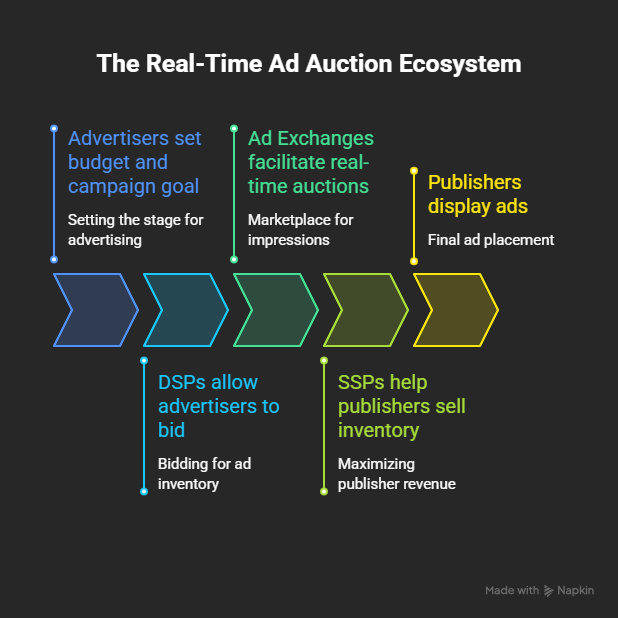
Behind every display ad is a real-time auction happening in milliseconds. Understanding this ecosystem helps marketers make sense of where their money actually goes:
● Advertisers set a budget and campaign goal.
● DSPs (Demand-Side Platforms) let advertisers bid for ad inventory across thousands of sites and apps from one dashboard.
● Ad Exchanges are the marketplaces where impressions are bought and sold in real time.
● SSPs (Supply-Side Platforms) help publishers sell their ad inventory at the best possible price.
● Publishers are the websites and apps where your ad ultimately appears.
This chain operates through Real-Time Bidding (RTB), where an impression is auctioned the instant a page loads, alongside Private Marketplaces (PMPs) and programmatic guaranteed deals, which let advertisers lock in premium inventory at a negotiated rate rather than an open auction.
Targeting Methods
Good display advertising isn’t about reaching everyone, it’s about reaching the right person, in the right context, at the right stage of their decision.
● Unified Customer Profiles merging data from your website, app, and CRM into a single customer view for more accurate targeting.
● Retargeting re-engaging visitors who browsed your site or added something to cart but didn’t convert.
● Demographic Segmentation targeting by age, gender, income, location, or other attributes.
● Behavioral Targeting based on browsing habits, purchase history, and engagement patterns.
● Contextual Placement matching ads to the content of the page itself rather than relying on user identity, a method growing in importance as privacy regulation tightens.
Metrics & KPIs
Cost Models
CPM charges advertisers per 1,000 impressions and suits awareness goals. CPC charges per click, tying spend to engagement. CPA charges per completed conversion, ideal for performance goals. CPL charges per qualified lead, common for service-based businesses generating enquiries rather than direct sales.
● CPM (Cost Per Mille) cost per 1,000 impressions; best for awareness campaigns.
● CPC (Cost Per Click) cost per click; ties spend to direct engagement.
● CPA (Cost Per Acquisition) cost per completed conversion or sale.
● CPL (Cost Per Lead) cost per qualified lead generated.
Performance Tracking
● Click-Through Rate (CTR) the percentage of viewers who click an ad.
● Conversion Rate the percentage of clicks that result in a desired action.
● Impressions total number of times an ad is displayed.
● Ad Frequency average number of times a unique user sees the same ad.
● Viewability whether an ad was actually visible on screen, per IAB standards.
● Bounce Rate the percentage of visitors who leave a landing page without further interaction.
Common Challenges in Display Advertising
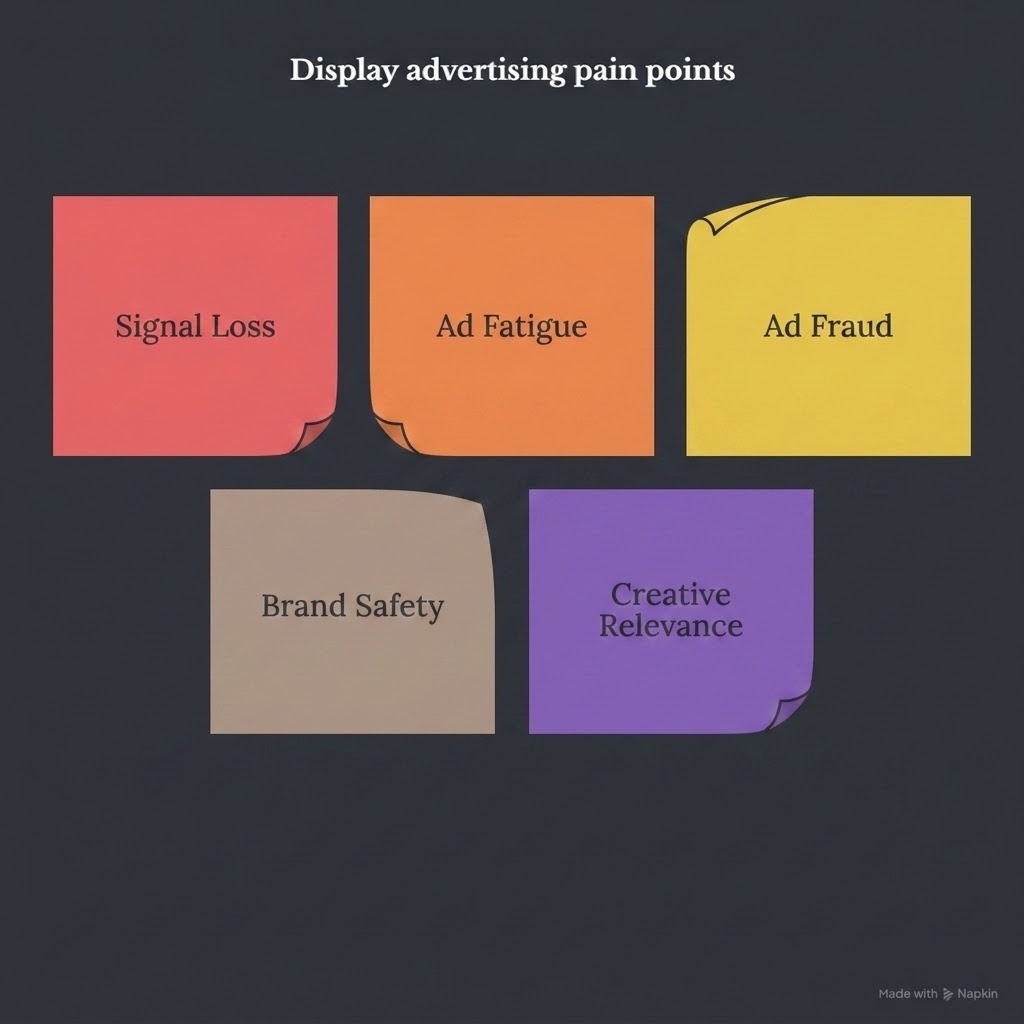
No channel is without friction, and display advertising has a few well-known pain points worth planning for rather than being surprised by:
● Signal Loss & Data Quality cookie deprecation and privacy regulation are steadily reducing targeting accuracy industry-wide. The fix is investing earlier in first-party data.
● Ad Fatigue (Banner Blindness) audiences learn to subconsciously ignore repeated, generic creative. Regular creative refreshes matter more than most budgets account for.
● Ad Fraud & MFA Sites invalid traffic and “made-for-advertising” sites can quietly inflate impression counts without delivering real audience value.
● Brand Safety Risks ads appearing next to inappropriate or reputation-damaging content remain a real risk with automated, open-exchange buying.
● Creative Relevance at Scale producing enough creative variety to stay relevant across audiences and formats is one of the most underestimated costs of running display well.
Leading Platforms & Solutions
Amazon Ads
● Amazon DSP programmatic buying across Amazon-owned and third-party inventory.
● Sponsored Display self-service display ads tied to Amazon shopping behaviour.
● Device Ads placements across Amazon’s owned devices and platforms.
Adobe Solutions
● Real-Time CDP unifying customer data for activation across channels.
● Journey Optimizer orchestrating personalized, cross-channel customer journeys.
● Advertising DSP Adobe’s programmatic buying platform, integrated with its broader data and creative stack.
Conclusion
Display advertising isn’t a replacement for search or social, it’s the layer that builds the awareness those channels later convert. From core concepts and formats to targeting, measurement, and platform selection, a well-run display strategy strengthens every other channel in your marketing mix.
Ready to put this into practice? Request a free display advertising audit or strategy consultation, or download our Display Advertising Metrics & Benchmarks Cheat Sheet to start planning your next campaign.
Display CTRs are typically lower than search, often well under 1%, since audiences aren’t actively looking to click. What matters more is whether the CTR and downstream conversion rate together produce an acceptable cost per acquisition.

