Search engine optimization is no longer just about ranking for keywords. Google’s ranking systems have evolved to evaluate whether content is genuinely helpful, accurate, trustworthy, and created by people with relevant knowledge. As search engines become more sophisticated and AI-powered search experiences continue to expand, credibility has become one of the most important aspects of SEO.
Strong E-E-A-T goes beyond writing informative articles. It involves demonstrating first-hand experience, showcasing subject matter expertise, earning authority within your industry, and building trust through transparency, accuracy, and a positive user experience.
For example, a travel blog becomes more valuable when the author shares personal travel experiences, original photographs, and practical recommendations. Likewise, a medical website gains credibility when its content is written or reviewed by qualified healthcare professionals and supported by reputable references.
In this guide, you’ll learn what E-E-A-T is, why Google introduced it, how each component contributes to content quality, and practical strategies for building credibility across your website.
What Is E-E-A-T?
E-E-A-T is a framework that evaluates the overall quality and credibility of content based on four essential components:
- Experience
- Expertise
- Authoritativeness
- Trustworthiness
Rather than focusing only on technical SEO or keyword optimization, E-E-A-T emphasizes the quality of information and the credibility of the people or organizations behind it.
This is where E-E-A-T plays a vital role: The structure described in Google’s Search Quality Rater Guidelines that helps human quality raters evaluate the quality and credibility of web content. Although E-E-A-T itself is not a direct ranking factor, the signals associated with it help Google’s ranking systems identify content that is useful, reliable, and worthy of appearing in
search results.
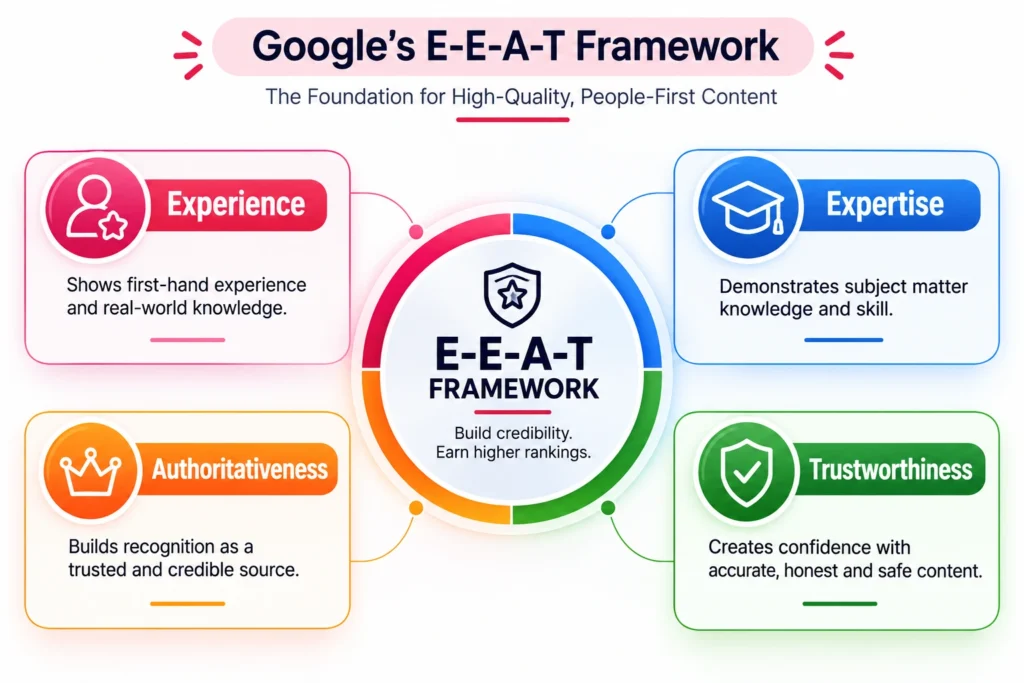
The skeleton of E-E-A-T encourages website owners to answer questions such as:
- Does the author have first-hand experience with the topic?
- Does the author possess relevant knowledge or qualifications?
- Is the website recognized as a trusted source?
- Can users confidently rely on the information provided?
These questions are especially important for content that can significantly impact a person’s health, finances, safety, or well-being.
Why Google Introduced E-E-A-T
Google’s mission is to organize the world’s information and make it useful for users. As the web expanded, search engines encountered increasing amounts of low-quality, misleading, and automatically generated content.
To improve search quality, Google introduced evaluation frameworks that emphasize content credibility rather than simply matching keywords.
The goals include:
- Promoting accurate information
- Reducing misinformation
- Rewarding expert-created content
- Improving user trust
- Encouraging transparent publishing practices
- Supporting people-first content
These principles help users find information they can rely on while encouraging publishers to prioritize quality over quantity.
Evolution from E-A-T to E-E-A-T
Originally, Google’s framework focused on three components:
- Expertise
- Authoritativeness
- Trustworthiness
In December 2022, Google expanded the framework by adding Experience, creating the current E-E-A-T model.
This change reflects the growing importance of first-hand knowledge.
For many topics, practical experience provides valuable insights that formal qualifications alone cannot offer.
Examples include:
- A traveler sharing personal destination guides
- A software developer documenting lessons from building an application
- A photographer explaining camera settings through real projects
- A business owner describing successful marketing campaigns
Adding “Experience” recognizes that genuine first-hand involvement can make content more helpful and trustworthy.
Why E-E-A-T Matters for SEO and AI Search
Modern search engines evaluate much more than keywords.
They aim to identify content that:
- Solves user problems
- Demonstrates expertise
- Provides trustworthy information
- Covers topics comprehensively
- Reflects genuine experience
AI-powered search systems also rely on credible sources when generating summaries and answers.
Strong E-E-A-T helps:
- Improve user confidence
- Support topical authority
- Strengthen brand reputation
- Increase content credibility
- Enhance AI search visibility
- Support long-term SEO performance
While E-E-A-T does not guarantee rankings, it contributes to many signals that Google’s ranking systems use to assess content quality.
The Four Core Components of E-E-A-T
Understanding each component individually makes it easier to implement E-E-A-T effectively across your website.
Experience
Experience refers to first-hand involvement with the subject being discussed.
Instead of repeating information found elsewhere, experienced authors share practical knowledge gained through real situations.
For example:
A digital marketer explaining SEO after optimizing dozens of websites demonstrates stronger experience than someone who simply summarizes online articles.
Likewise, a customer reviewing a product after using it provides more valuable insights than someone who has never interacted with the product.
Google recognizes that practical experience often improves content quality because it includes observations, lessons learned, and realistic recommendations.
First-Hand Lived Experience
Original experiences help distinguish your content from generic summaries.
Examples include:
- Personal case studies
- Original photographs
- Screenshots
- Workflow demonstrations
- Testing results
- Before-and-after comparisons
- Lessons learned
These elements increase authenticity while providing information that competitors may not have.
Real Case Studies and Practical Examples
Case studies demonstrate how concepts work in real situations.
For example, instead of simply stating that internal linking improves SEO, explain how reorganizing a website’s content clusters increased crawl efficiency and improved organic traffic over several months.
Practical examples help readers understand not only what to do but also why it works.
Unique Human Perspectives
Every creator has unique experiences that AI-generated summaries cannot replicate.
Sharing:
- Challenges encountered
- Mistakes made
- Alternative approaches
- Decision-making processes
- Personal recommendations
adds originality and value to your content.
Expertise
Experience shows that you’ve done something.
Expertise demonstrates that you understand it deeply.
Expertise involves:
- Subject knowledge
- Technical understanding
- Industry best practices
- Accurate explanations
- Reliable recommendations
Expert content should simplify complex concepts while remaining factually correct.
Subject Matter Knowledge
Strong expertise comes from studying, practicing, and continuously learning within a specific field.
For example:
An SEO specialist should understand:
- Search intent
- Technical SEO
- Structured data
- Content optimization
- Website architecture
- Semantic SEO
- Topical authority
- Analytics
This depth of knowledge allows them to create accurate and practical guidance
Author Qualifications
Qualifications strengthen credibility where appropriate.
Examples include:
- Professional certifications
- Academic degrees
- Industry experience
- Published research
- Speaking engagements
- Professional memberships
Not every topic requires formal qualifications.
For hobbies, travel, cooking, or product reviews, demonstrated experience may be more valuable than academic credentials.
Demonstrating Professional Experience
Expertise should be visible throughout your content.
Examples include:
- Detailed explanations
- Practical workflows
- Accurate terminology
- Real examples
- Updated recommendations
- References to authoritative documentation
Showing how something works often demonstrates expertise more effectively than simply defining it.
Authoritativeness
Authority reflects how others recognize your expertise.
While expertise comes from what you know, authoritativeness grows through reputation and recognition within your industry.
A website becomes more authoritative when trusted sources consistently reference, recommend, or cite its content.
Recognition from Trusted Sources
Authority increases when your work is acknowledged by reputable organizations, publications, or professionals.
Examples include:
- Industry mentions
- Guest articles on respected websites
- Conference presentations
- Interviews
- Expert roundups
- Citations by other publishers
These signals help establish your reputation within your field.
High-Quality Backlinks
Backlinks remain one of the strongest indicators of authority when they come from relevant and trustworthy websites.
Quality matters far more than quantity.
A few links from respected industry websites often provide greater value than hundreds of low-quality links.
Focus on earning links through:
- Original research
- Comprehensive guides
- Case studies
- Useful tools
- Data-driven content
Brand Reputation and Digital Presence
Authority extends beyond your website.
A strong digital presence may include:
- Consistent branding
- Positive customer reviews
- Social proof
- Media coverage
- Speaking opportunities
- Active industry participation
Building a recognizable and respected brand strengthens long-term authority.
Trustworthiness
Among all four components, trustworthiness is the most important.
A website may demonstrate experience, expertise, and authority, but if users cannot trust the information, those strengths lose much of their value.
Trust is built through transparency, accuracy, security, and honesty.
Why Trust Is the Most Important Component
Google’s Search Quality Rater Guidelines emphasize that trust is central to evaluating page quality.
Users should feel confident that the information is:
- Accurate
- Current
- Transparent
- Secure
- Honest
Trust also extends to the website itself.
Visitors should easily find:
- Contact information
- About Us page
- Privacy Policy
- Terms and Conditions
- Customer support details
These elements reassure users that there are real people behind the website.
Accurate, Transparent, and Secure Information
Trustworthy websites:
- Fact-check content before publishing
- Update outdated information
- Cite reputable sources
- Avoid misleading headlines
- Correct errors when identified
- Use HTTPS encryption
- Clearly distinguish facts from opinions
Transparency builds long-term credibility with both users and search engines.
Real People Behind the Website
People trust people.
Introduce the individuals responsible for your content through:
- Author bylines
- Professional biographies
- Team pages
- Organization information
- Contact details
- Social profiles (where relevant)
Clear authorship helps readers understand who created the content and why they are qualified to discuss the topic.
Content Strategies for Building E-E-A-T
E-E-A-T is not achieved through a single optimization. It develops over time through consistent content quality and a well-planned publishing strategy.
Develop Topical Authority Clusters
Rather than publishing isolated articles, organize your content into topical clusters around a central pillar page. Covering related subtopics comprehensively demonstrates expertise and strengthens your website’s authority within a subject.
Publish Regular Content Updates
Keep important pages accurate and up to date. Refresh statistics, replace outdated references, and expand sections when new information becomes available. Regular updates show that your content remains relevant and trustworthy.
Create Multiple Content Formats
Present your expertise through different formats, such as:
- Step-by-step guides
- Case studies
- Tutorials
- Videos
- Infographics
- Checklists
- FAQs
Offering information in multiple formats improves accessibility and helps users engage with your content.
Maintain Factually Accurate Reporting
Support important claims with credible sources, industry research, official documentation, or first-hand evidence where appropriate. Avoid speculation and ensure that facts are reviewed before publication.
Conclusion
E-E-A-T is an important framework for creating credible, useful, and trustworthy content. Experience demonstrates first-hand knowledge, expertise shows subject understanding, authoritativeness builds industry recognition, and trustworthiness gives users confidence in the information they consume.
Building E-E-A-T is not about adding keywords or making a page look authoritative. It comes from consistently demonstrating real experience, accurate information, qualified knowledge, credible sources, transparent authorship, and a trustworthy website.
E-E-A-T should also work alongside your broader Content SEO strategy. Strong topical clusters can demonstrate subject depth, helpful content can address real user needs, semantic SEO can establish relationships between concepts, and clear website architecture can make important information easier to discover.
Most importantly, focus on creating content that people can understand, rely on, and trust. When experience, expertise, authority, and trust are built consistently across your website, you create a stronger foundation for long-term SEO performance and a better experience for your audience.
