Search is moving beyond traditional results and blue links.
AI-powered search experiences can retrieve information from websites, identify relevant passages, combine information from multiple sources, and generate answers for users.
That changes how content should be planned and written.
Traditional SEO focuses on factors such as search intent, keywords, rankings, links, and technical accessibility. Generative Engine Optimization (GEO) adds another consideration: creating content that is clear, useful, well-structured, and easy for search and retrieval systems to interpret.
The goal isn’t to write for AI. The goal is to create valuable content that works well for both people and the systems that help them find information.
This guide presents a practical approach to building a GEO content strategy, including the CITABLE framework, content structure, authority, technical considerations, measurement, and common mistakes.
What Is a GEO Content Strategy?
A GEO content strategy is the process of creating content that is clear, useful, and easy to interpret within AI-powered search experiences.
Instead of focusing only on individual keywords, consider:
- Topics
- Questions
- Search intent
- Entities
- Evidence
- Content structure
For example, instead of publishing separate articles about what GEO is, its benefits, GEO vs. SEO, and how GEO works, connect them into a broader GEO content system.
Traditional SEO still matters. GEO adds another layer of focus on how information is structured, understood, and potentially used in AI-powered search.
The CITABLE Framework: A Practical Framework for GEO Content
The CITABLE framework is a practical framework developed for this guide, not an industry-standard GEO methodology.
It focuses on seven characteristics of useful GEO content:
- C — Clear Entities & Structure
- I — Intent-Focused Content
- T — Third-Party Validation
- A — Answer-Grounded Information
- B — Block-Structured Content
- L — Latest & Consistent
- E — Entity-Rich & Structured
C — Clear Entities & Structure
Clearly define the topic, key terms, and important entities. Use clear headings, consistent terminology, and logical structure.
I — Intent-Focused Content
Focus on what users want to know, not just one keyword. Address relevant questions, problems, comparisons, and decisions.
T — Third-Party Validation
Support important claims with credible sources such as research, official documentation, industry publications, and expert sources.
Use evidence, not artificial authority.
A — Answer-Grounded Information
Give readers specific, useful information.
Weak:
GEO is important for businesses.
Better:
GEO improves content so AI-powered search experiences can understand and potentially use information from a website.
Support important claims with sources, data, examples, or attribution.
B — Block-Structured Content
Break information into focused blocks such as answers, definitions, comparisons, steps, examples, and FAQs.
Each block should communicate one main idea.
L — Latest & Consistent
Keep information accurate and current. Review statistics, examples, sources, and technical recommendations. Update content when information changes.
E — Entity-Rich & Structured
Clearly define important entities and their relationships.
Company → offers → Product
Relevant structured data can add machine-readable context, but it doesn’t guarantee AI citations or recommendations. It is one supporting element alongside content quality, relevance, and accessibility.
How to Structure Content for AI Search
Good information can be difficult to understand or retrieve when poorly structured. Use a clear hierarchy, direct answers, and focused sections.
1. Use Question-Based Headings
Use descriptive headings that clearly tell readers what they will learn.
Less descriptive:
GEO Content Optimization
Better:
How Do You Optimize Content for AI Search?
Question-based headings can align content with real user queries. However, don’t force every heading into a question. Clarity matters more than the format.
Keep the Heading Hierarchy Logical
Use:
- H1: Main topic
- H2: Major sections
- H3: Subsections
- H4: Specific points when necessary
Headings should show the relationship between ideas, not just control text size.
2. Put the Answer First
Give the main answer before the explanation.
GEO content should be clear, well-structured, evidence-based, and easy to understand.
Then provide supporting details, examples, and evidence.
This BLUF (Bottom Line Up Front) approach helps readers find answers quickly.
3. Keep Sections Focused
Give each section one clear purpose.
For example:
What Makes Content Easier to Evaluate?
Cover:
- Clear answers
- Supporting evidence
- Relevant context
- Source attribution
- Specific examples
Avoid combining multiple unrelated ideas into one long section.
One heading → one purpose → one focused answer.
Before and After: Making Content More Useful
GEO isn’t about stuffing keywords into sentences. It’s about making information clear, specific, and useful.
Example 1: Defining GEO
Weak:
GEO is an important strategy for businesses that want to succeed in AI search.
Better:
GEO is the practice of improving content so AI-powered search experiences can understand and potentially use information from a website.
The better version defines GEO, explains its purpose, and avoids vague claims.
Example 2: Making a Claim Specific
Weak:
Well-structured content performs better in AI search.
Better:
Clear headings, direct answers, and focused sections make information easier to find and interpret.
The lesson: focus on clarity and usefulness, not on writing sentences specifically to trigger AI citations.
No formatting trick or sentence structure can guarantee an AI citation.
Content Formats That Can Support GEO
Different formats are useful for different types of information.
Comparison Tables
Useful when readers need to compare:
- SEO vs. GEO
- Tools
- Products
- Features
- Strategies
- Processes
Checklists
Checklists turn complex strategies into actionable steps.
For example:
GEO Content Checklist
- Clear topic definition
- Descriptive headings
- Direct answers
- Verifiable claims
- Relevant sources
- Internal links
- Clear entities
- Updated information
- Author information
How To Guides
Step-by-step guides work well when users need to understand a process or complete a task.
Definitions and Glossaries
Useful when a topic contains unfamiliar terminology or multiple related concepts.
Original Research
Surveys, experiments, datasets, and original analysis can provide information that other publishers may reference.
But don’t choose a format simply because someone calls it “AI-friendly.”
Choose the format that communicates the information most effectively.
Build Authority Around the Topic
One article rarely establishes strong expertise on a broad topic. Build a connected content ecosystem around your main subject.
For example:
GEO
→ What Is GEO?
→ How AI Search Works
→ Entity SEO
→ Technical GEO
→ GEO Content Strategy
→ GEO vs. SEO vs. AEO
→ Measuring AI Search Visibility
Internal links help users and crawlers discover related pages and understand how your content connects. However, internal links alone don’t create authority.
Build credibility through:
- Clear authorship
- Relevant experience
- Expert review where appropriate
- First-hand insights
- Original research
- Reliable sources
Don’t manufacture expertise. Demonstrate it.
Practitioner Insight
When reviewing a GEO article, don’t ask only:
“Did we cover the keyword?”
Ask:
“Would this paragraph still make sense if someone read it on its own?”
If not, add the missing context, definition, or source.
This simple test helps make your content clearer, more useful, and easier to evaluate.
Technical Requirements Still Matter
Content strategy doesn’t exist separately from technical SEO.
Important content needs to be accessible and properly structured.
Your website should support:
- Crawlable content
- Appropriate robots.txt configuration
- Indexability
- Accessible HTML
- Semantic HTML
- Logical internal linking
- Relevant structured data
Use semantic HTML to give page content meaningful structure.
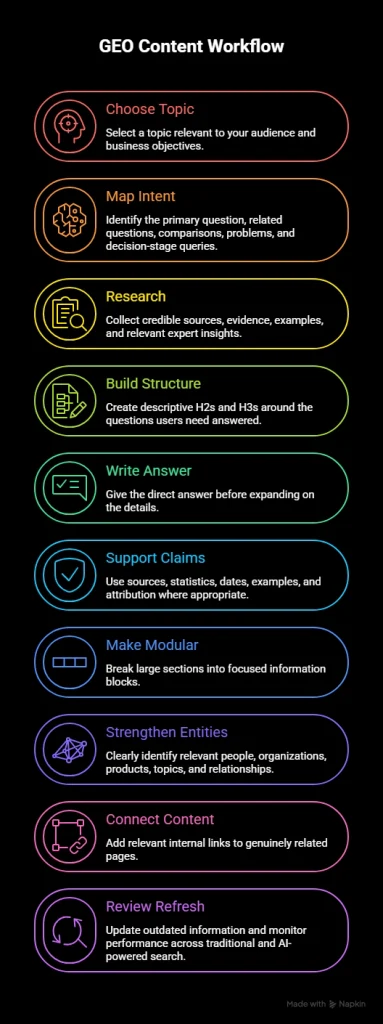
A Simple GEO Content Workflow
You don’t need a complicated process.
How to Measure GEO Content Performance
Traditional SEO metrics still matter, but AI-powered search introduces additional visibility signals.
Depending on the platforms and tools available, monitor:
- AI citation rate — how often your content is cited.
- Brand mentions — whether your brand appears in AI-generated responses.
- Share of voice — how frequently your brand appears compared with competitors.
- AI referral traffic — visits attributed to AI platforms.
- Prompt visibility — whether your brand appears for important queries.
- Citation context — whether your content is cited for relevant claims and topics.
These metrics can help identify patterns in AI-search visibility.
Don’t obsess over a single metric.
Look for relationships between visibility, mentions, referral traffic, engagement, leads, and conversions.
Common GEO Content Mistakes
Writing for AI Instead of Users
Don’t insert awkward phrases because you believe an AI system will prefer them.
Write naturally for people.
Keyword Stuffing
GEO isn’t keyword stuffing with a new name.
Use natural language and cover the topic comprehensively.
Making Unsupported Claims
Broad statements without evidence are difficult for readers to evaluate.
Be specific and provide sources when evidence is available.
Creating Walls of Text
More words don’t automatically mean more authority.
Structure and usefulness matter more than unnecessary length.
Ignoring Technical SEO
Content still needs to be accessible to search engines and other systems that retrieve web information.
Treating Schema as a Shortcut
Structured data can provide machine-readable context, but it doesn’t guarantee AI citations.
Publishing and Forgetting
Outdated information can reduce the usefulness and credibility of an article.
GEO Content Checklist
Before publishing, review the page across four areas.
Content
- Is the topic clearly defined?
- Does the article satisfy the primary search intent?
- Are important questions answered directly?
- Are important claims specific and verifiable?
- Are credible sources included?
- Does the article provide genuine expertise or useful insight?
Structure
- Are headings descriptive?
- Does each section focus on one idea?
- Are important answers placed early?
- Are lists, tables, or examples used where appropriate?
- Can important information be understood without unnecessary context?
Authority
- Is the author clearly identified?
- Is relevant experience demonstrated?
- Are important claims appropriately sourced?
- Does the website have genuinely related supporting content?
- Are internal links useful rather than excessive?
Technical & Freshness
- Is important content crawlable?
- Is critical information available in HTML?
- Is semantic structure used appropriately?
- Are related pages internally linked?
- Is relevant structured data implemented?
- Are statistics and examples current?
- Are outdated claims removed or updated?
You’re right. Repeating the full CITABLE framework in the conclusion adds little value because the reader has already seen it. The conclusion should synthesize the main lesson and give a practical next step, not recap the entire article.
Conclusion
A strong GEO content strategy isn’t about writing specifically for AI. It’s about creating clear, useful, well-structured, and trustworthy content that serves people first and can also be effectively interpreted in AI-powered search experiences.
Focus on answering real questions, supporting important claims with evidence, organizing information clearly, demonstrating genuine expertise, and keeping content accurate and accessible.
Don’t chase a formula for guaranteed AI citations. There isn’t one. AI visibility depends on many factors beyond how a single page is formatted.
Instead, improve the quality of the information you already publish. Make it easier to understand, easier to evaluate, and more useful to your audience.
The goal of GEO isn’t to create more content. It’s to create better content that deserves to be found, referenced, and trusted—wherever people search.
