Search engine optimization has changed significantly over the last decade. In the early days of SEO, achieving higher rankings often meant repeating a target keyword throughout a webpage. While keywords remain an important part of SEO, modern search engines have become much better at understanding the meaning behind a search query rather than matching exact words.
Today, Google uses artificial intelligence, natural language processing (NLP), entity recognition, and semantic understanding to determine whether a page satisfies a user’s search intent. Instead of asking, “Does this page contain the keyword?” search engines now ask, “Does this page answer the user’s question accurately and comprehensively?”
This evolution has given rise to Semantic SEO, an approach that focuses on topics, entities, context, and relationships rather than isolated keywords. By creating semantically rich content, website owners can help search engines understand the meaning of their pages, strengthen topical authority, and improve visibility in both traditional search results and AI-powered search experiences.
What Is Semantic SEO?
Semantic SEO is the process of optimizing content around topics, entities, context, and user intent rather than relying only on individual keywords. Its goal is to help search engines understand what a page is about and how it relates to other concepts within the same subject area.
Instead of creating separate pages for every keyword variation, Semantic SEO encourages building comprehensive resources that answer related questions, explain connected concepts, and cover a topic in depth.
For instance, a traditional keyword-focused article might target only the phrase:
“Semantic SEO”
A semantically optimized article naturally includes related concepts such as:
- Search Intent
- Entities
- Knowledge Graph
- Topic Clusters
- Structured Data
- NLP
- Contextual Relevance
- Internal Linking
- AI Search
- E-E-A-T
Because these concepts are closely connected, search engines gain a clearer understanding of the topic and its scope.
Definition of Semantic SEO
Semantic SEO is an SEO strategy that improves search visibility by organizing content around meaning, relationships, and user intent instead of relying solely on exact-match keywords.
It combines several principles, including:
- Topic optimization
- Entity-based SEO
- Search intent alignment
- Contextual relevance
- Comprehensive topic coverage
- Internal linking
- Structured data
- Topical authority
Rather than treating each keyword as an independent opportunity, Semantic SEO treats related keywords as part of a broader subject.
For example, an article about Technical SEO naturally connects to:
- Crawling
- Indexing
- Rendering
- XML Sitemaps
- Robots.txt
- Canonical Tags
- Core Web Vitals
- Structured Data
Covering these related concepts creates a richer semantic context for both users and search engines.
How Semantic SEO Differs from Traditional Keyword SEO
Traditional SEO and Semantic SEO share the same goal of helping users find relevant content but they approach optimization differently.
| Traditional Keyword SEO | Semantic SEO |
| Focuses on exact keywords | Focuses on topics and meaning |
| Individual keyword targeting | Entity and topic optimization |
| Keyword density | Contextual relevance |
| Separate pages for keyword variations | Comprehensive topic coverage |
| Limited internal relationships | Strong topical clusters |
| Exact-match optimization | Search intent optimization |
| Ranking individual pages | Building topical authority |
Example
Suppose you want to rank for “Search Intent.”
A traditional approach might create separate pages for:
- Search Intent SEO
- What is Search Intent
- Search Intent Types
- Search Intent Examples
A semantic approach would create one comprehensive guide that explains:
- Definition of search intent
- Different intent types
- User behavior
- Keyword mapping
- Content optimization
- Practical examples
- Related concepts
- Internal links to supporting resources
This approach improves user experience while strengthening semantic relevance.
Why Search Engines Focus on Meaning Over Keywords
Modern search engines aim to understand what users mean, not just what they type.
Consider the following searches:
- Best laptop for students
- Good laptop for college
- Affordable notebook for university
Although the wording differs, the user’s underlying need is similar.
A keyword-based system might treat these as separate searches.
A semantic search system understands that all three queries relate to choosing a laptop for education.
This ability allows search engines to deliver more relevant results without depending on exact keyword matches.
Meaning-based search benefits users because it:
- Understands natural language
- Recognizes synonyms
- Identifies related concepts
- Connects entities
- Interprets conversational queries
- Supports voice search
- Improves AI-generated answers
As search technology advances, optimizing for meaning becomes increasingly important.
Importance of Context in Modern Search
Context helps search engines interpret the purpose behind a query.
For instance, the word:
“Apple”
could refer to:
- Apple Inc.
- The fruit
- Apple devices
- Apple software
Search engines determine the intended meaning by analyzing contextual clues within the query and surrounding content.
Similarly, the phrase:
“Java”
could refer to:
- Programming language
- Indonesian island
- Coffee
Semantic SEO helps clarify context by surrounding primary topics with related entities and supporting concepts.
The stronger the contextual signals, the easier it becomes for search engines to understand your content accurately.
Defining Context
Semantic SEO is built on the principle that search engines understand relationships between concepts rather than isolated keywords.
This understanding depends on five key elements:
- Topic optimization
- Meaning over keywords
- Entity relationships
- Search intent relevance
- Contextual relevance
Together, these components create a stronger semantic foundation for your content.
Optimizing for Topics Instead of Individual Keywords
One of the biggest shifts in modern SEO is moving from keyword optimization to topic optimization.
Instead of creating multiple pages targeting slight keyword variations, organize content around a central topic.
Example:
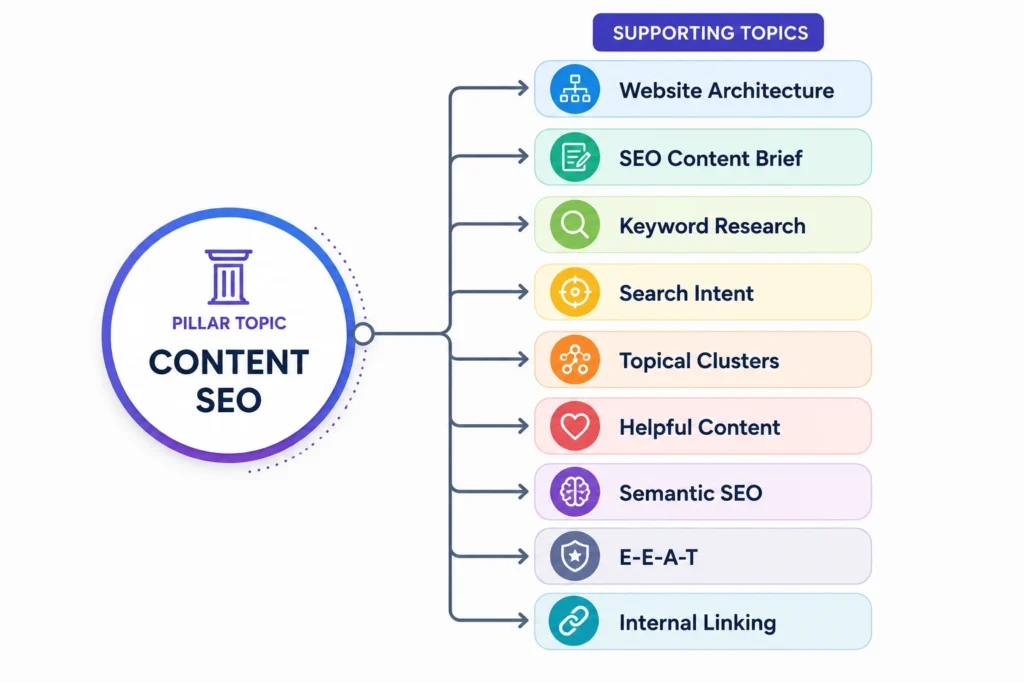
Each supporting article explores one aspect in depth while linking back to the pillar page and related cluster pages.
This structure helps search engines understand both the individual pages and the broader subject.
Meaning Over Keywords
Semantic SEO encourages writers to think about meaning first and keywords second.
Rather than repeating the same keyword unnaturally, use language that reflects how people actually discuss the topic.
For instance, an article about Semantic SEO may naturally include phrases such as:
- Entity optimization
- Semantic search
- Topic relevance
- Search intent
- Knowledge Graph
- Contextual signals
- AI search
- Content relationships
These related terms provide richer context without relying on keyword repetition.
This approach improves readability while helping search engines understand the subject more accurately.
Entity Relationships
Entities are one of the foundations of Semantic SEO.
Instead of identifying only keywords, search engines identify real-world concepts and understand how they connect.
What Are Entities?
An entity is a uniquely identifiable concept, person, place, organization, product, event, or idea.
For instance
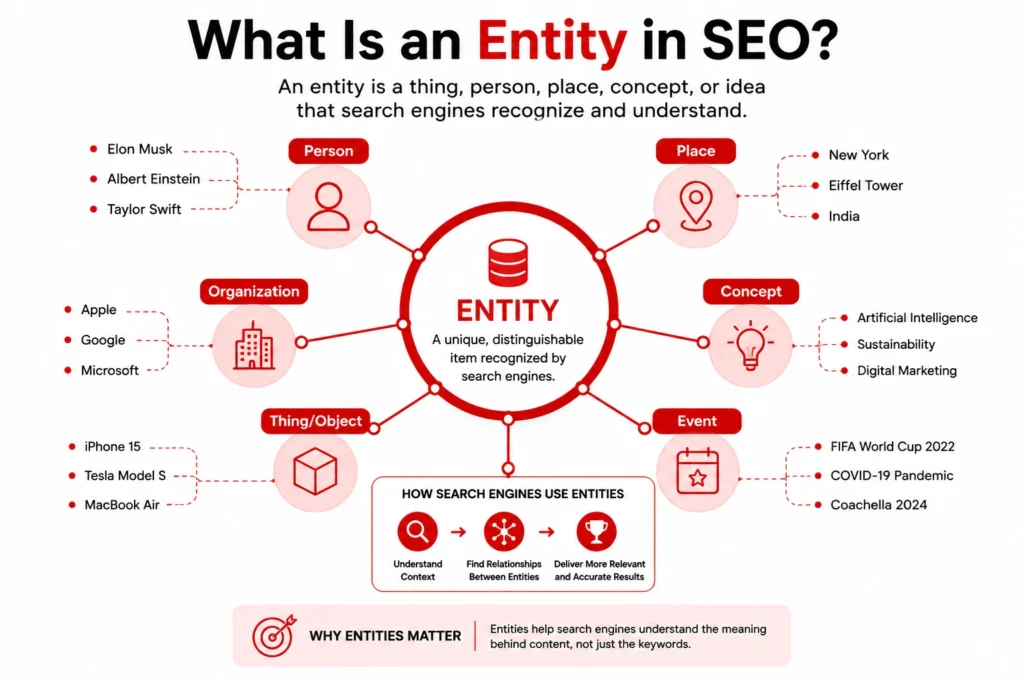
Unlike keywords, entities have clear identities that remain consistent regardless of wording.
For example:
Google understands that:
- NYC
- New York City
- New York
refer to the same entity.
Similarly,
- Artificial Intelligence
- AI
represent the same concept.
Entity recognition helps search engines interpret language more accurately.
How Search Engines Connect Entities
Search engines don’t simply recognize entities—they map relationships between them.
For example: will add image
Content SEO
│
├── Keyword Research
├── Search Intent
├── Helpful Content
├── Semantic SEO
├── Website Architecture
├── E-E-A-T
└── Internal Linking
Each entity strengthens the overall understanding of the topic.
When your website consistently covers these relationships, search engines gain greater confidence in your expertise.
Search Intent Relevance
Search intent generally falls into four categories.
Semantic SEO begins with understanding why someone performs a search.
Different users may use similar keywords while expecting different types of answers.
Matching search intent helps ensure your content satisfies user expectations.
Informational Intent
Users want to learn something.
Examples:
- What is Semantic SEO?
- How does Google understand entities?
- What is structured data?
The best format is an educational guide or tutorial.
Navigational Intent
Users want to reach a specific website or page.
Examples:
- Google Search Console
- Schema.org
- Ahrefs blog
Content should make it easy for users to find the destination they expect.
Commercial Intent
Users are researching before making a decision.
Examples:
- Best SEO tools
- Semrush vs Ahrefs
- Best schema generator
Content should provide balanced comparisons, feature explanations, and decision-making guidance.
Transactional Intent
Users are ready to take action.
Examples:
- Buy SEO software
- Book SEO consultation
- Download SEO template
Landing pages and service pages work best for this intent.
Matching content format to search intent improves both user satisfaction and SEO performance.
Contextual Relevance
Semantic SEO depends on more than keywords and entities. It also requires contextual relevance.
Context helps search engines understand how ideas fit together within a page.
Three factors contribute significantly to contextual relevance:
- Semantic context
- Related concepts
- User expectations
Semantic Context
Semantic context refers to the surrounding information that explains a topic.
For instance, an article about Schema Markup naturally includes concepts such as:
- Structured Data
- JSON-LD
- Rich Results
- Google Search
- Technical SEO
- HTML
These related concepts reinforce the page’s primary topic.
Related Concepts
Every major SEO topic connects to several supporting ideas.
For Semantic SEO, related concepts include:
- Search Intent
- Entities
- Knowledge Graph
- NLP
- Topic Clusters
- Structured Data
- Internal Linking
- E-E-A-T
- AI Search
- Helpful Content
Including these naturally creates stronger semantic signals and helps readers understand the broader subject.
User Expectations
Ultimately, Semantic SEO succeeds when content fulfills the expectations behind a search.
Someone searching for “Semantic SEO” expects more than a simple definition. They are likely looking for:
- How Semantic SEO works
- Why it matters
- The role of entities and search intent
- Practical implementation steps
- Technical considerations
- AI search implications
- Common mistakes
- Best practices
When content anticipates these needs and answers them clearly, it creates a satisfying experience for readers while providing search engines with stronger evidence of topical relevance.
Conclusion
Semantic SEO has moved content optimization beyond simple keyword placement. It focuses on meaning, entities, search intent, context, and relationships between related concepts to help search engines understand content more accurately.
Creating semantically relevant content means covering a topic naturally, addressing the user’s actual needs, and connecting related concepts through a clear content structure. Search intent, entity relationships, contextual relevance, and comprehensive topic coverage all contribute to this approach.
The key is to think beyond individual keywords. Build content around topics and their relationships, satisfy the searcher’s intent, and connect relevant pages through a strong internal linking structure.
When these elements work together, your content becomes easier for both users and search engines to understand, creating a stronger foundation for topical relevance and search visibility.
