Modern SEO brings together four areas that once worked separately: technical performance, entity-driven content, AI-search visibility, and measurable business results. Search engines now look beyond individual keywords and backlinks. They analyze entities, relationships, context, and trust to decide which information deserves visibility and citation.
This guide covers five pillars: technical SEO, entity-based content, AI and answer-engine optimization, authority and trust signals, and SEO operations. It also introduces two useful frameworks: EAV (Entity-Attribute-Value) for structuring information, and E-E-A-T for evaluating content quality and trust.
What Modern SEO Means Right Now
How Modern SEO Differs from Traditional SEO
Think about introducing a person. You don’t just give their name. You explain who they are, what they do, and how they are connected to others. Search engines work in a similar way. This is especially important as search engines and AI assistants can now answer questions directly.
| Traditional SEO | Modern SEO |
| Targets keywords. | Understands entities and context. |
| Matches search phrases. | Connects information and relationships. |
| Relies heavily on backlinks. | Builds authority and trust. |
| Optimizes individual pages. | Builds broader topical relevance. |
| Focuses mainly on rankings. | Supports search visibility and AI citations. |
| Example: Targeting “digital marketing agency.” | Example: Connecting an agency with its services, location, expertise, team, and brand. |
Simple Takeaway
Traditional SEO focused on matching words. Modern SEO focuses on helping search systems understand information and its connections.
Keywords and backlinks still matter. They are simply parts of a larger SEO system.
The Five Pillars of a Modern SEO Strategy
Modern SEO strategy rests on five pillars, and a page that skips any one of them leaves visibility on the table:
- Technical SEO — the infrastructure that lets search engines crawl, render, and index your site.
- Entity-based content — the substance that tells search engines and AI models what your page is actually about.
- AI and answer-engine optimization (AEO/GEO) — the structure that earns citations inside AI Overviews and chat-based answers.
- Authority and trust signals — the external and local proof that your site deserves to rank.
- SEO operations — the system that turns SEO from a one-time project into a compounding growth engine.
The next five sections walk through each pillar in order.
Build Your Technical SEO Foundation
Search engines cannot reward a page they cannot crawl, render, or measure. Technical SEO removes the friction between your content and the search engine that is trying to read it.
Optimize for Mobile-First Indexing
Google indexes the mobile version of your site by default, not the desktop version. Build your site with responsive design so every layout, image, and interactive element works identically on a phone screen. Test your most important pages on an actual mobile device, not just a browser’s simulator — mobile-first indexing rewards sites that treat mobile as the primary experience, not a fallback.
Improve Core Web Vitals and Site Speed
Core Web Vitals measure how a real user experiences your page: Largest Contentful Paint (LCP) measures loading speed, Interaction to Next Paint (INP) measures responsiveness, and Cumulative Layout Shift (CLS) measures visual stability. Compress images, defer non-critical scripts, and simplify your critical rendering path so the browser can paint content faster.“A faster page improves user experience, reduces friction, and can support better SEO performance.”
Implement Schema Markup for Structured Data
Add schema.org markup in JSON-LD format to every important page. Structured data tells search engines explicitly what a page contains — a product, a recipe, an article, a local business — instead of forcing them to infer it from unstructured text. Well-implemented schema earns rich snippets in search results and gives AI systems a clean, machine-readable summary of your page’s semantic relationships.
Create an Entity-Based Content Engine
This is where most modern SEO advice stays shallow. Real entity-based SEO means applying a specific model to every important page you write.
Apply the EAV Model to Map Entities, Attributes, and Values
The EAV model — Entity, Attribute, Value — gives you a repeatable way to plan content around what search engines actually store in a knowledge graph, rather than around a keyword list.
- Entity: the real-world thing your content is about.
- Attribute: a defining characteristic of that entity.
- Value: the specific answer to that attribute.
A worked example: if “Core Web Vitals” is your entity, its attributes and values look like this — Defined by: Google. Measures: loading, interactivity, visual stability. Metrics: LCP, INP, CLS. Write each attribute-value pair into your content explicitly, in plain sentences, instead of hoping the reader infers the relationship. Search engines extract entities and their attributes the same way a reader does — from clear, factual statements, not from vague description.
Map your primary entity in the title, the first paragraph, and every H2. Map supporting entities in the H3s beneath them. This single habit does more for topical relevance than any amount of keyword repetition.
Build Topical Authority with a Pillar-Cluster Model
Topical authority measures how completely your site covers a subject, not how well a single page ranks. Structure your content as a pillar page — a broad overview like this one — surrounded by cluster pages that go deep on each subtopic: one article on Core Web Vitals, one on schema markup, one on E-E-A-T. Link every cluster page back to the pillar, and link the pillar out to every cluster. That internal link structure tells search engines your site has genuine depth on the topic, not just one lucky page.
Demonstrate E-E-A-T Through Experience and Expert Review
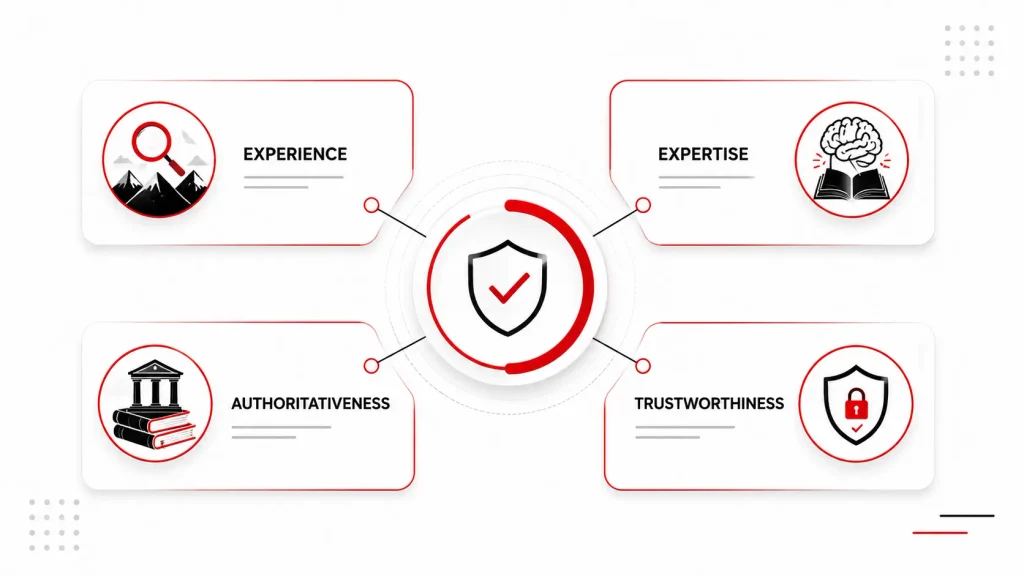
E-E-A-T stands for Experience, Expertise, Authoritativeness, and Trustworthiness — the framework Google’s Search Quality Rater Guidelines use to judge content quality, especially on topics that affect a reader’s health, finances, or safety.
Apply the E-E-A-T formula to every page you publish:
- Experience: show that you have actually done the thing you are writing about — a screenshot, a result, a first-hand detail a generic writer could not fake.
- Expertise: credit the content to a named author with real, checkable credentials in the subject.
- Authoritativeness: cite recognized sources, such as Google Search Central, and earn citations or links from others in the field.
- Trustworthiness: keep information accurate and current, disclose your sources, and make your site secure and transparent about who runs it.
Weak E-E-A-T signals are the most common reason technically sound, keyword-optimized content still fails to rank.
Optimize for AI and Answer Engines
Search behavior has split. Some users still click through a list of ten blue links. A growing share now get their answer directly from an AI Overview, a featured snippet, or a chat assistant. Optimizing for that second group requires a different discipline: Answer Engine Optimization (AEO) and Generative Engine Optimization (GEO).
Structure Content for AI Overviews and Featured Snippets
Answer the core question in the first one to two sentences after the heading that asks it, before you add nuance or caveats. Search engines and AI systems pull featured snippets and AI Overview content from passages that state a clear answer immediately, in a self-contained sentence that does not depend on the paragraph before it.
Write Citation-Ready, Fact-Bundled Content for LLMs
AI systems generate answers by pulling verifiable facts from multiple sources and assembling them into a response — a process sometimes called factual bundling. Give the AI clean facts to bundle: state numbers, definitions, and steps explicitly, attribute claims to a specific source, and avoid burying the fact inside a long narrative sentence. Content that reads like a reference entry gets cited more often than content that reads like a story.
Capture Zero-Click Visibility Without Losing Traffic
A zero-click search resolves entirely within the search results page — the user never visits your site. You cannot stop zero-click behavior, but you can benefit from it: being the cited source inside an AI Overview builds brand recognition and trust even without a click, and it often produces higher-intent clicks later, from users who already trust your answer. Track brand-search volume and direct traffic alongside organic clicks so you can see this effect instead of missing it.
Strengthen Authority and Trust Signals
Technical health and strong content earn eligibility to rank. Authority signals earn the actual ranking.
Earn Backlinks and Brand Mentions from Credible Sources
A trusted backlink comes from a site with real editorial standards, topical relevance to your subject, and its own established authority. Earn these links through original research, expert commentary, and content genuinely worth referencing, not through link exchanges. Track unlinked brand mentions too — a mention without a link still signals authority to search engines that read the broader web, and it is often an easy follow-up ask for a link.
Maintain NAP Consistency and a Complete Google Business Profile
If your business serves a physical area, keep your Name, Address, and Phone number (NAP) identical across your website, directories, and social profiles. Search engines cross-reference NAP data to confirm your business is a real, stable entity. Complete every field in your Google Business Profile — categories, hours, photos, services — since Google treats the profile itself as a verified entity that reinforces your website’s authority.
Use Internal Links to Distribute Link Equity
Internal links pass authority from your strongest pages to newer or weaker ones. Link from high-traffic pillar pages down into relevant cluster content, and use descriptive anchor text that matches the entity you are linking to, rather than generic phrases like “click here.”
Run SEO as a System, Not a One-Time Project
The teams that get the most out of SEO treat it as an ongoing system with a repeatable cadence, not a project with an end date.
Apply the SEO Flywheel Model for Compounding Growth
The SEO flywheel model treats organic growth as self-reinforcing: better content earns more visibility, more visibility earns more links and brand searches, and those signals make the next piece of content easier to rank. Each pillar you build strengthens the ones that follow it, which is why the technical, content, and authority pillars above compound instead of operating in isolation.
Follow a Step-by-Step Framework to Scale
Run SEO in a repeatable cycle: audit your current performance, research keywords and entities across every platform your audience actually uses, analyze competitor gaps, define your content pillars, plan your technical foundation, allocate resources by impact and effort, and work in focused 90-day sprints so you can measure and adjust every quarter instead of waiting a full year to find out what worked.
Align Cross-Functional Teams Around SEO Goals
SEO touches development, design, and content, so treat SEO coordination as a project-management discipline, not a solo task. Set shared goals with developers before a redesign ships, brief writers on entity and E-E-A-T requirements before they draft, and give every stakeholder visibility into the same roadmap so nobody undoes another team’s work.
Measure Modern SEO by Business Impact
Track Qualified Leads and Revenue, Not Just Rankings
A ranking is a proxy metric — it matters only because it is supposed to lead to a qualified visitor. Track the metrics that actually reflect business impact: qualified leads, conversion rate from organic traffic, and revenue attributable to organic search. A page that ranks first for a broad term but converts poorly is worth less than a page that ranks fourth for a specific term and converts well.
Build Dashboards That Connect SEO to Business Outcomes
Build a dashboard that connects organic traffic directly to pipeline and revenue data, not just to Search Console impressions. Leading indicators — indexation rate, Core Web Vitals scores, entity coverage across your content — let you catch problems before they show up in a ranking drop weeks later.
The Bottom Line
Modern SEO is not a single tactic — it is five pillars working together: a technically sound site, entity-based content mapped with the EAV model, content structured for AI and answer engines, real authority and trust signals, and an operating system that turns all of it into a compounding flywheel instead of a one-time project. Apply the E-E-A-T formula to every page, track business impact instead of vanity rankings, and treat entities, not keywords, as the unit you optimize around. Do that consistently, across all five pillars, and you will be positioned to win visibility in classic search results and in the AI-generated answers that are quickly becoming the default way people search.
