Creating helpful content is not simply about producing longer articles or adding more keywords. Effective content starts with understanding what people need and providing information that genuinely solves their problems.
A helpful page should have a clear purpose, useful information, appropriate expertise, and a satisfying experience for the reader.
Google’s systems are designed to surface useful information in search results. This means content creators should focus on creating resources that are valuable even when search engines are not considered.
How to Create Helpful Content-Step by Step
Step 1: Understand Your Audience
Before writing, identify who the content is intended for.
Understand:
- Their problems
- Their questions
- Their knowledge level
- Their goals
- Their concerns
This gives the content a clear direction.
Step 2: Identify the Search Intent
Determine what the user expects from the search.
For example, someone searching:
What is topical authority?
probably needs an explanation.
Someone searching:
Best SEO tools for keyword research
may need comparisons and recommendations.
The format and depth should match the intent.
Step 3: Define the Content Goal
Decide what the page should accomplish.
It might aim to:
- Educate
- Explain
- Compare
- Guide
- Help users solve a problem
- Support a decision
A clear goal prevents unnecessary content.
Step 4: Research the Topic
Use reliable sources and relevant research to understand the subject.
Look for:
- Important concepts
- Common questions
- Industry information
- Existing knowledge gaps
- Practical examples
Research should improve the content rather than simply provide material to rewrite.
Step 5: Add Original Value
Ask:
What can this page provide that existing content does not?
Original value could include:
- First-hand experience
- Original examples
- Case studies
- Data
- Practical workflows
- Expert observations
- Clear explanations
This helps prevent generic content.
Step 6: Create a Logical Structure
Organize information according to the reader’s journey.
A simple structure might be:
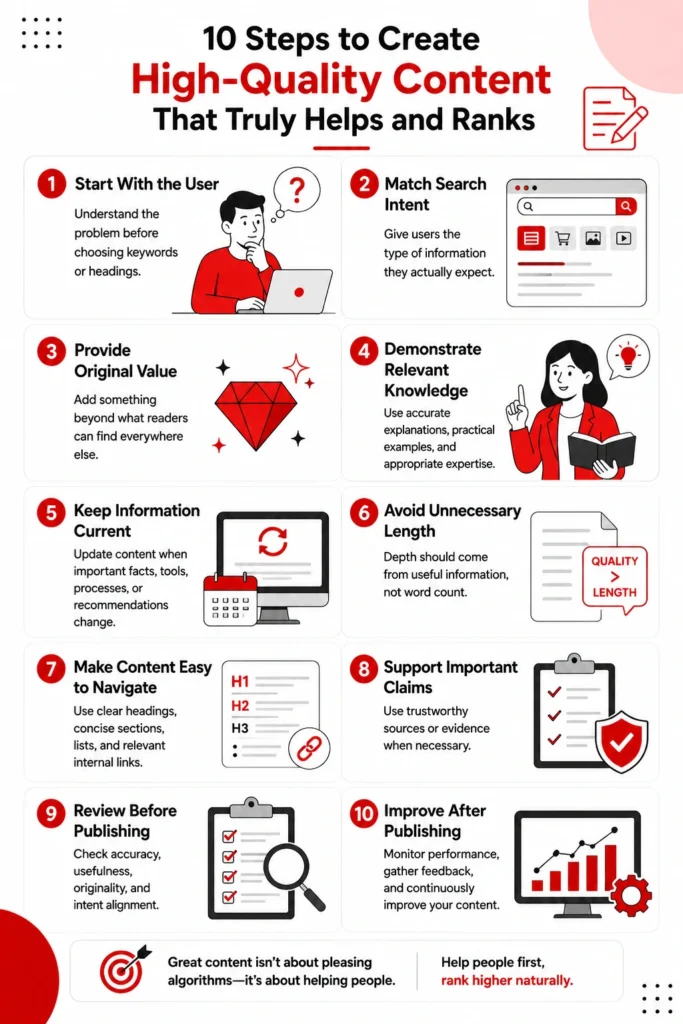
The structure should feel natural rather than being created solely to insert keywords.
Step 7: Write for People First
Use language your audience can understand.
Avoid unnecessary jargon.
Explain complex ideas clearly and provide practical information where appropriate.
The reader should not need to work hard to understand the answer.
Step 8: Add Supporting Evidence
Where claims require support, use reliable sources or relevant evidence.
This can include:
- Official documentation
- Research
- Industry data
- Original testing
- Expert sources
Evidence strengthens the usefulness and credibility of content.
Step 9: Review Before Publishing
Ask:
- Does the page answer the main question?
- Is the information accurate?
- Is anything unnecessary?
- Does it provide original value?
- Is the structure easy to follow?
- Does the page meet the user’s intent?
Only publish when the page genuinely helps the intended audience.
The Who, How, and Why Framework
Before publishing content, consider three fundamental questions:
Who created the content?
Readers should be able to understand who is responsible for the information.
Depending on the topic, this could be:
- An individual author
- A subject matter expert
- A company
- A professional team
- A reviewed or edited contributor
Clear authorship can improve transparency and help readers understand the source of the information.
How was the content created?
Consider how the information was researched, written, reviewed, or produced.
For instance, useful content may involve:
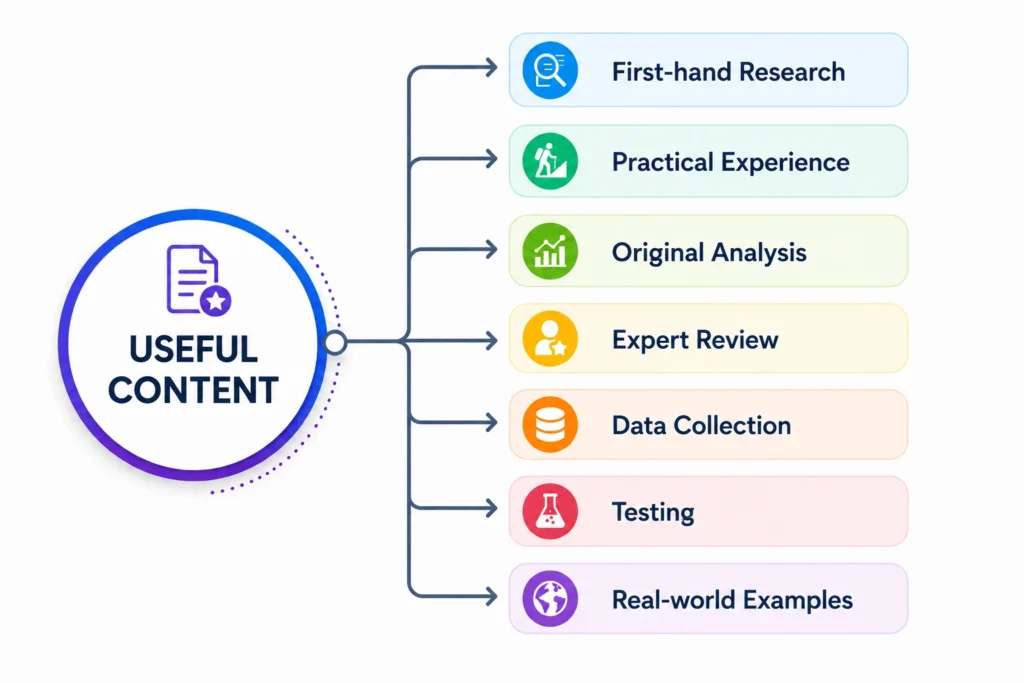
The goal is not to explain every step of content production. Instead, provide enough context when the creation process is important to understanding the content’s credibility.
Why was the content created?
This is perhaps the most important question.
Content should primarily exist to help people.
If the main reason for creating a page is to attract search traffic without providing meaningful value, the content may become search-engine-first rather than people-first.
A useful test is:
Would this content still be valuable if search engines did not send traffic to it?
If the answer is yes, the content is more likely to have a genuine user-focused purpose.
Page Experience Factors
Helpful information becomes less useful when the page is difficult to use.
Page experience refers to how easily visitors can access, read, navigate, and interact with content.
Important considerations include:
Mobile Usability
Your content should work effectively on mobile devices.
Readers should not need to zoom excessively, scroll horizontally, or struggle with small buttons.
Readability
Use:
- Short paragraphs
- Clear headings
- Descriptive subheadings
- Lists where appropriate
- Simple sentence structures
Good formatting makes information easier to understand.
Page Speed
Slow pages can create friction for users.
Optimize unnecessary scripts, large images, and other elements that negatively affect loading performance.
Intrusive Elements
Avoid excessive:
- Pop-ups
- Interstitials
- Advertisements
- Overlapping elements
These can interrupt the user’s ability to access the information they came to find.
Navigation
Readers should be able to move through your website naturally.
Relevant internal links can guide visitors toward supporting information without forcing them to search for it themselves.
How to Optimize Existing Content
Creating helpful content does not always mean publishing something new.
Your existing content may already have valuable information that can be improved.
A content audit can help identify pages that need attention.
1. Identify Underperforming Pages
Review pages with:
- Declining traffic
- Low engagement
- Outdated information
- Weak rankings
- Poor conversion performance
These pages may contain opportunities for improvement.
2. Check Search Intent
Ask whether the page actually satisfies what users are looking for.
If search intent has changed, the content may need restructuring.
3. Remove Unnecessary Content
Do not add information simply to increase word count.
Remove:
- Repetitive sections
- Generic introductions
- Unnecessary explanations
- Outdated examples
- Irrelevant tangents
Every section should contribute something useful.
4. Add Missing Information
Look for important questions that the current page does not answer.
Add information when it improves the reader’s understanding.
5. Improve Accuracy
Check:
- Statistics
- Facts
- Links
- Examples
- Recommendations
- References
Replace outdated information where necessary.
6. Improve Readability
Break large blocks of text into smaller sections.
Use headings and formatting to make important information easier to find.
Helpful Content and Google’s Ranking Systems
Helpful content should not be viewed as a single optimization technique.
Google uses automated ranking systems designed to surface relevant and useful information. These systems evaluate many signals when determining which pages should appear for a query.
This means there is no single formula that guarantees rankings.
Instead, content should focus on satisfying the user’s need behind the search.
Helpful content generally aims to:
- Answer the main question clearly
- Provide relevant information
- Demonstrate appropriate knowledge
- Avoid unnecessary repetition
- Offer original value
- Maintain accuracy
- Provide a good page experience
SEO still has an important role.
Search optimization can help search engines understand and discover your content. However, optimization should support the content rather than become its primary purpose.
Helpful Content Is Not About Avoiding SEO
People-first content and SEO are not opposites.
A strong page can:
- Target a relevant topic
- Use descriptive headings
- Include important terms naturally
- Use internal links
- Follow a logical structure
- Provide useful information
The difference is why and how these techniques are used.
SEO should help users find useful content.
It should not encourage creators to produce content that exists only to capture search traffic.
Common Helpful Content Mistakes
Even content created with good intentions can become less useful through poor execution.
Writing Mainly for Search Traffic
Creating pages solely because a keyword has search volume can produce content without genuine value.
Better approach: Start with the user’s problem and determine whether the topic deserves a dedicated page.
Obsessing Over Word Count
A longer article is not automatically more helpful.
A focused 1,500-word guide can be more useful than an unnecessary 4,000-word article.
Better approach: Write enough to satisfy the user’s need.
Rewriting Existing Content
Simply combining information from other websites rarely creates strong original value.
Better approach: Add your own analysis, examples, experience, or useful perspective.
Adding Unnecessary Sections
Extra sections can dilute the main topic.
Better approach: Keep every section relevant to the page’s purpose.
Using AI Without Meaningful Review
AI tools can assist with research, organization, and drafting, but unreviewed output may contain:
- Generic explanations
- Inaccuracies
- Repetition
- Missing context
- Unsupported claims
Better approach: Review, verify, edit, and add genuine human value.
Ignoring Existing Content
Publishing new content while older pages remain outdated can create an inconsistent content library.
Better approach: Regularly review and improve existing pages.
Best Practices for Helpful Content
Follow these principles when creating people-first content.
Use performance data and user feedback to identify opportunities for improvement.
Helpful Content and AI Search
Search is changing as AI-powered experiences become more common.
Users may increasingly receive summarized answers instead of visiting multiple traditional search results.
This makes useful, trustworthy, well-structured information increasingly important.
Content that provides clear explanations, original insights, practical examples, and credible information can give search systems stronger context to understand the subject.
However, creating content specifically to appear in AI-generated answers should not replace the people-first approach.
The fundamental principle remains the same:
Create content because it helps people, not simply because an AI system might reference it.
How to Prepare Content for AI-Driven Search
Focus on:
- Clear answers
- Well-organized information
- Accurate facts
- Original insights
- Strong topical relevance
- Useful examples
- Clear authorship
- Trustworthy sources
These practices improve the usefulness of content regardless of how users discover it.
AI search should therefore be viewed as another reason to prioritize quality, clarity, originality, and trust rather than another reason to create content solely for algorithms.
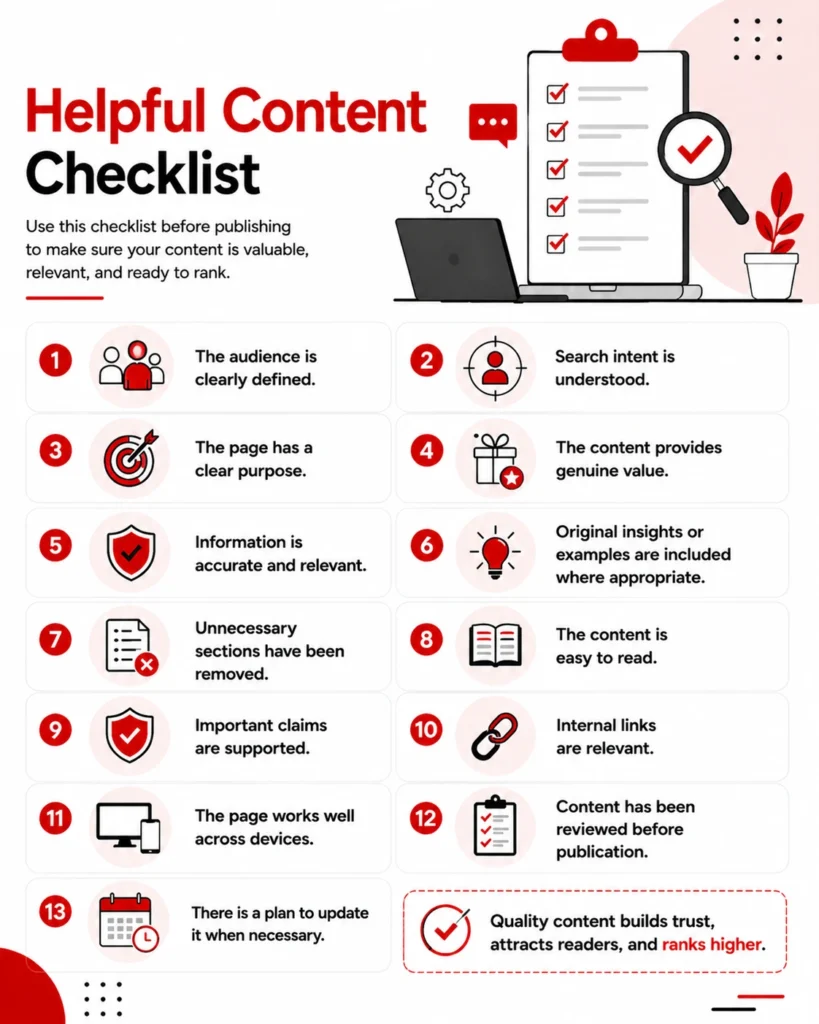
Helpful Content Checklist
Before publishing, use this quick checklist:
Conclusion
Helpful content is ultimately about serving the reader before serving the search engine. A successful page should understand the user’s needs, satisfy search intent, provide accurate information, and offer genuine value rather than simply targeting keywords or increasing word count.
The Who, How, and Why framework provides a useful starting point. Combine it with strong content planning, clear structure, relevant evidence, good page experience, and regular content improvement to create resources that remain useful over time.
SEO still matters, but it should support the content rather than control it. When search optimization and people-first principles work together, your content can become easier to discover without sacrificing quality.
The goal is simple: create something worth finding, worth reading, and worth trusting.
