Have you searched something on Google today? A recipe, a doctor near you, a shop for shoes? Chances are, you clicked one of the first few results. Some of those results are marked “Sponsored” or “Ad.” Have you ever wondered how they got there?
That is Search Engine Marketing, or SEM. This guide explains it from zero, in plain language, with no jargon left unexplained. By the end, you will understand exactly what SEM is, how it works, and how anyone can use it — even with no marketing background.
What Is SEM,
Search Engine Marketing (SEM) is a way of paying Google to show your website at the top of the search results. You choose a few words related to your business, called keywords. When someone searches those words, your ad can appear right at the top, above the normal results.
In simple words: Imagine a busy market street. Every shop pays rent based on its spot. SEM is like paying a little extra to place your shop’s signboard right at the entrance, where everyone walks in. You only pay when someone actually stops and walks into your shop.
That last part is important. With SEM, you do not pay just for showing your ad. You pay only when someone clicks it. This is called Pay-Per-Click, or PPC.
How Does SEM Actually Work?
Every time someone types a search into Google, a very fast, invisible auction happens behind the scenes. Every business that wants to show an ad for that search competes in this auction. It all happens in a fraction of a second, before the search results even load.
Two things decide who wins a spot in the ad auction:
• How much you are willing to pay — called your bid. This is the highest amount you agree to pay for one click.
• How good and relevant your ad is — called your Quality Score. Google checks if your ad and your website truly match what the person is searching for.
This means a small business with a well-written, relevant ad can beat a bigger business that bids more money but writes a poor ad. Google rewards ads that are genuinely useful to the searcher, not just the highest bidder.
The Different Types of SEM Ads
SEM is not just one type of ad. Here are the common types you will come across:
• Search ads — Simple text ads that appear above the normal search results. This is the most common type.
• Shopping ads — These show a photo of a product along with its price and shop name, usually when you search for something you want to buy.
• Display remarketing — Banner ads that follow you aroun d different websites after you visit a page. If you have ever visited a website and then seen its ad on a completely different site later, that is remarketing.
SEM vs. SEO — What Is the Difference?
Beginners often mix up SEM and SEO. They sound similar but work very differently. Here is a simple comparison:
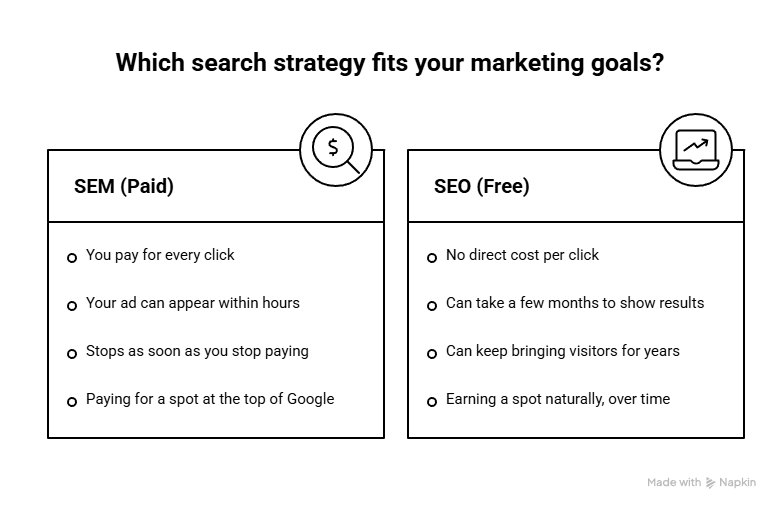
Neither one is “better” than the other they simply solve different problems. If you need visitors right now, SEM is the faster option. If you are willing to wait and build something long-term, SEO is worth the effort. Many businesses eventually use both together.
The Basic Parts of an SEM Ad Campaign
An SEM “campaign” simply means a set of ads you run together for a goal, like promoting one product or one offer. Every campaign is built from a few simple parts. As a beginner, these are the only five things you need to understand first.
1. Keywords
These are the exact words or phrases people type into Google. Choosing the right keywords is the foundation of SEM. If you sell handmade soap, your keywords might include “handmade soap online” or “natural soap for skin.”
2. The Ad Itself
This is the short text a person sees and reads before clicking. A good ad clearly says what you offer and why someone should click it, in just a line or two.
3. The Landing Page
This is the page someone lands on after clicking your ad. It should match what your ad promised. If your ad talks about a discount, the landing page should show that discount clearly, not a random homepage.
4. Your Budget
This is simply how much money you are willing to spend. You can set a small daily limit, so you never spend more than you plan to.
5. Your Target Audience
This means choosing exactly who should see your ad for example, people in a certain city, or people using a mobile phone. This way, your ad reaches the right people, not everyone.
How to Run Your First SEM Campaign, Step by Step
In simple terms, running an SEM campaign means setting a clear goal, picking the right keywords, writing your ad, and then watching and improving it over time. Here is the process broken down for a complete beginner:
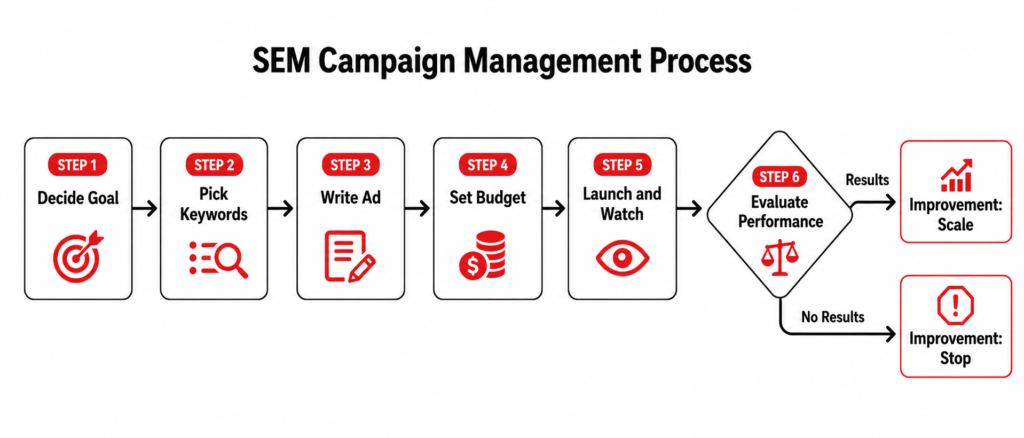
1. Decide your goal first. Do you want more phone calls, more website visits, or more sales? Knowing this helps you measure success later.
2. Pick a small list of keywords. Start with 5–10 keywords that closely match what you offer, instead of trying to cover everything at once.
3. Write a simple, honest ad. Say clearly what you offer and why someone should choose you.
4. Set a small daily budget. You can always increase it later once you see what works.
5. Launch, then watch closely. Check how your ad is performing every day for the first week.
6. Learn and improve. Turn off what is not working, and spend more on what brings results.
Important Search Engine Marketing Terms
SEM comes with its own set of short forms and terms. Here is what the common ones actually mean, in plain language:
• Click-through rate (CTR) — Out of everyone who saw your ad, how many people actually clicked it.
• Cost per click (CPC) — How much you pay, on average, for one click on your ad.
• Quality Score — Google’s way of rating how relevant and useful your ad is.
• Conversion — When someone does what you wanted after clicking — like calling you, filling a form, or buying something.
• Return on ad spend (ROAS) — For every rupee you spend on ads, how many rupees you earn back.
You do not need to memorise all of these right away. As you run your first campaign, these terms will start to make natural sense.
How AI Is Transforming Search Engine Marketing
SEM is becoming easier for beginners, thanks to AI. A few changes worth knowing about:
• Smart, automatic bidding — Google’s own AI can now decide how much to bid for you, based on the goal you set.
• Voice search — More people are speaking to their phones to search, instead of typing.
• Automatic ad writing — Tools can now suggest or even write ad text for you, so you do not have to start from a blank page.
These tools do not remove the need to learn the basics they simply make the starting point easier for someone new.
Conclusion
Search Engine Marketing may look complicated from the outside, but at its core, it is a simple idea: pay to show your ad to people who are already searching for what you offer, and pay only when they actually click.
You now know how the ad auction works, what separates SEM from SEO, the five building blocks of a campaign, and the common terms you will come across along the way. That is more than enough to make sense of SEM the next time you see an ad on Google, or decide to try running one yourself.
Like any new skill, SEM makes the most sense once you see it in action. Start small, watch closely, and learn from what the results tell you that is how every experienced SEM marketer got started too.

