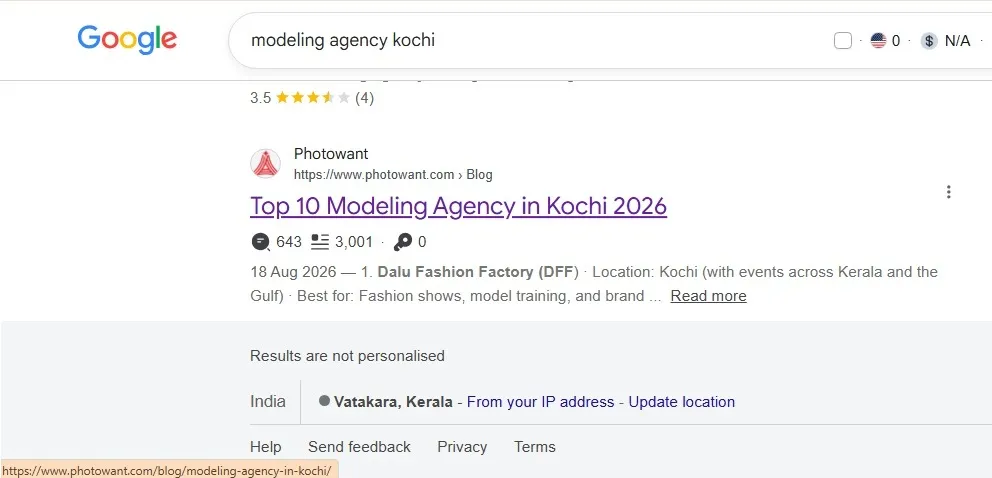
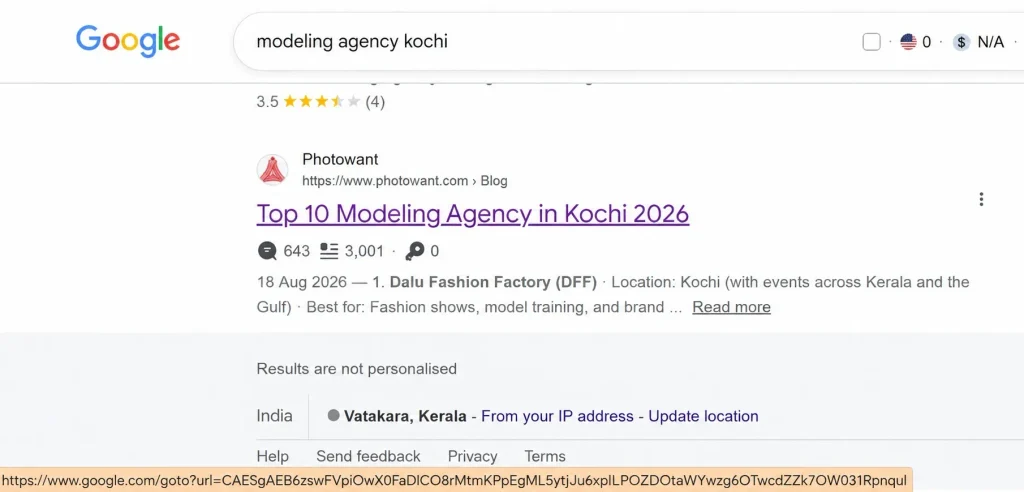
Google has started rolling out a new google.com/goto redirect for links in Search results. Instead of sending the browser directly to the destination URL, Google can now route the click through its own /goto endpoint before redirecting the user to the selected webpage.
For most searchers, the experience remains almost identical. The bigger change is technical, particularly for systems that collect, parse, monitor, or retrieve Google Search results at scale.
What Is Google’s goto Redirect
Previously, an organic Search result could effectively follow this path:
Google Search ↓ Destination URL ↓ Website
With the new implementation, the flow becomes:
Google Search ↓ google.com/goto ↓ Destination URL ↓ Website
The goto URL contains an encoded identifier for the destination. Google processes the request on its server and then redirects the browser to the actual webpage.
This means the destination URL is no longer exposed directly through the Search-result link in the same way. The change is therefore less about the webpage being visited and more about the transport layer between Google Search and the destination.
When Did Google Start Testing goto URLs
The behaviour was first reported during testing in June 2026, before Google publicly confirmed the rollout on August 26. Search Engine Roundtable reported that Google had been testing the passthrough URLs and that they were becoming increasingly visible across Search results.
By August 26, the change had moved beyond an isolated test. Google confirmed that it was rolling out the mechanism, describing it as part of its broader technical measures against evolving forms of abuse.
The rollout appears to have become widespread quickly. Nozzle reported seeing the goto behaviour at nearly 100% across several residential IP providers. That figure represents the infrastructure tested by Nozzle, however, and should not be interpreted as proof that Google has completed a worldwide rollout.
Why Is Google Using goto Redirects
Google’s official explanation is broad. The company says it regularly deploys technical measures to protect its services and users from evolving forms of abuse.
The technical consequence is more specific. A system that previously read the destination URL directly from Google’s Search results may now need to request the Google URL and follow the redirect to determine the actual destination.
That adds another step to automated SERP extraction. At small scale, following a redirect is trivial. At large scale, systems processing thousands or millions of Search results have additional HTTP requests and processing to handle.
Industry reporting therefore connects the change with Google’s broader efforts to make automated scraping and large-scale Search-result extraction more difficult. This includes SERP scrapers, rank trackers, Search APIs, competitive research systems, and potentially AI systems that retrieve Google Search results.
It is important to separate this industry interpretation from Google’s confirmed statement. Google has not said that goto was specifically introduced to block AI companies or rank-tracking platforms.
What Does goto Mean for SERP Tools
The most immediate impact is likely to be on tools that programmatically collect Google Search results.
A SERP tracking system may previously have extracted the destination URL directly from the result page. With google.com/goto, it may need to resolve the redirect before it can associate the result with the final URL. This changes how a crawler, scraper, or API processes the result.
The distinction is important because SERP data collection is not the same as crawling the destination website. Google’s new redirect sits between the Search-result interface and the destination page. It does not change how Google’s crawler accesses the publisher’s URL.
For rank trackers and SEO platforms, the practical concern is therefore data collection and URL resolution, not necessarily ranking.
Tools may need to adapt their request handling, redirect processing, caching, and result parsing. Website owners using third-party rank tracking should also watch for temporary inconsistencie
s such as missing URLs, unusual SERP data, or changes in reporting.
Does goto Affect Google Rankings
There is currently no evidence that the goto rollout is a ranking algorithm update.
The change modifies how Google handles links inside its own Search results. It does not indicate that Google has changed its ranking systems, crawling rules, indexing signals, canonicalization, or on-page requirements.
So website owners do not need to change their canonical tags, robots.txt, XML sitemaps, internal links, structured data, redirects, or content strategy because of goto.
If a rank-tracking platform suddenly reports unusual data, the first question should be whether the measurement layer has changed, rather than assuming that Google’s ranking system has changed.
What About Analytics and Referrer Data
There is another technical area worth watching.
Because the click now passes through Google’s infrastructure before reaching the destination, website owners should monitor whether their analytics, attribution, and referral data behave as expected.
This does not mean that Google Search traffic will automatically disappear from analytics or that organic attribution is broken. The available reporting does not establish such a universal effect. It simply makes monitoring worthwhile, particularly for websites that depend heavily on detailed Search attribution.
For technical SEO teams, this is a good example of why traffic measurement and search visibility are different data layers.
What Does goto Mean for AI and GEO
This is where the update becomes interesting from a GEO perspective.
AI systems increasingly use search and retrieval systems to discover information, identify sources, and construct answers. If access to Google Search results becomes more controlled, AI systems may have greater incentive to retrieve information directly from websites rather than relying entirely on search-result extraction.
That could make the accessibility and machine-readability of websites increasingly important. An AI agent needs to understand not only the content on a page but also its navigation, links, forms, buttons, labels, and other interface elements to complete tasks independently.
So I see an important shift ahead: GEO may increasingly involve making a website accessible not only to search engines and humans, but also to AI agents. The goto rollout does not prove that this shift will happen, but it is another signal that the web’s discovery and retrieval layer is changing.
For website owners, the practical takeaway is simple: make your website accessible to agents. Use clear semantic HTML, meaningful accessible names, structured content, predictable navigation, machine-readable information, and interfaces that an AI agent can understand and interact with directly.
For most websites, no immediate technical change is required.
Keep monitoring:
Google Search Console
Organic search traffic
Analytics and attribution
Rank-tracking platforms
SERP APIs
Competitive research tools
Automated Search-data pipelines
If a third-party tool begins reporting unusual SERP data, check whether its URL extraction or redirect handling has been affected before assuming a ranking problem.
The goto rollout is a change to Google’s Search infrastructure, not a reason to modify your website’s technical SEO foundation.
The Bigger Takeaway
Google’s goto rollout may look like a small URL change, but technically it introduces another server-side redirect layer between Search results and destination URLs.
For ordinary users, very little changes. For systems that collect Search results at scale, however, URL resolution becomes a more controlled part of Google’s Search infrastructure.
From a technical SSEO EO perspective, the immediate priority is monitoring data integrity rather than changing ranking strategy. From a GEO Expert’s perspective, the development highlights something broader: as search and AI retrieval systems evolve, being discoverable, understandable, and retrievable are increasingly distinct parts of web visibility.