Local SEO (Local Search Engine Optimization) is the process of optimizing your online presence to help your business appear in local search results on Google and other search engines. It focuses on attracting customers from a specific geographic area who are actively searching for nearby products or services.Local SEO is a specialized branch of Search Engine Optimization (SEO) that helps businesses appear in location-based search results. If you’re new to SEO, read our complete guide on what is seo to understand the fundamentals before diving deeper into Local SEO.
For example, when someone searches “coffee shop near me,” “dentist in Kochi,” or “best digital marketing agency in Bangalore,” Google displays businesses based on location, relevance, and prominence. Local SEO helps your business appear in these results, increasing visibility, website traffic, phone calls, and store visits.
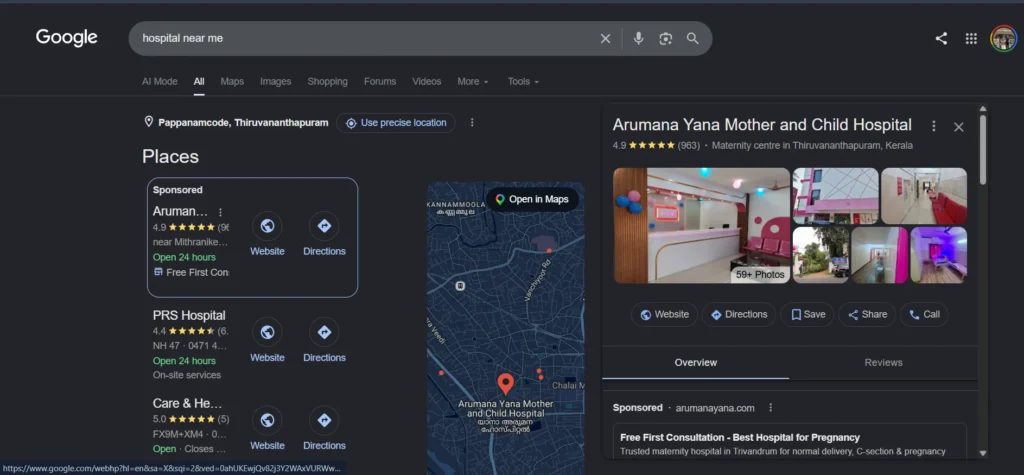
At its core, Local SEO means optimizing your website and online listings so that search engines can confidently connect your business to searches happening near you. It differs from traditional SEO in one key way: instead of competing for visibility across the entire internet, you’re competing to be the best answer for people in a defined geographic radius.
Traditional SEO asks, “Who is the most relevant result for this keyword, anywhere in the world?” Local SEO asks, “Who is the most relevant, closest, and most trustworthy result for this keyword, right here?” That’s why location matters so much in search Google factors in the searcher’s physical location (or the location they’ve specified) before it even starts ranking results.
Who Needs Local SEO?
Local SEO isn’t limited to shops with a storefront. It matters for:
- Local businesses cafes, gyms, bookstores, and any business people visit in person.
- Service-area businesses plumbers, electricians, cleaners, and other providers who travel to the customer.
- Restaurants where “near me” and mealtime searches drive walk-ins.
- Healthcare providers clinics, dentists, and specialists patients search for urgently.
- Law firms where trust and proximity both influence which firm gets the call.
- Retail stores for both in-store visits and “in stock near me” searches.
- Freelancers consultants and contractors who serve clients within a city or region.
- Multi-location businesses — brands with several branches, each needing its own local visibility.
If your customers care about where you are, Local SEO applies to you.
Why Is Local SEO Important?
- More local customers — you reach people who are geographically able and ready to buy.
- Higher Google visibility — appearing in the Local Pack (the map and top-three local listings) puts you ahead of competitors who haven’t optimized.
- Increased website traffic — local searchers click through to learn more before visiting or calling.
- More phone calls — Google Business Profile listings put a “Call” button one tap away.
- More direction requests — a well-optimized listing turns a search into a visit.
- Better conversion rates — local searches carry higher purchase intent than broad, generic searches.
- Cost-effective marketing — once built, your local presence keeps generating visibility without a per-click cost.
- Long-term growth — Local SEO compounds over months and years, unlike a paid ad that stops the moment you stop paying.
Local Search Statistics
The numbers make the case for Local SEO clearly. Industry research consistently shows that a substantial share of all Google searches commonly cited around 46% carry local intent, meaning the person is looking for something nearby rather than general information. “Near me” searches in particular have grown sharply over the past several years as smartphone and GPS usage have become universal.
Mobile plays an outsized role in this behavior: local searches skew heavily toward mobile devices, and “near me” queries in particular are overwhelmingly conducted on a phone, often while someone is out and already close to making a decision. This urgency shows up in the conversion data research from Google and industry SEO firms puts the share of near-me searchers who visit a business within 24 hours at around three in four, with a meaningful share of local searches converting into an actual purchase within a day.
Google Business Profile completeness also has a measurable impact: businesses with a fully filled-out profile tend to receive significantly more location visits and calls than businesses with incomplete listings. Reviews matter just as most consumers read online reviews before choosing a local business, and a low star rating is enough to make many shoppers look elsewhere.
How Local SEO Works
Google’s Local Ranking Factors
Google has publicly confirmed that local ranking is built on three core factors:
- Relevance — how well your business matches what the searcher is looking for.
- Distance — how close your business is to the location used in the search (or the searcher’s actual location).
- Prominence — how well-known and reputable your business is, both online and offline, based on signals like reviews, links, and citations.
A business doesn’t need to win on all three a highly prominent, relevant business can still rank well even if it’s not the absolute closest option, which is why an optimized profile matters as much as your physical address.
Understanding the Local Search Algorithm
Beyond the three core factors, Google’s local algorithm draws on several supporting signals:
- Business information — accuracy and completeness of your name, address, category, and hours.
- Reviews — both the quantity and the quality (star rating, recency, and content) of customer reviews.
- Citations — mentions of your business across directories and websites that reinforce your legitimacy and location.
- Website optimization — how well your site itself is built for search, from content to technical health.
- User engagement — how people interact with your listing and website, including clicks, calls, and time spent.
None of these signals work in isolation — Google cross-references them to build confidence that your business is real, active, and relevant to the searcher.
Key Elements of Local SEO
Google Business Profile (GBP)
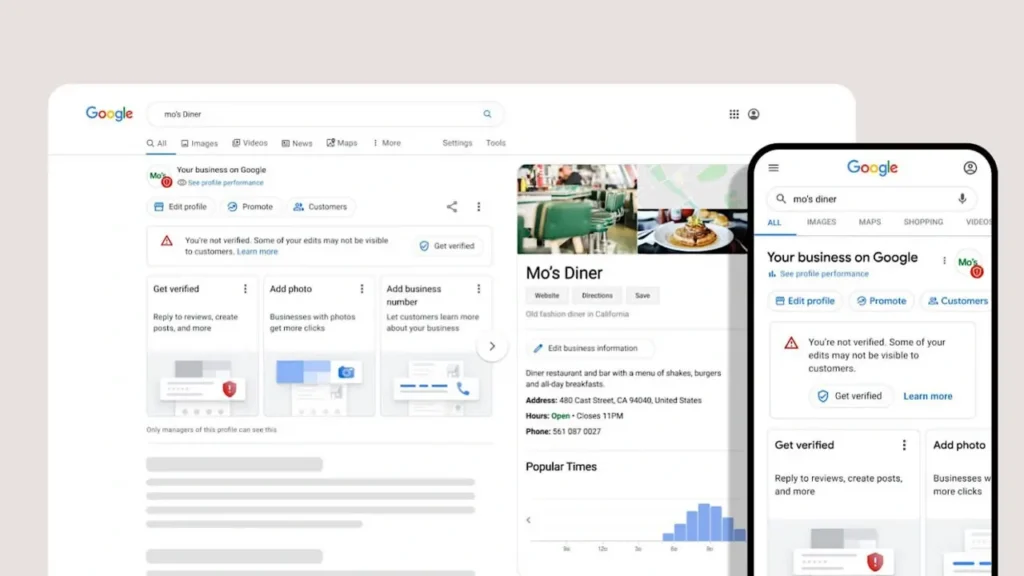
- Choosing accurate, specific business categories.
- Keeping business hours current, including holiday hours.
- Uploading real, high-quality photos of your location, team, and work.
- Listing your products and services with clear descriptions.
- Publishing regular GBP posts (offers, updates, events).
- Responding to messages promptly.
- Monitoring and answering the Q&A section before misinformation sets in.
NAP Consistency
NAP stands for Name, Address, and Phone number. three core identifiers of your business. These must match exactly across your website, Google Business Profile, and every directory or citation. Even small inconsistencies (a suite number here, an abbreviated street name there) can confuse search engines about whether they’re looking at the same business, which weakens your local trust signals.
Local Citations
A citation is any online mention of your business’s NAP information.
- Structured citations appear in business directories with defined fields think Yelp, Justdial, or industry-specific directories.
- Unstructured citations appear in less formal contexts, like a mention in a local news article or blog post.
Both types reinforce Google’s confidence in your business’s location and legitimacy, especially when the information matches consistently.
Online Reviews
Reviews influence both rankings and human decision-making. A strong review strategy includes actively requesting Google Reviews from happy customers, responding to reviews positive and negative in a professional and timely way, and treating review management as an ongoing part of reputation building rather than a one-time task.
Local Keywords
Local keyword research targets how people actually search for businesses like yours, including:
- Location-based keywords (“digital marketing agency Trivandrum”).
- “Near me” searches (“coffee shop near me”).
- Long-tail keywords (“affordable dentist near me open on weekends”).
- Service + city combinations (“AC repair Kochi”).
On-Page Local SEO
Your website itself needs to reinforce your local relevance through:
- Title tags and meta descriptions that include your service and location.
- Headings that naturally reference your area.
- Internal linking between location or service pages.
- Local schema markup (structured data) that explicitly tells search engines your business details.
- Image optimization, including descriptive file names and alt text referencing your location where relevant.
How to Do Local SEO (Step-by-Step)
- Claim and verify your Google Business Profile — this is the foundation everything else builds on.
- Optimize business information — make sure your name, address, phone number, category, and hours are complete and accurate.
- Research local keywords — understand exactly how your customers search for what you offer.
- Optimize your website — align on-page elements (titles, headings, content) with local search intent.
- Build local citations — get listed consistently across relevant directories.
- Get more customer reviews — build a steady, genuine flow of reviews rather than a one-time push.
- Create local landing pages — especially important for multi-location or service-area businesses.
- Build local backlinks — earn links from local news sites, community organizations, and local partners.
- Publish local content — blog posts, guides, or news relevant to your area and industry.
- Track Local SEO performance — monitor rankings, traffic, and conversions to know what’s working.
Local SEO Ranking Factors:
- Google Business Profile optimization
- Reviews and ratings
- NAP consistency
- Local backlinks
- Website authority
- User behavior signals (clicks, calls, engagement)
- Local citations
- Mobile friendliness
- Page speed
- Content quality.
Common Local SEO Mistakes
- Incomplete Google Business Profile — missing hours, categories, or photos.
- Keyword stuffing — cramming location keywords unnaturally into content.
- Inconsistent NAP — mismatched details across listings.
- Duplicate listings — multiple GBP entries for the same business.
- Ignoring reviews — not responding, especially to negative feedback.
- No local landing pages — trying to rank multiple locations from a single generic page.
- Poor mobile experience — slow or clunky mobile sites drive away local searchers.
- Missing schema markup — leaving search engines to guess at your business details.
- Weak internal linking — failing to connect related local and service pages.
Measuring Local SEO Success
Track your progress using:
- Local keyword rankings
- Organic traffic to location or service pages
- Google Business Profile insights (views, searches, actions)
- Calls generated from your listing
- Direction requests
- Website clicks from GBP
- Conversions and leads
- Customer review volume and rating trends.
Conclusion
Local SEO helps businesses increase visibility, attract nearby customers, build trust, and generate more leads all without competing on the same scale as national or global SEO. By optimizing your Google Business Profile, keeping your business information consistent everywhere it appears, actively earning reviews, and creating locally relevant content, you build a local search presence that keeps working for you long after the initial setup. Start with your Google Business Profile today, and build outward from there for sustainable, long-term growth.

