In a competitive market, being visible is not enough. Customers have many brands to choose from, so they often look for businesses they can trust before making a decision. This is where brand authority becomes important.
Brand authority shows how strongly a brand is trusted within its industry. It develops when a business consistently demonstrates knowledge, delivers reliable information, and provides valuable solutions. Over time, this builds a reputation that makes people more likely to trust the brand’s expertise and recommendations.
However, brand authority does not develop from advertising alone. It grows through consistent actions such as demonstrating expertise, publishing useful content, earning industry recognition, collecting genuine customer feedback, and maintaining a reliable brand presence.
Building authority also requires a clear focus. A brand should know what it wants to be known for and consistently demonstrate knowledge in that area. Over time, these efforts can help the brand become a trusted name within its niche.
What Is Brand Authority?
Brand authority is the level of trust, credibility, and expertise a brand has within its industry.People see an authoritative brand as a reliable source of information, products, or services. They are more likely to consider its recommendations, content, and solutions.
Brand authority develops through several factors, including:
- Demonstrated expertise
- Valuable content
- Positive customer experiences
- Industry recognition
- Consistent communication
- External mentions and recommendations
It is important to distinguish brand awareness from brand authority. Awareness means people recognize your brand. Authority means they trust your brand’s knowledge and judgment.Brand authority also supports the principles of Experience, Expertise, Authoritativeness, and Trustworthiness (E-E-A-T). A brand strengthens these signals when it consistently demonstrates real knowledge and provides trustworthy information.
Why Brand Authority Matters
Brand authority influences how customers evaluate your business. When people recognize your brand as credible, they are more likely to trust your information and consider your products or services.Strong brand authority can help you:
- Build customer confidence
- Improve brand recognition
- Strengthen industry credibility
- Reduce customer hesitation
- Attract more qualified prospects
- Develop stronger customer relationships
- Establish a stronger market position
It also creates long-term value. Customers may actively look for your brand when they need information or solutions in your area of expertise. Therefore, building authority should not focus only on immediate visibility. The goal is to become a trusted reference within your industry.
Brand Authority Building Process
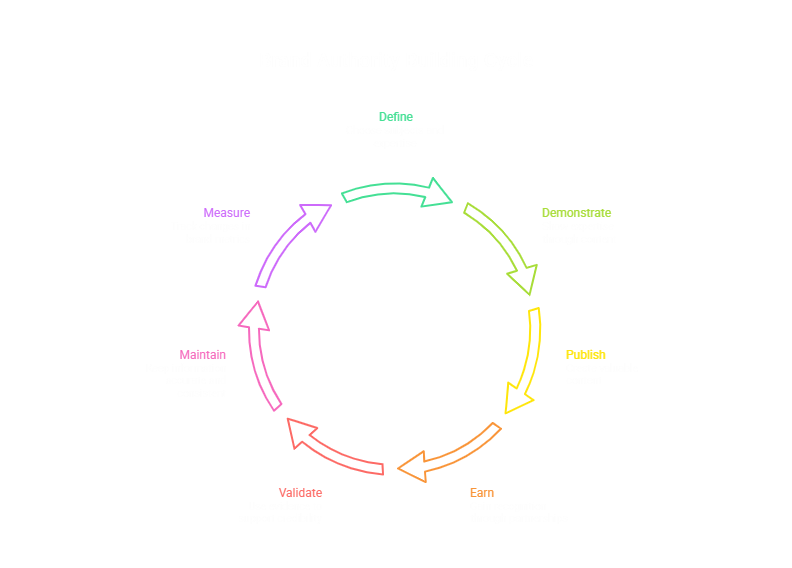
Building brand authority works best when you follow a clear process rather than using disconnected tactics.
1. Define: Choose the subjects and expertise you want your brand to represent.
2. Demonstrate: Show that expertise through experience, research, insights, and useful information.
3. Publish: Create valuable content that answers real audience needs and strengthens your area of expertise.
4. Earn: Gain recognition through relevant publications, partnerships, expert contributions, and industry relationships.
5. Validate: Use reviews, testimonials, case studies, and other evidence to support your credibility.
6. Maintain: Keep your information accurate, your messaging consistent, and your brand active across relevant channels.
7. Measure: Track changes in branded searches, mentions, recognition, reputation, and engagement.
This process turns brand authority into a long term strategy rather than a one time marketing activity.
How to Build Brand Authority
Building brand authority requires a focused approach. Start by defining what you want your brand to be known for. Then, consistently demonstrate that expertise through your content, relationships, and customer experience.
Establish a Clear Area of Expertise
Choose the specific subjects your brand understands best. Avoid trying to position your business as an expert in everything.Define your core areas of knowledge and build your brand around them. This gives customers a clear reason to associate your business with a particular subject.For example, an SEO agency could focus on technical SEO, content strategy, and search visibility instead of covering every digital marketing topic. A clear specialization makes your expertise easier to recognize.
Publish Original and Useful Content
Content gives your audience a reason to trust your brand’s knowledge. However, authority comes from useful and credible content, not from publishing frequently.Create content that solves specific problems your audience faces. Go beyond basic definitions by adding practical insights, original research, data, examples, and expert opinions.
Useful formats include:
- In-depth guides
- Original research
- Data-driven reports
- Case studies
- Expert insights
- Practical tutorials
- Industry resources
Make every piece serve a clear purpose. Support important claims with reliable evidence and keep information accurate and updated.Most importantly, create content that reflects your actual expertise and experience. This helps your brand become a reliable source instead of another website competing for attention.
Build a Strong Content Structure
A collection of unrelated articles will not establish strong topical depth. Instead, organize your content around a few important subjects that directly support your brand expertise.Start with content pillars that represent your main areas of knowledge. Then create supporting articles that answer specific questions within each pillar.
For example:
SEO → Technical SEO → Crawling → Indexing → XML Sitemaps
Connect these related pages through relevant internal links. This helps readers navigate your expertise and creates a clear relationship between your main topics and supporting content.Keep the structure focused. Every topic should have a clear connection to what your brand wants to be known for.
Earn External Recognition
Your brand becomes more credible when respected sources recognize your expertise. Focus on earning relevant recognition rather than collecting mentions from unrelated websites.You can build external recognition through:
- Industry publications
- Expert interviews
- Digital PR
- Guest contributions
- Industry events
- Professional networking
- Expert commentary
Contribute genuine knowledge to platforms that your target audience already trusts. Share original insights, research, and practical opinions instead of promotional content.Relevant recognition also introduces your brand to new audiences. Over time, repeated exposure through credible industry sources can strengthen your position within the market.
Develop Social Proof
People often trust a brand more when others can verify its claims. Social proof provides evidence that your brand delivers what it promises.Useful forms of social proof include:
- Customer reviews
- Testimonials
- Case studies
- Industry awards
- User-generated content
- Client success stories
Make these proof points specific. Instead of saying “We provide excellent service,” show measurable results, customer experiences, or documented outcomes.Place relevant proof where customers make decisions, such as service pages, product pages, landing pages, and your website homepage.Strong social proof reduces uncertainty and gives potential customers more confidence in choosing your brand.
Create Relevant Brand Partnerships
Relevant partnerships can expand your credibility by connecting your brand with established professionals and organizations.Look for partners that share your target audience or operate within your industry. Suitable opportunities include:
- Industry collaborations
- Expert collaborations
- Co-branded campaigns
- Professional organizations
- Relevant influencers
- Joint educational initiatives
Choose partnerships based on relevance and credibility, not follower count alone.A partnership should provide genuine value to both audiences. For example, an SEO agency could collaborate with a web development company to create an educational resource about building SEO-friendly websites.These collaborations can introduce your brand to new audiences while strengthening its position within the industry.
Maintain a Consistent Brand Presence
Consistency helps people recognize your brand across different touchpoints. Your website, social media, publications, and other channels should communicate a clear brand identity.
Maintain consistency in:
- Brand messaging
- Visual identity
- Tone of communication
- Business information
- Customer experience
- Content quality
Keep important business information accurate and updated. Avoid changing your positioning frequently without a clear reason.A consistent presence makes your brand easier to recognize and understand. More importantly, it shows that your business can deliver a reliable experience over time.
How to Measure Brand Authority
Brand authority develops gradually, so you need measurable indicators to understand whether your efforts are working.
Track metrics such as:
- Branded searches: Shows whether more people actively search for your brand.
- Brand mentions: Tracks how often other websites and platforms mention your business.
- Share of voice: Shows how visible your brand is compared with competitors.
- Direct traffic: Indicates whether people visit your website without relying on search results.
- Customer sentiment: Reveals how people perceive your brand.
- Industry recognition: Includes expert citations, media coverage, awards, and relevant partnerships.
Do not rely on a single metric. Look for consistent improvement across visibility, recognition, reputation, and audience engagement.The goal is not simply to become more visible. It is to become more trusted and recognized within your specific industry.
Common Mistakes When Building Brand Authority
Building brand authority can fail when the strategy focuses on quantity instead of credibility. Avoid these common mistakes:
- Publishing unrelated content: Covering every possible topic can weaken your brand positioning.
- Creating content without expertise: Generic information adds little authority.
- Chasing backlinks: A large number of irrelevant links does not establish credibility.
- Buying low-quality mentions: Poor-quality placements can damage your reputation.
- Making unsupported claims: Claims about expertise or results should have evidence.
- Ignoring customer feedback: Reviews and customer experiences directly influence trust.
- Changing brand positioning frequently: Constant changes make your expertise harder to recognize.
- Expecting quick results: Brand authority develops through consistent effort and recognition.
Focus on relevance, evidence, expertise, and consistency rather than shortcuts.
Conclusion
Brand authority develops when people consistently recognize your brand as a credible and reliable source within a specific industry.Start with a clear area of expertise. Then demonstrate that expertise through useful content, external recognition, social proof, relevant partnerships, and consistent communication.
Avoid shortcuts that prioritize visibility over credibility. Instead, focus on providing genuine value and proving your expertise over time.The goal is simple: become a brand people recognize, trust, and choose.
